

From DSP-Centric to Creator-Led
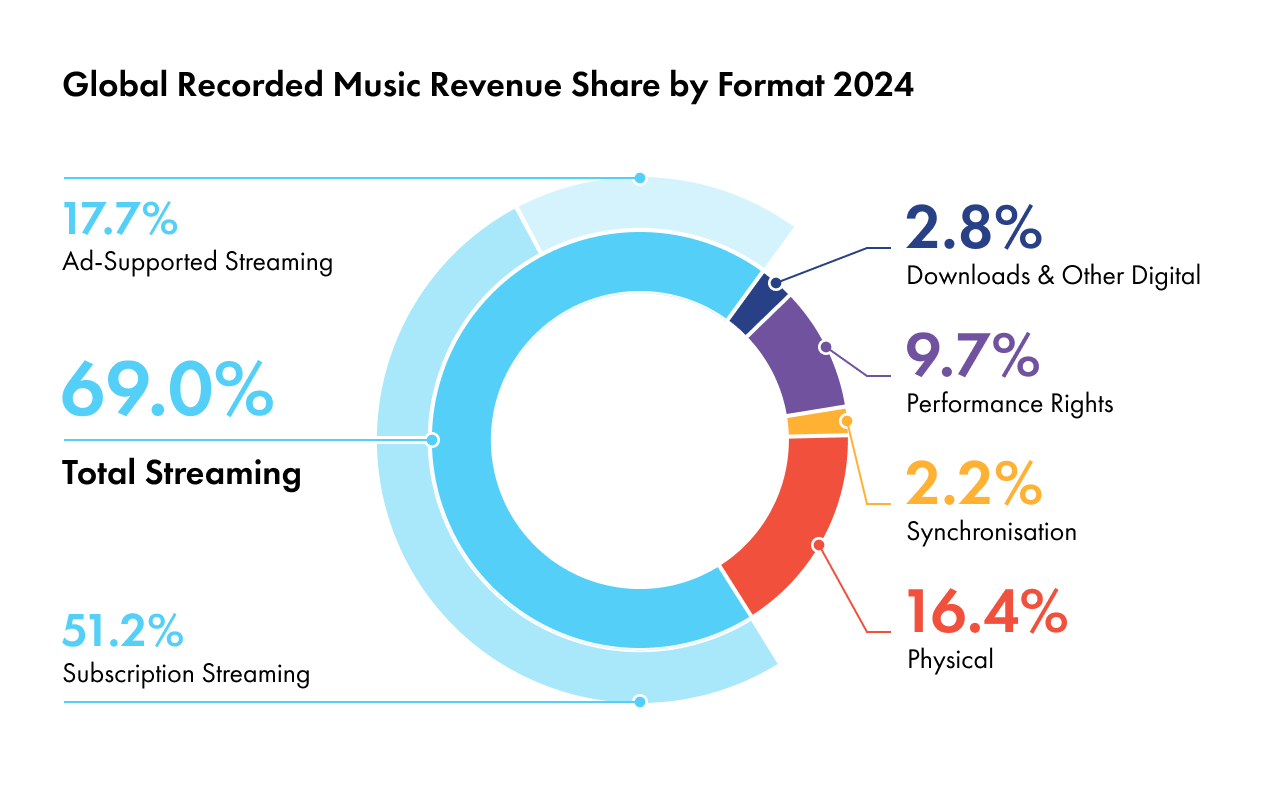
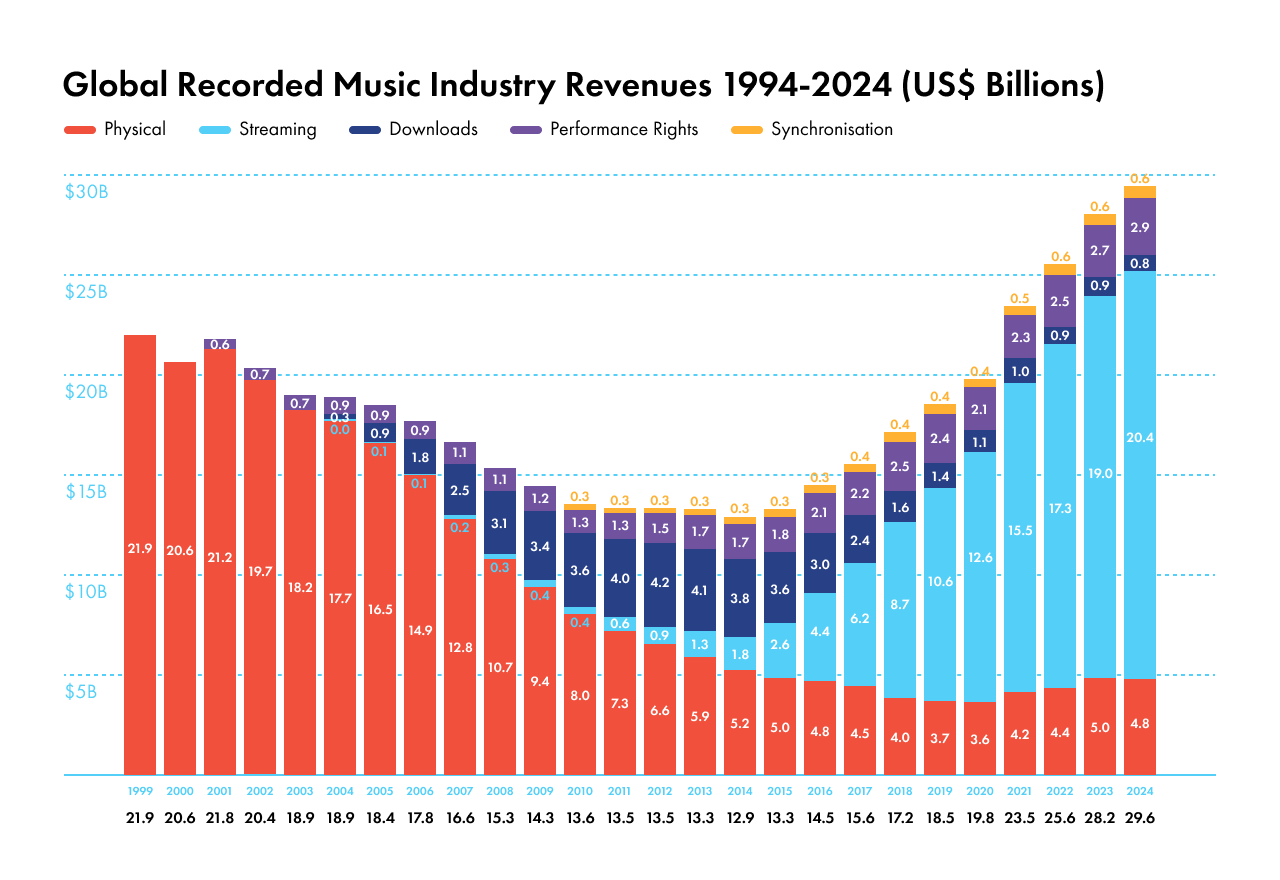
According to IFPI’s Global Music Report 2025, global recorded music revenues grew for the tenth consecutive year in 2024, rising 4.8% to $29.6 billion. Streaming remained the dominant source of income, accounting for 69% of total revenues. But beyond the core figures, the report highlights a growing influence of music consumption on platforms outside traditional DSPs. With over 752 million users subscribed to streaming accounts, platforms like TikTok and YouTube Shorts are increasingly where fans first encounter tracks.
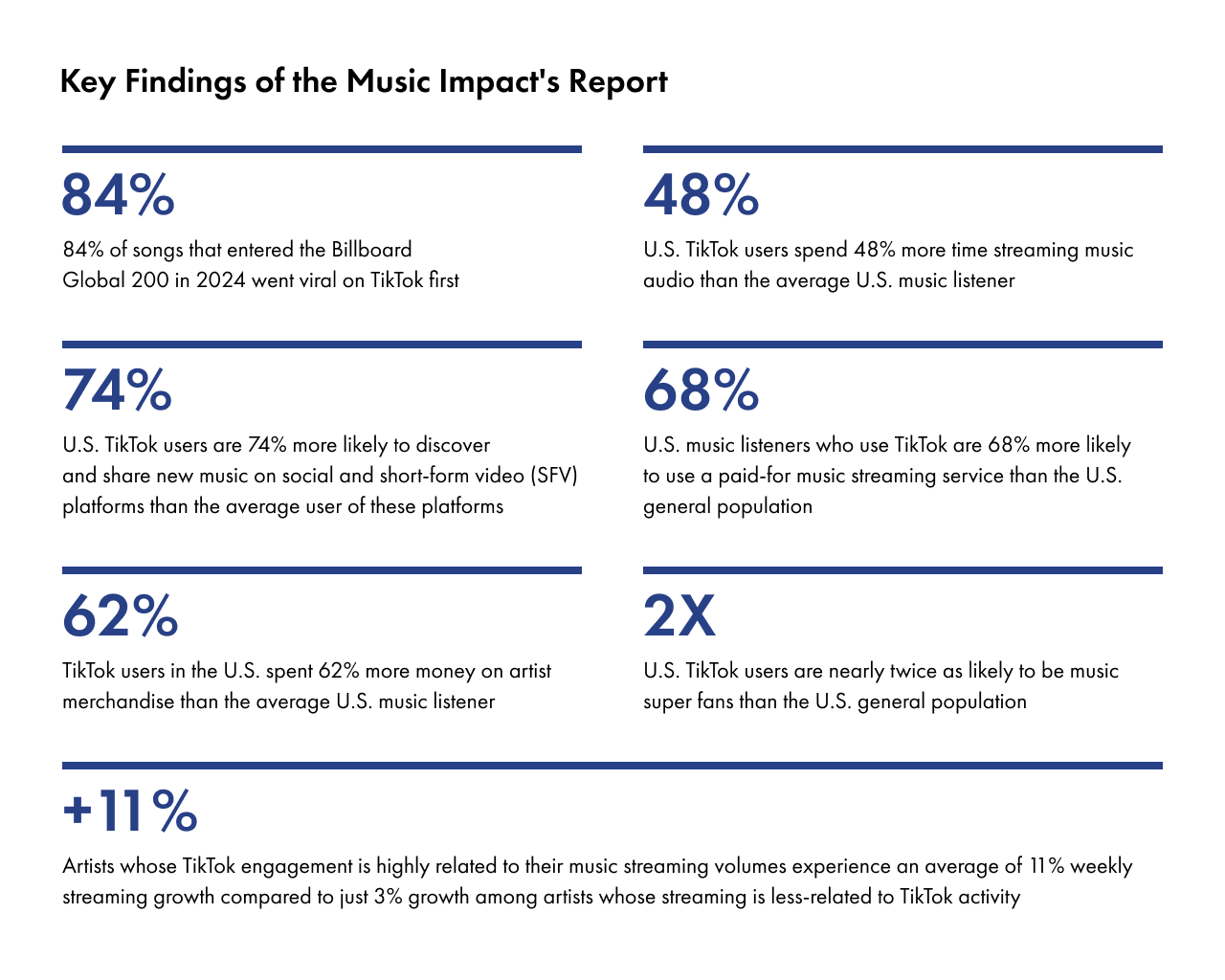
TikTok, in particular, plays an outsized role in this shift. According to TikTok and Luminate’s Music Impact Report, TikTok users in the US are 74% more likely to discover and share new music on social and short-form video (SFV) platforms than the average user of those platforms. This represents more than just a shift in platform preference - it signals a generational transformation in how audiences encounter music: through short, algorithm-driven clips long before a song appears on a DSP playlist.
The trend doesn’t stop at discovery. TikTok users are early adopters when it comes to new music—according to the report, they’re 54% more likely than the average U.S. listener to stream an album on its release day. Nearly half say they enjoy watching music-related content like interviews and behind-the-scenes footage - a behavior 47% more common than among typical short-form video users.
The effect is both viral and measurable. 84% of songs that entered the Billboard Global 200 in 2024 went viral on TikTok first, proving the platform’s outsized influence on global music consumption. Moreover, artists with high TikTok engagement experience an average of 11% weekly growth in on-demand streaming: a significant increase compared to the 3% seen by peers with weaker platform correlation.
In an ecosystem where more than one million tracks are released globally every week, short-form video platforms have evolved from promotional channels into cultural gatekeepers. These platforms elevate emerging artists, revive legacy tracks, and shape the conversation around what’s worth listening to next.
The Monetization Shift: UGC and Platform Partnerships
While DSPs continue to lead global music revenue, an increasing share of monetization now stems from user-generated content (UGC) and strategic partnerships with social platforms. TikTok, YouTube, and Meta have evolved from promotional channels into powerful revenue engines with their own licensing frameworks and monetization models.

YouTube remains a leader in UGC monetization, thanks to tools like Content ID. Its rights management infrastructure enables labels and artists to track, block, or monetize fan-uploaded content at scale.
TikTok has emerged as one of the most influential platforms for viral music discovery, and with that influence comes a growing licensing footprint. According to TikTok and Luminate’s 2024 Music Impact Report, the platform has secured licensing agreements with a broad set of rights holders and now compensates artists directly through streaming royalties, or indirectly through fan engagement and exposure. However, disputes like Universal Music Group pulling its catalog from TikTok in early 2024 have highlighted tensions around valuation, content protection, and rights attribution in the social media context.
The rise of “social streaming” is creating a new ecosystem that combines peer-to-peer interaction with passive listening. But it also introduces major technical challenges. Managing rights for user-generated content (UGC) demands accurate metadata pipelines and precise ownership tracking—yet the infrastructure needed to support this complexity is still playing catch-up.
To address these challenges, many platforms have adopted DDEX standards. These XML-based protocols streamline the exchange of licensing data, metadata, and usage policies between labels, DSPs, and social platforms. Platforms implementing Electronic Release Notification (ERN) messages can also support immersive audio formats, territory-specific rules, and UGC identification - capabilities essential in today’s multi-platform landscape.
Supporting this shift, DataArt partnered with a global music rights administrator to modernize its royalties system, building a cloud-native platform using microservices on AWS. The solution automated 80% of royalties-to-metadata matching, processed over 6 billion royalty payments, and enabled 90% of transactions to run in the cloud, improving scalability, accuracy, and operational efficiency.
VR Concerts and Immersive Audio
As music consumption evolves, so do the spaces where it happens. More and more, music is being woven into immersive experiences on gaming platforms like Fortnite and Roblox—blending fan interaction, gameplay, and live performance into one seamless environment.
In October 2024, British singer-songwriter Myles Smith premiered an exclusive virtual concert inside Fortnite. Developed in partnership with Sony Music, RCA UK, and Sony Immersive Music Studios, the performance featured a lifelike avatar of Smith, delivering three of his top tracks on a custom-designed island built to reflect his artistic vision.
The concert leveraged advanced technology, including Epic’s Unreal Editor for Fortnite, MetaHuman avatars, and motion capture powered by Move AI, which enabled high-fidelity animation without the need for traditional motion capture suits or studio setup. This approach significantly lowers the barrier to entry for artists seeking to engage fans through virtual performances.
In parallel with performance innovation, music production is also becoming more accessible. Sony Corporation recently opened access to its 360 Virtual Mixing Environment audio system - a tool that lets creators produce studio-quality spatial mixes using only a pair of headphones. By capturing the sound profile of reference studios and recreating them with personalized binaural processing, 360VME removes the physical limitations of traditional mixing spaces.
The company also partnered with BandLab Technologies to integrate 360 Reality Audio into the BandLab platform, which currently serves over 100 million users. This integration empowers a new generation of creators to produce and share immersive audio experiences directly from their smartphones - further blurring the line between professional and social music creation. Music created in 360 Reality Audio can be shared and experienced directly within the BandLab app - listeners will only need standard headphones to enjoy the spatial audio effect.
Challenges in the Social Streaming Economy
Despite rapid growth, the non-DSP streaming ecosystem presents a number of operational and legal challenges. Rights metadata remains fragmented across platforms, and attribution frequently fails when songs go viral via memes, remixes, or background usage in short-form videos.

IFPI refers to this fragmentation as “metadata chaos.” Compounding the issue is the emergence of Generative AI, which some bad actors use to mass-produce tracks and inflate streaming numbers. This undermines the integrity of royalty systems and erodes artist trust in the platforms.
In 2024, Universal Music Group’s decision to pull its catalog from TikTok highlighted the friction that arises when compensation models, IP protection, and content moderation are not aligned. The message from rights holders is clear: innovation is welcome, but it must be accompanied by ethical and enforceable licensing practices.
As music consumption expands beyond traditional DSPs into social and non-DSP platforms, data fragmentation increases. Centralizing usage, rights, and revenue data becomes critical for accurate reporting and monetization. DataArt’s Music Data Foundations Accelerator, powered by AILA for Music, creates a scalable data foundation that supports multi-platform reporting and AI-driven insights.
Explore the Music Data Foundations Accelerator and book your demo.
What DSPs Can Learn from Social
While social platforms now dominate music discovery, DSPs are beginning to incorporate social-native features in an effort to remain relevant. Spotify, for instance, has introduced tools such as collaborative playlists, real-time lyric sharing, and a premium “Music Pro” tier aimed at creators.
These features signal a shift toward community engagement and user interaction. However, they may not go far enough. Today's listeners, particularly younger audiences, seek participatory experiences. They expect music to come with narrative context, shareable moments, and opportunities for co-creation.
To stay competitive, DSPs should evolve from passive listening platforms into dynamic ecosystems that support creative expression and peer interaction. This will require rethinking both interface design and rights infrastructure.
The shift toward non-DSP streaming represents more than a format change-it is a broader cultural realignment. Future-forward platforms may blend real-time engagement with streaming functionality, effectively combining the social interactivity of TikTok with the catalog depth of Spotify. The next major success stories are likely to come from hybrid models that seamlessly unite these capabilities.
To remain competitive in an increasingly integrated music landscape, companies and platforms should focus their investments on four key areas:
- Cross-platform licensing and attribution frameworks
- Interactive music formats, including stems, loops, and remix kits
- AI governance tools that respect intellectual property rights
- Strategic partnerships across gaming, wellness, and creator economies
Looking to stay ahead of these shifts? Explore how DataArt’s music business software solutions support platforms and rights holders in navigating today’s complex, multi-platform music ecosystem.