


















By using our site, you acknowledge that you have read and understand our Privacy and Cookie Policy.
All trademarks listed on this website are the property of their respective owners. All rights reserved.
Copyright © 2026 DataArt


AI in the music industry has reduced the cost of creating and distributing music to near zero. That is great for experimentation, but it creates a platform-scale problem for labels, publishers, DSPs, and rights orgs: identity, provenance, and monetization must now work across hundreds of millions of assets, in near real time.
According to Luminate, streaming catalogs now include roughly 253 million tracks and listening is more concentrated than ever: in 2025, 88% of tracks were streamed 1,000 times or fewer, while a tiny fraction of releases captured a disproportionate share of total plays
AI is showing up in two places at once: creation and operations. Over the past few years, AI-powered composition tools, automated mixing, and generative audio platforms have matured, enabling artists to experiment faster and reduce technical friction in production workflows.
At the same time, streaming services heavily rely on AI-driven personalization to analyze listening behavior and deliver curated experiences through personalized playlists, discovery feeds, and AI-assisted DJs.
But generative tools and automated distribution have also dramatically lowered barriers to entry. Deezer now receives over 50,000 fully AI-generated tracks per day, with the platform estimating that up to 70% of plays on synthetic music may be fraudulent. In response, streaming services are deploying AI detection systems to identify artificial uploads, remove them from recommendations, and protect royalty pools.
Fraud is a symptom. The root cause is that the industry is trying to run platform-scale economics on fragmented metadata, inconsistent identifiers, and incomplete lineage.
Rights organizations are adapting in parallel. ASCAP, BMI, and SOCAN now accept registrations for partially AI-generated works, while introducing safeguards to distinguish human-created music from fully synthetic content. As a result, metadata quality has shifted from a technical concern to a commercial requirement. It increasingly determines whether music is discoverable, eligible for royalties, and compliant with platform policies. In practice, that means rights teams need better identity resolution, stronger metadata QC, and auditable lineage to support registrations, claims, and disputes.
Where AI delivers measurable ROI is operational: identity resolution, reconciliation, fraud detection, metadata automation, and fan analytics - all dependent on clean, governed data. Alongside detection, the industry is investing in AI systems designed to transform large music catalogs into operational insight. Rather than generating music, these platforms focus on connecting metadata, usage data, and rights information to support better business and creative decisions.
Musixmatch’s recently announced AI agent, Music Lens, is designed to help labels and publishers analyze more than 100 million works to surface creative opportunities, monitor performance, and clarify royalties within a unified, ethically licensed data environment.
At the same time, major record companies are formalizing partnerships with generative AI platforms. Warner Music Group’s agreement with Suno, alongside similar licensing deals across the industry, signals a shift toward responsible, opt-in AI models that protect artists while enabling new forms of creation and engagement.
Source: Luminate
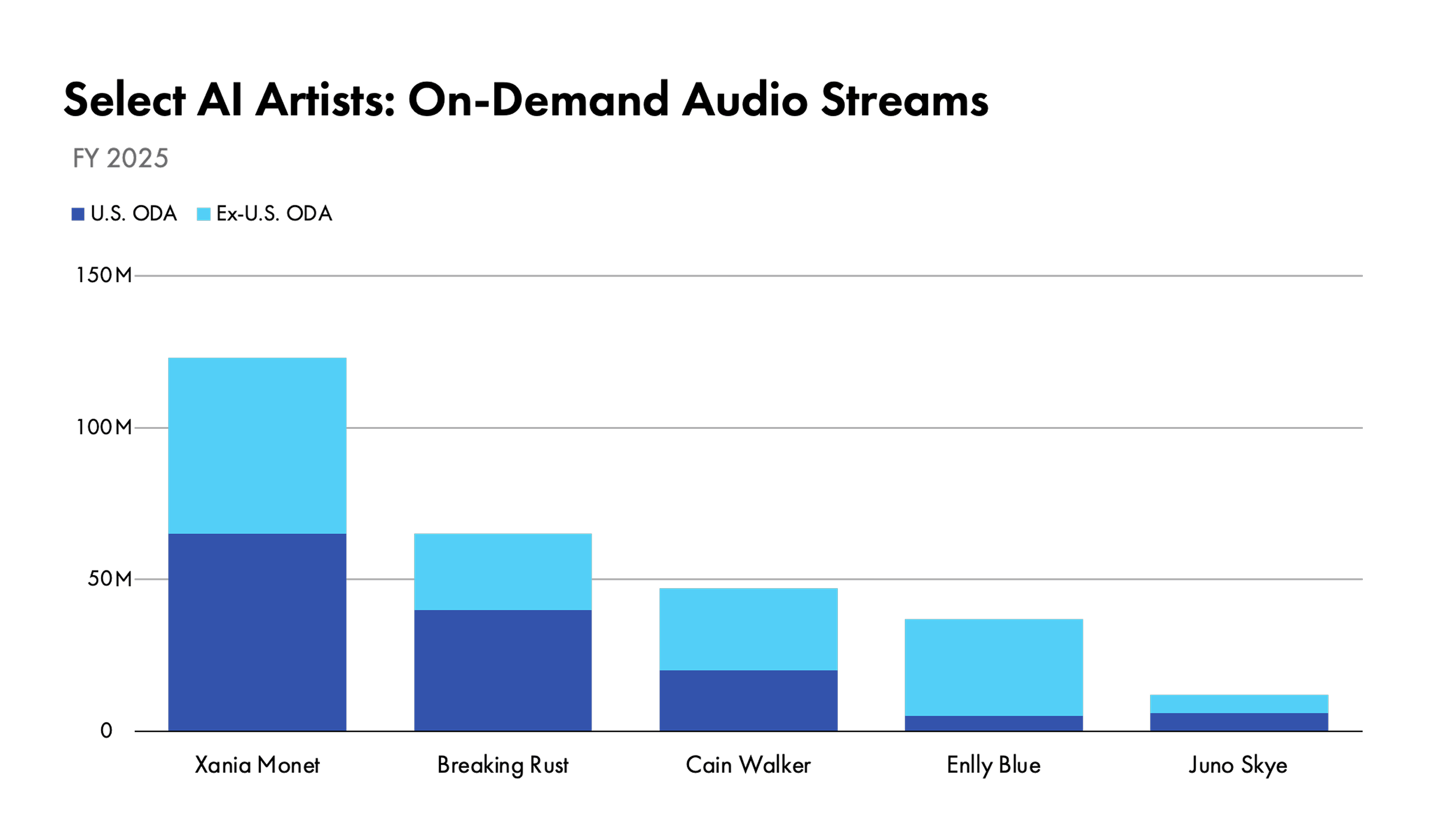
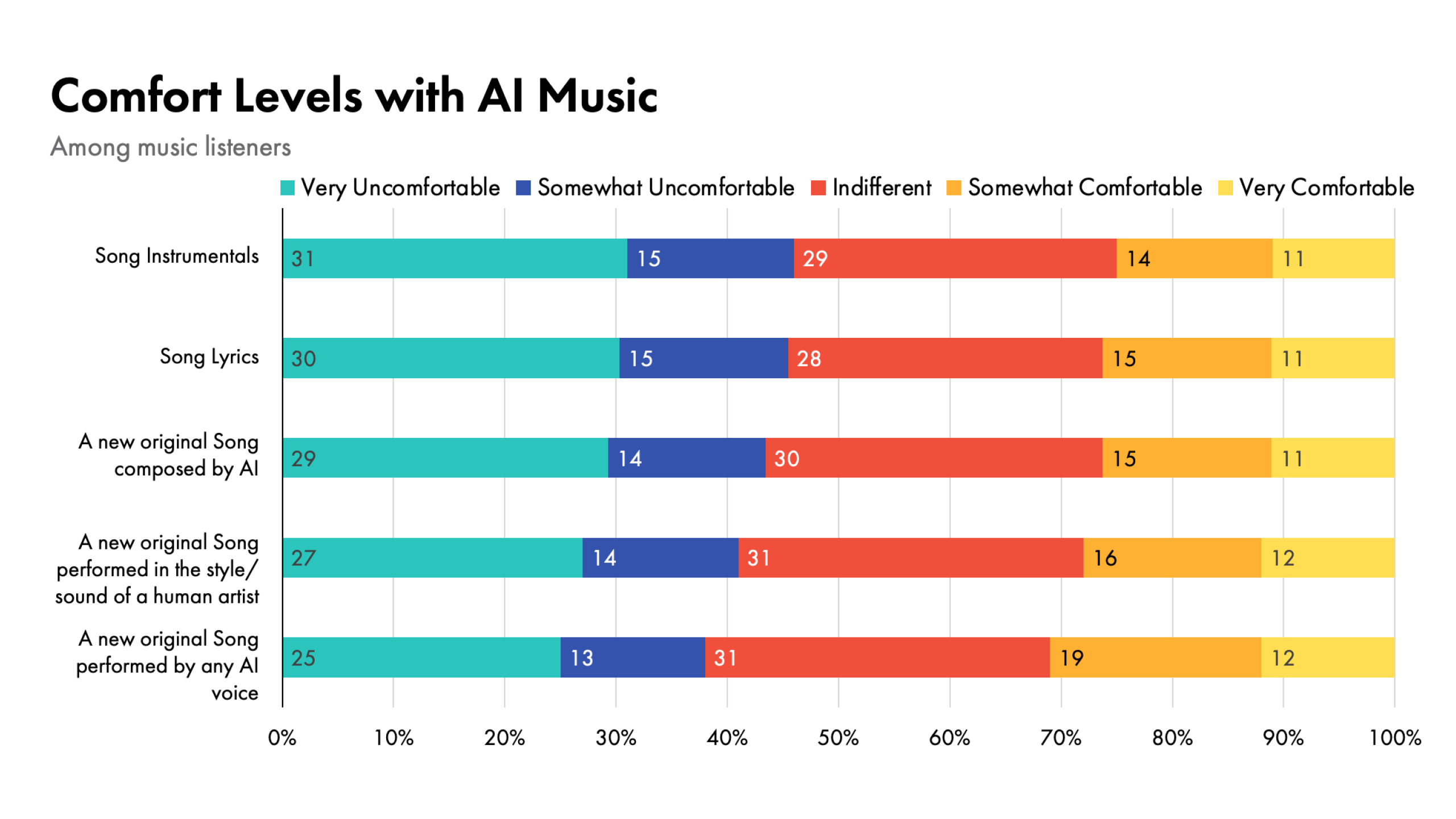
Luminate’s data also highlights AI’s rapid entry into mainstream listening. In 2025, AI artist Xania Monet reached roughly 125 million streams globally and 70 million in the US. Yet trust remains fragile: 44% of US listeners say they would be less interested in music if they knew it was generated by AI, particularly when synthetic vocals are involved.
Source: Luminate
Together, these signals point to a growing divide between scale and trust.
In music, "AI-ready" does not mean a model. It means an operating layer that can ingest, normalize, validate, and govern data from dozens of sources without breaking downstream payouts and reporting.
In music, this includes audio files, usage logs, rights data, and royalty statements - often fragmented across hundreds of formats and systems. Without standardized ingestion, quality controls, and normalization, even advanced AI models struggle to produce reliable results.
Data readiness also depends on industry-wide standards like DDEX – they are the backbone of interoperability, but most organizations still struggle with adoption at scale: mapping legacy schemas, validating completeness, handling exceptions, and monitoring drift over time. The differentiator is not knowing the standard - it is operationalizing it.
This shift comes as revenue growth slows. In the UK, streaming subscription revenues grew just 3.2% year over year in 2025, roughly matching inflation. When growth slows, operational leakage matters more. Every mismatch, late adjustment, and disputed claim becomes a margin problem.
As a result, music businesses are increasingly investing in AI-ready data foundations.
DataArt's Music Data Foundations Accelerator streamlines standards-based ingestion (including DDEX-aligned workflows), automated QC, and identity/metadata resolution - enabling royalty transparency, faster reconciliation cycles, and audit-ready reporting at catalog scale.
We are seeing strong demand for joint AWS + Snowflake delivery models: governed data platforms on AWS with Snowflake analytics that reduce time-to-value for modernization and AI readiness.
Optimize your music data management with DataArt’s Music Data Foundations Accelerator.
The next chapter of AI in the music industry is operational. Companies that invest in trusted data foundations - interoperability, QC, identity resolution, and governance - will move faster, pay more accurately, and innovate with less risk.
With hundreds of millions of tracks in circulation and AI-generated content accelerating, success depends on turning fragmented data into structured, trusted intelligence. Businesses that treat AI as part of a broader data strategy - rather than a standalone capability - are better positioned to move faster from insight to action.
Looking to stay ahead of these shifts? Explore how DataArt’s music business software solutions support platforms and rights holders in navigating today’s complex, multi-platform music ecosystem.
Subscribe now to get a monthly recap of our biggest news delivered to your inbox!




These cookies are necessary for the website to function and cannot be switched off in our systems. They are usually only set in response to actions made by you which amount to a request for services, such as setting your privacy preferences, logging in or filling in forms. You can set your browser to block or alert you about these cookies, but some parts of the site will not then work. These cookies do not store any personally identifiable information.
These cookies enable the website to provide enhanced functionality and personalisation. They may be set by us or by third party providers whose services we have added to our pages. If you do not allow these cookies then some or all of these services may not function properly.
These cookies may be set through our site by our advertising partners. They may be used by those companies to build a profile of your interests and show you relevant adverts on other sites. They do not store directly personal information, but are based on uniquely identifying your browser and internet device. If you do not allow these cookies, you will experience less targeted advertising.
These cookies allow us to count visits and traffic sources so we can measure and improve the performance of our site. They help us to know which pages are the most and least popular and see how visitors move around the site. All information these cookies collect is aggregated and therefore anonymous. If you do not allow these cookies we will not know when you have visited our site, and will not be able to monitor its performance.

All Consent Allowed