

The global music streaming market is projected to grow by $53.49 billion from 2024 to 2029, expanding at a rate of 19% per year. This growth is driven by increasing demand for streaming services, widespread smartphone adoption, and the rapid rise of mobile advertising.
According to Luminate’s 2024 Year-End Music Report, on-demand audio (ODA) streaming in the US grew by 6.4% in 2024, a slower pace than the 17.3% growth in international markets. While the US market remains the largest for music streaming, the industry’s focus is shifting toward global expansion as international markets experience higher adoption rates.
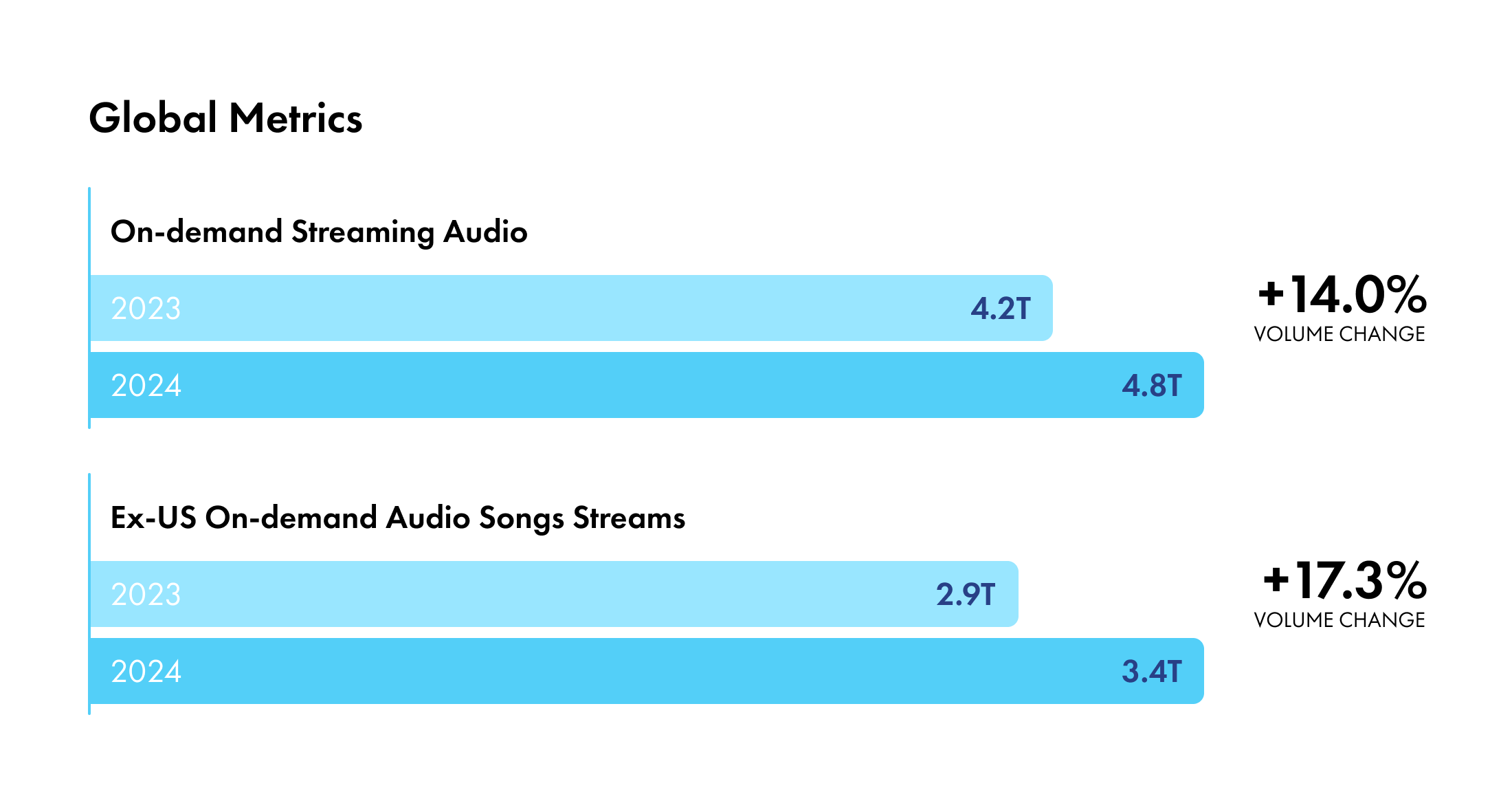
On-Demand Audio Streaming Growth in 2024
In the broader streaming landscape, the majority of on-demand audio streaming in the US comes from music released in the last two decades. The dominance of the 2020s and 2010s in streaming underscores listeners' preference for new and recent music, with nearly 80% of streams coming from these decades. Meanwhile, older catalog music (pre-2000s) makes up a much smaller share, highlighting the industry's focus on fresh content and the challenge of keeping older catalogs relevant in the streaming era.
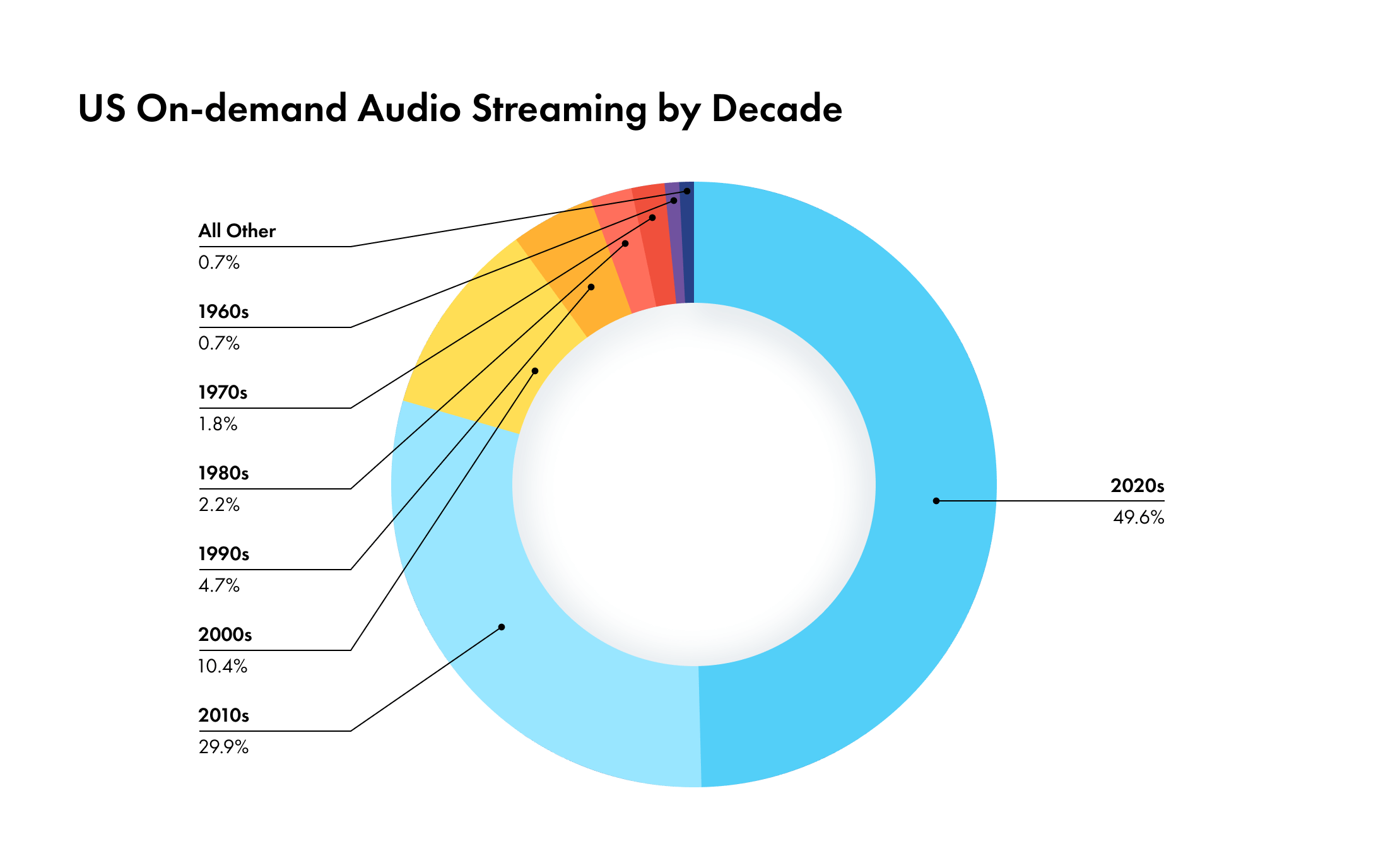
US On-Demand Audio Streaming by Decade
AI-Generated Music and Copyright Issues
The emergence of AI-generated music is certainly shaking up the music industry, offering innovative tools that enhance creativity and efficiency. Alongside these technological advancements, significant ethical concerns regarding copyright, artist compensation, and the use of proprietary content have surfaced. As AI models are increasingly trained on vast amounts of existing music data, the question of whether creators are fairly compensated and whether their intellectual property is respected is gaining attention.
The United States Copyright Office (USCO) has clarified its stance on the copyrightability of AI-generated content, stating that works created entirely by AI cannot be copyrighted. However, if human creativity is involved, such as in AI-assisted creations, the work may qualify for copyright protection. This determination hinges on whether the human contribution is substantial enough to be considered original. While fully AI-generated works, like those produced by platforms such as Suno and Udio, will not be granted copyright, works that incorporate human input—such as AI-modified compositions—may still receive protection. This distinction is particularly relevant for artists utilizing AI tools to assist in their creative processes, as it ensures that human contributions remain protected under existing copyright law.
One of the companies addressing the rise of AI-generated content in the music industry is Deezer. The platform recently reported that approximately 10,000 fully AI-generated tracks are uploaded to its service every day, making up about 10% of the daily content. In response, Deezer has launched an AI detection tool designed to identify music created by generative AI models such as Suno and Udio, with plans to expand its capabilities to detect other models.
Tackling issues regarding copyright in AI-generated music, Delphos has introduced Soundworld, a platform that allows artists to create their own personalized AI-driven music generators. This technology enables creators to upload their own stems and use AI to compose, remix, and generate new music while retaining full control over their copyrights and the creative process. Delphos’ system can learn an artist’s unique style from existing songs and assist in creating original compositions, speeding up the music production process. The platform also offers a new revenue stream for artists, as users can access individual Soundworlds for a fee.
Several new developments in AI music generation are addressing ethical concerns and aiming to ensure creators’ rights are respected. Platforms like Voice-Swap, Vocalist AI, Kits.AI, and Beatoven aim to create ethical, artist-friendly AI tools that pay musicians for their contributions. For instance, Voice-Swap offers artists a 50% revenue share whenever their AI voice model is used, while Kits.AI enables voice actors to monetize their clones and earn royalties. Beatoven and Musical AI plan to launch the first fully licensed AI song generator, ensuring that artists are compensated when their music trains AI systems. Through these ethical models, AI’s potential can be harnessed responsibly, with fair compensation for creators and maintenance of innovation in the music industry.
At Music Biz 2024’s Metadata Summit, Edward Ginis, Co-Founder at OpenPlay, and Muhammad Qasim, CIO at SESAC Music Group, addressed the challenges and opportunities AI presents to the music industry. During the session, we discussed the preparedness of the music industry for the impact of AI:

Our conversation also touched on the potential for new revenue streams through AI:

Curated Playlists and Hyper-Personalized Experiences
As AI-generated music continues to disrupt the industry, streaming platforms are leveraging the same technology to enhance user engagement in more organic ways. Music platforms have significantly evolved over the past year, focusing on exploring user behavior via AI-powered technologies. While geographical boundaries, language, or genres are still important in 2025, other factors such as activity, time, background setting, and mood of the listeners will remain more pertinent for music discovery and consumption on DSP music streaming services.

The shift from content-based to context-based listening behavior is still going strong, supported by the increasing popularity of meditation and sound apps like Endel, which deliver personalized soundscapes for productivity, mood-boosting, anxiety management, and fitness DSPs with business plans.
Another trend we will witness this year is a more refined level of personalization with major music streaming services utilizing AI algorithms for contextual recommendation and in-depth song analysis. Spotify's AI-powered Discover Weekly and Daily Mix features leverage data on individual preferences, listening habits, and cultural contexts of users to craft hyper-personalized playlists.
To take hyper-personalization even further, Spotify is reportedly set to launch a new premium tier called ‘Music Pro’ in 2025. This subscription add-on is designed to provide superfans with exclusive perks such as early access to concert tickets, AI-powered remixing tools, and higher-fidelity audio. With this move, Spotify aims to bundle multiple premium features into a single offering, catering to engaged listeners who seek deeper interaction with their favorite artists and content. Industry analysts suggest that other major DSPs may introduce similar "superfan" tiers, transforming how dedicated listeners access and experience music.
Music personalization and contextualized playlists are standard among major DSPs, catering to engagement, discovery, and listener preferences. In 2025, DSPs will continue to extend their music recommendations beyond the platforms themselves and will not rely solely on past listening behaviors but more and more – on native ecosystem touchpoints.
Non-DSP Streaming: The Rise of Social Music Streaming
The surge in revenue from user-generated content has created enormous growth potential for the industry while also fueling the rise of social media-based non-DSP streaming platforms.
According to Luminate’s 2024 Year-End Music Report, social media platforms are key drivers of music discovery, particularly for younger audiences and niche music genres. As these platforms blend social media features with streaming, we are witnessing the rise of “social streaming,” where users can share playlists, follow friends' listening activities, and collaborate on music creation. Short-form video platforms like TikTok, YouTube Shorts, and Instagram Reels are driving music discovery more than ever, particularly among younger audiences.
While streaming has long been the primary revenue driver, the rapid growth of earnings from collaborations with social media giants such as Meta and TikTok is noteworthy. Prominent record labels are increasingly intertwining their strategies with social media entities, as demonstrated by partnerships like the one between Universal Music Group and Meta Platforms. The deal allows artists to have their music shared across Meta's suite of platforms, including WhatsApp.
Gaming and virtual engagement have further fueled this shift in consumption, as platforms like Fortnite and Roblox increasingly feature music-driven experiences. In November 2024, Fortnite Remix partnered with Snoop Dogg, Eminem, Ice Spice, and Juice WRLD, resulting in a significant boost in streaming for these artists.
Yet, the landscape of social music streaming, while promising, is not without its challenges and contentious moments. This conflict reflects a deeper, ongoing struggle between the evolving demands of the music industry for fair compensation and control, and the innovative, user-driven nature of tech companies. The non-DSP streaming revenue potential is quickly outpacing that of traditional DSP streaming. In a matter of years, DSPs would have to compete with elaborate music-video ecosystems with resident artists and creators.
VR Concerts and Metaverse
With the rise of AR and VR technologies, music streaming is becoming a powerful tool to re-engage audiences and ramp up their revenue potential. Some music streaming services have already integrated these experiences with Snapchat’s Lens Studio platform, TikTok’s Pico 4, and Meta’s Quest 3 VR headset.

While the ad industry is still learning the ropes of metaverse monetization, games like Fortnite and Roblox are creating an entire industry of metaverse formats. In November 2024, Fortnite’s Remix: The Finale virtual concert shattered records by drawing 14.3 million concurrent players, surpassing the previous milestone set by Travis Scott’s concert with 12.3 million attendees. Similarly, TWICE’s virtual Meet & Greet on Roblox triggered a 6.4% weekly increase in global on-demand audio streams, reinforcing the growing trend of virtual fan engagement as a key driver for music promotion.
In January 2025, Realize Music launched Realize Music: Sing - a virtual reality app designed to harness the therapeutic benefits of singing. Backed by licensing agreements with Universal Music Group and Warner Music Group, the app features over 1 million tracks, with additional songs added weekly. Powered by B2B streaming technology provider Tuned Global, the app’s backend aims to ensure seamless integration of licensed music into this immersive singing experience.
What can we expect from music industry developments in 2025? More exclusive live streaming of concerts, virtual series, DJ sets, and shows are available on a particular streaming service. The opportunities are endless, and music streaming services should be bold in their creative strategies and seek out innovative tech partnerships to back them up.
Music Data Exchange and UGC
In 2025, the value of music in user-generated content keeps growing. While UGC's monetization potential for the music business is enormous, this revenue stream has still not uncovered its full potential.
To increase interoperability in the convergence of social media and music, the music industry rallied around Digital Data Exchange (DDEX) - a consortium of leading media companies, music licensing organizations, digital music service providers, and technical intermediaries. Over the last few years, the DDEX protocol solidified its position as a common set of standards for communication in the digital media supply chain. YouTube and Meta have embraced DDEX integrations and standardized ways to integrate their Content IDs into the wider ecosystem.
Universal Music Group has recently taken a step in improving metadata accuracy and ensuring proper creator recognition by adopting the International Standard Name Identifier (ISNI) system. As the first major label to become an ISNI registration agency, UMG is setting a new precedent for the industry. ISNI functions as a digital passport for contributors, assigning unique identifiers to songwriters, producers, and artists. This initiative not only increases visibility and credit for creators but also streamlines rights management, ensuring accurate metadata across platforms.
The success of DDEX integrations, in turn, depends on the music metadata quality within the company. The need for enriched metadata is growing as more people come on board. The industry still lacks coherent standards for collecting and storing music metadata. Instead, fragmented data from disparate sources are stitched together. Going forward, metadata enrichment and standardization will be critical for industry technical maturity.
Download the DataArt DDEX white paper to learn more about bridging the gaps in music streaming with data pipelines.
As streaming platforms manage hundreds of millions of tracks and increasingly complex royalty flows, scalable data infrastructure becomes essential. DataArt’s Music Data Foundations Accelerator, powered by AILA for Music, helps centralize rights, metadata, and usage data into a governed, AI-ready foundation - enabling faster reconciliation and transparent reporting at catalog scale.
Explore the Music Data Foundations Accelerator and book your demo.
Lossless Music Streaming and Hi-Res Audio
Lossless streaming continues to gain popularity with the increasing availability of high-resolution audio (also referred to as hi-res audio) formats in popular music streaming services like Apple Music, Amazon Music, and TIDAL. In 2025, the hi-res audio format is becoming more accessible to a broader audience, providing a richer and more detailed listening experience.
To win a competitive edge over TIDAL, Amazon Music HD, and Deezer, which have their CD-quality, hi-res, and spatial audio formats, Apple brought another industry-leading sound quality – Spatial Audio. All these audio upgrades and features will become prerequisites for new DSP development and credibility among audiophiles.
While other major industry players have long supported high-resolution audio as part of their standard plans, Spotify has lagged behind, although the launch was supposed to happen several years ago. After nearly four years of delays, Spotify HiFi is reportedly launching in 2025 as part of the new premium add-on "Music Pro." However, Spotify’s lossless streaming won’t be included in the base subscription. As of early 2025, the world's most popular streaming service still does not support hi-res audio streams while awaiting the long-delayed Spotify HiFi launch. The question that remains is whether it will match up to existing lossless streaming propositions, and whether it will be worth the wait.
Programmatic Audio Advertising
Programmatic audio advertising is going through significant growth and transformation as it becomes an essential tool for brands in 2025. This development is largely driven by the surge in digital audio consumption, particularly via platforms like Spotify, Pandora, and an expanding podcast ecosystem. As audio consumption rises, brands have more opportunities to boost visibility, engage targeted audiences, and strengthen brand recall.
One of the key trends in programmatic audio is the increasing adoption of AI-driven tools that enable more effective campaign optimization. AI allows advertisers to target audiences with precision, leveraging user data from streaming platforms, podcasts, and other audio sources. Real-time ad buying, personalized targeting, and dynamic content delivery are empowering marketers to craft more relevant and engaging audio campaigns. As programmatic audio integrates seamlessly with broader digital marketing strategies, advertisers can now create multi-channel campaigns that span social media, radio, and streaming services.
Podcast advertising, in particular, is set for rapid growth in 2025. This surge is driven by the ability of podcasts to create deep emotional connections with listeners through storytelling. The unique nature of podcast content enables brands to engage with niche audiences and build strong, authentic connections. As podcast genres diversify, with categories like true crime, society and culture, and news growing in popularity, advertisers are presented with new opportunities to tailor their messages to highly engaged communities.
The podcasting industry continues to expand, not only in terms of content variety but also in its potential to drive measurable business outcomes. As digital audio advertising becomes more sophisticated, agencies are increasingly applying the same performance measurement techniques used for video ads to podcasts. The ability to track engagement and campaign performance at granular levels allows advertisers to fine-tune their strategies for maximum impact.
The convergence of AI and programmatic audio is also paving the way for more innovative formats. AI-powered audio ads that leverage advanced voice synthesis and contextual targeting are enabling brands to deliver personalized messages that resonate with listeners in real time. For example, AI-generated voices can adjust ad content to suit listener preferences or reflect the mood of the surrounding content, creating a more immersive and relevant experience. Additionally, the rise of 3D sound technology promises to further enhance the impact of audio ads, making them more memorable and engaging for the audience.
While the outlook for programmatic audio advertising is promising, there are still challenges to overcome. One major hurdle is the lack of standardized measurement and tracking tools across the digital audio landscape. Although agencies recognize the potential of programmatic audio, the need for improved ad verification transparency and better collaboration between media owners, publishers, and advertisers remains. Additionally, the ongoing shift toward privacy-first targeting solutions presents both challenges and opportunities for the audio advertising ecosystem. With stricter data regulations on the horizon, advertisers will need to prioritize first-party data and invest in technologies that respect consumer privacy.
Music Streaming Trends Going Strong in Early 2025
Music industry trends are experiencing unprecedented growth, and only savvy competitors who strive to stay ahead of the developments are sure to have a competitive edge. From AI-powered hyper-personalization, contextual recommendation, and curated playlists to enriched music metadata, VR concerts, and hi-res audio, adopting current music trends can set your business up for the future. Explore DataArt's solutions in designing and building software for the music industry.