


Client
Monex Europe is a leading specialist in commercial foreign exchange. Headquartered in London, the company offers a suite of foreign exchange products designed for corporate clients and high net-worth individuals.
Challenge
In March 2015, Shelton Fray, Co-founder and Systems Director at Monex, was searching for an IT services provider to supply a couple of engineers to support the infrastructure of a back-office application.
Solution
DataArt deployed a small team to work on the project. Less than a year later, Monex had entrusted DataArt with the application’s modernisation and comprehensive support. Currently, DataArt is the exclusive provider of custom software development for Monex Europe.
Engagement History
As the DataArt team continued to prove its value, Monex called on DataArt to tackle more complex and challenging projects. The team grew from two people in the first quarter of 2015 to nearly 60 people by the end of 2017.
Mr. Fray, who continues to oversee the engagement, introduced DataArt’s team to other business stakeholders in different departments. In 2019, Kirill Shustov, DataArt’s Programme Manager for Monex Europe, moved to London to work on-site at Monex’s U.K. headquarters.
DataArt is currently Monex’s exclusive custom software development vendor, providing a range of IT services from systems ideation to 24/7 customer support.
Partnership Scope
DataArt is involved in conceiving, designing, developing, and supporting Monex’s bespoke software, which enhances the operation of numerous functions, including trading, sales, operations, reporting, payroll, HR, legal, compliance, and risk management.
The engagement can be broken down into the following core categories:
Team Structure, Governance, and Business Agility
When the team was relatively small, hands-on management and oversight by Monex were achievable. But, as the number of engineers grew, DataArt implemented a lean, flexible, and efficient governance structure designed for client convenience. As Shelton Fray puts it: "I deal with four people, not sixty. I leave the nitty gritty, day-to-day project management to Kirill."
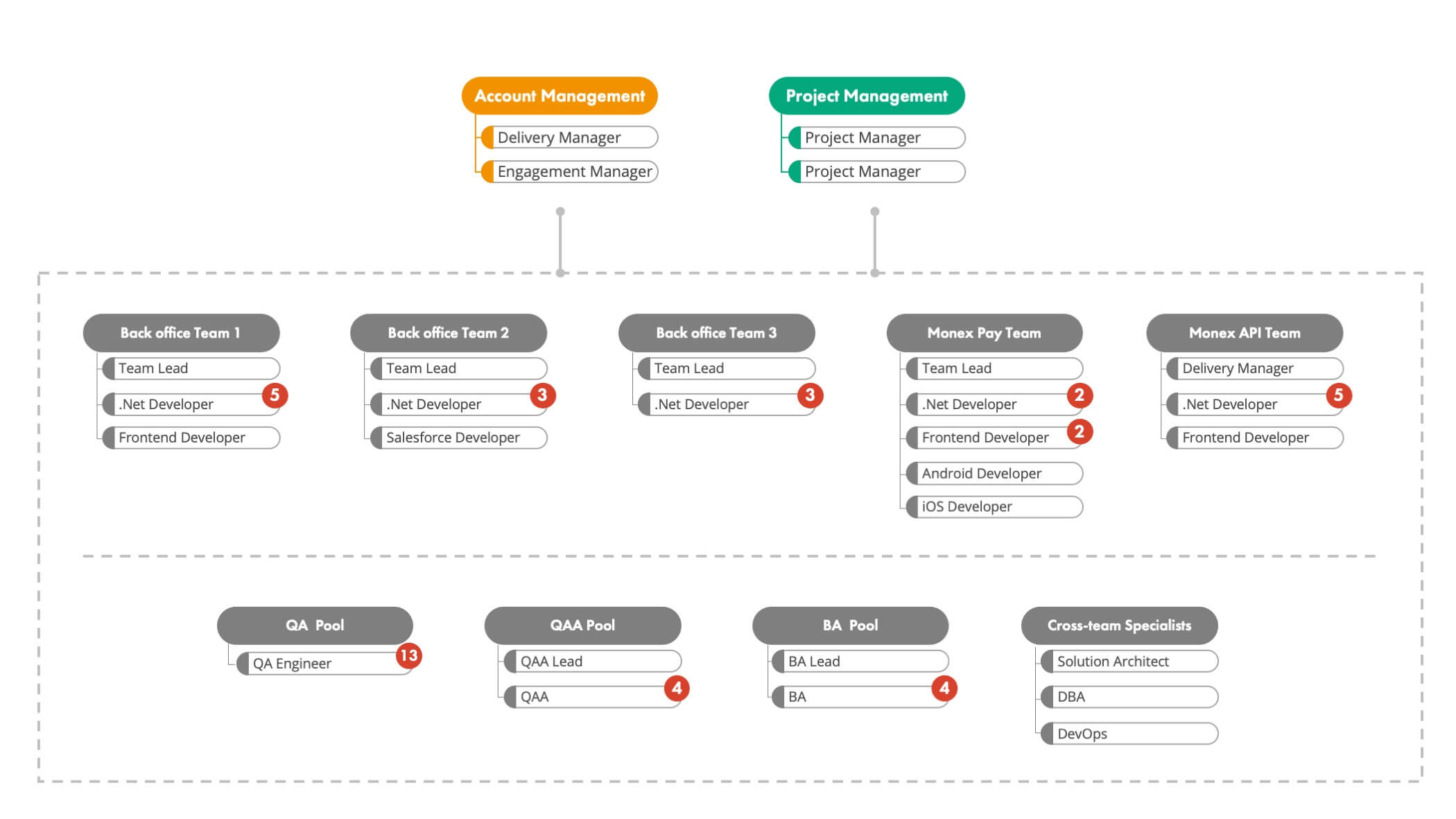
Figure 1
As shown in Figure 1, the account management team is responsible for strategic decisions, while five scrum development teams focus on specific products. There are also project managers, cross-team specialists (such as architects, database administrators, and DevOps), QA automation specialists, and business analysts who work with the development teams as needed. Teams are self-sufficient and require only minimal client input.
This structure allows for a direct, many-to-many relationship between teams and business stakeholders. Every business stakeholder (usually a function head at Monex) can reach out directly to the team leader to request and discuss any new product, feature, or functionality. The DataArt team can develop five major features at once in three-week release cycles with the flexibility to quickly correct course. This structure also allows development teams to make decisions, self-organise, and combine efforts in response to new challenges and changing priorities and then rebalance when appropriate. The result is exceptional business agility for Monex.
My colleagues at Monex love the effectiveness of the support function DataArt provides. There’s a team member called Lubov, who has become known internally as the fastest responder on email. She’s almost like an autoresponder! Whenever a staff member emails saying ‘this is not working’ she replies within seconds saying ‘we are looking at it now.’ This gives our staff the comfort that a human being is looking into the issue straight away.
The development teams consistently work with and have a direct and close relationship with as many as 12 business stakeholders (Monex’s department heads and executives) and occasionally develop solutions for 30 or more stakeholders at a time. This lean, autonomous structure results in efficient workflow and collaboration, allowing management to focus on the strategic direction of Monex’s IT.
A six-month roadmap of DataArt’s projects allows every Monex department to track their progress and discuss priorities, development speed, and any other specifics directly with the DataArt team. Mr. Fray says: "I have daily contact with Kirill and maybe one or two of the business analysts. Then we have monthly meetings and quarterly meetings. They produce many reports on how things are going. The invoicing is broken down by project each month, which makes it easier for our head office to go through."
The Relationship

Mr. Fray describes the relationship as «trusting and reliable» noting, "Trust was there from the start. I liked the DataArt team as soon as I met them. But it wasn’t blind trust. The way they approached the engagement and projects from the outset just set the relationship off to a good start, and it has been good since." He has high praise for the quality of the team, "DataArt has smart people. I’ve been impressed with everyone. When the product is released, it works, and it stays working. It’s very reliable."
The minimal involvement of management in day-to-day operations promotes a feeling of ownership and responsibility for all operational, architectural, and methodological decisions.
Conclusion
Here are just some of the key accomplishments supported by improved technology:
- Monex has opened offices and established legal entities in Amsterdam, Madrid, Toronto, and Singapore, providing 24/5 operational coverage for its customers. All new entities use the same DataArt - supported bespoke software.
- Monex has significantly diversified its main liquidity providers, tripling their number. DataArt handled the integration process with each of these brokers and developed an engine to automatically choose the optimal provider for each trade.
-
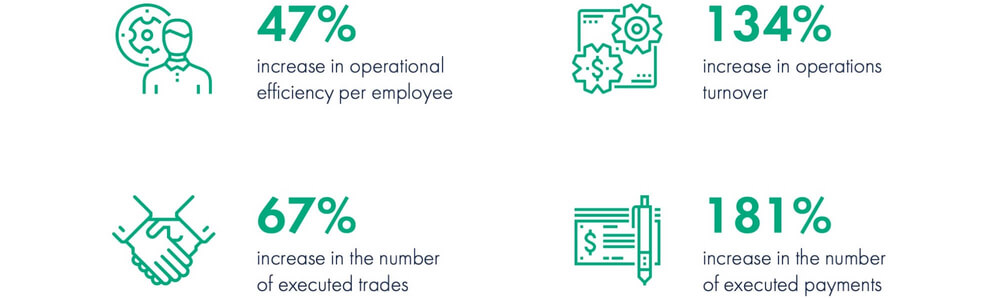
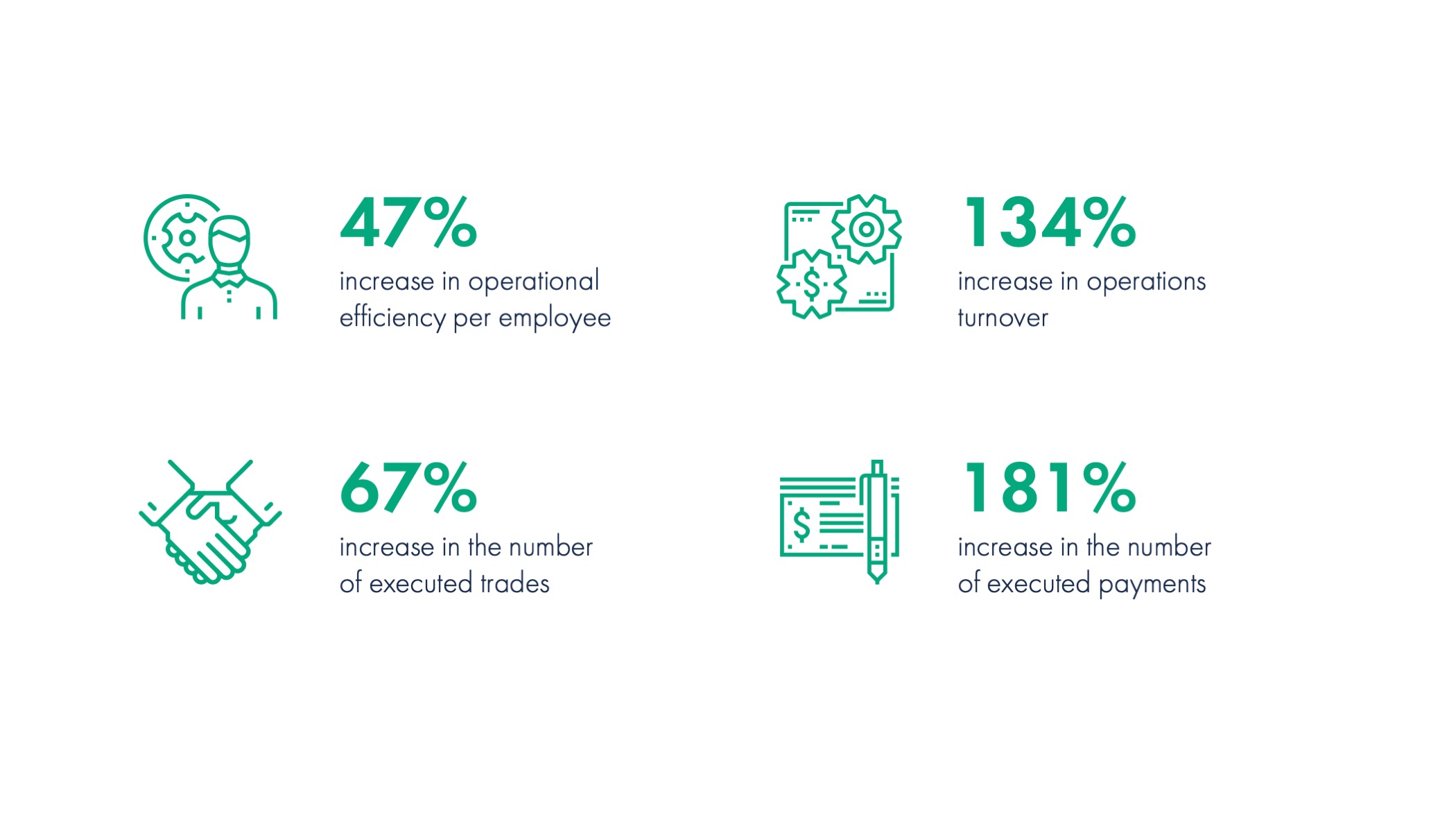
- Monex has attracted new segments of more profitable customers, creating additional compliance requirements. DataArt automated some of the compliance processes, including KYC, risk calculation, transaction monitoring, and PEP/Sanction screening.
- Monex has grown from no online execution in 2015 to:
- 29% of trades executed online in 2019
- Over 41% of payments completed online in 2019
DataArt and Monex Europe’s collaboration will continue to drive the evolution of Monex’s IT systems and support its future expansion.



