












By using our site, you acknowledge that you have read and understand our Privacy and Cookie Policy.
All trademarks listed on this website are the property of their respective owners. All rights reserved.
Copyright © 2026 DataArt


A startup with a handful of people, amplified by AI, could take your business. That’s not a scare line from a conference keynote. It’s the quiet warning underneath every number in Phocuswright’s latest travel data: AI adoption is moving faster than trust, faster than most leadership teams’ plans, and faster than the industry’s ability to agree on who’s responsible when an agent gets it wrong. The next 24 months will decide who owns their data, who owns the guest relationship, and who gets quietly disintermediated while they’re still debating the pilot.
A frontier AI model got pulled under export controls this year. Not a vendor outage, not a funding round drying up, but a government decision that could cut off access to the model an entire travel business had quietly built itself around. That single fact, raised on the floor at Phocuswright Europe 2026, is a useful jolt: the AI shift in travel isn’t just about adoption curves anymore. It’s about who controls the switch.
Consumers have already made their choice. They are moving to natural-language search and handing off requests to AI agents that research, compare, and increasingly act on their behalf. Trust hasn’t caught up yet, but it’s growing, and as it builds alongside spend and itinerary complexity, an opening appears for operators who can provide the guardrails.
This is the gap at the center of the AI in travel industry conversation right now: capability is sprinting, trust is walking. The businesses that close that gap first, on their own terms, will set the pace for the next cycle. Below, we break down the data, the three moves that matter, and what travel leaders should do next.
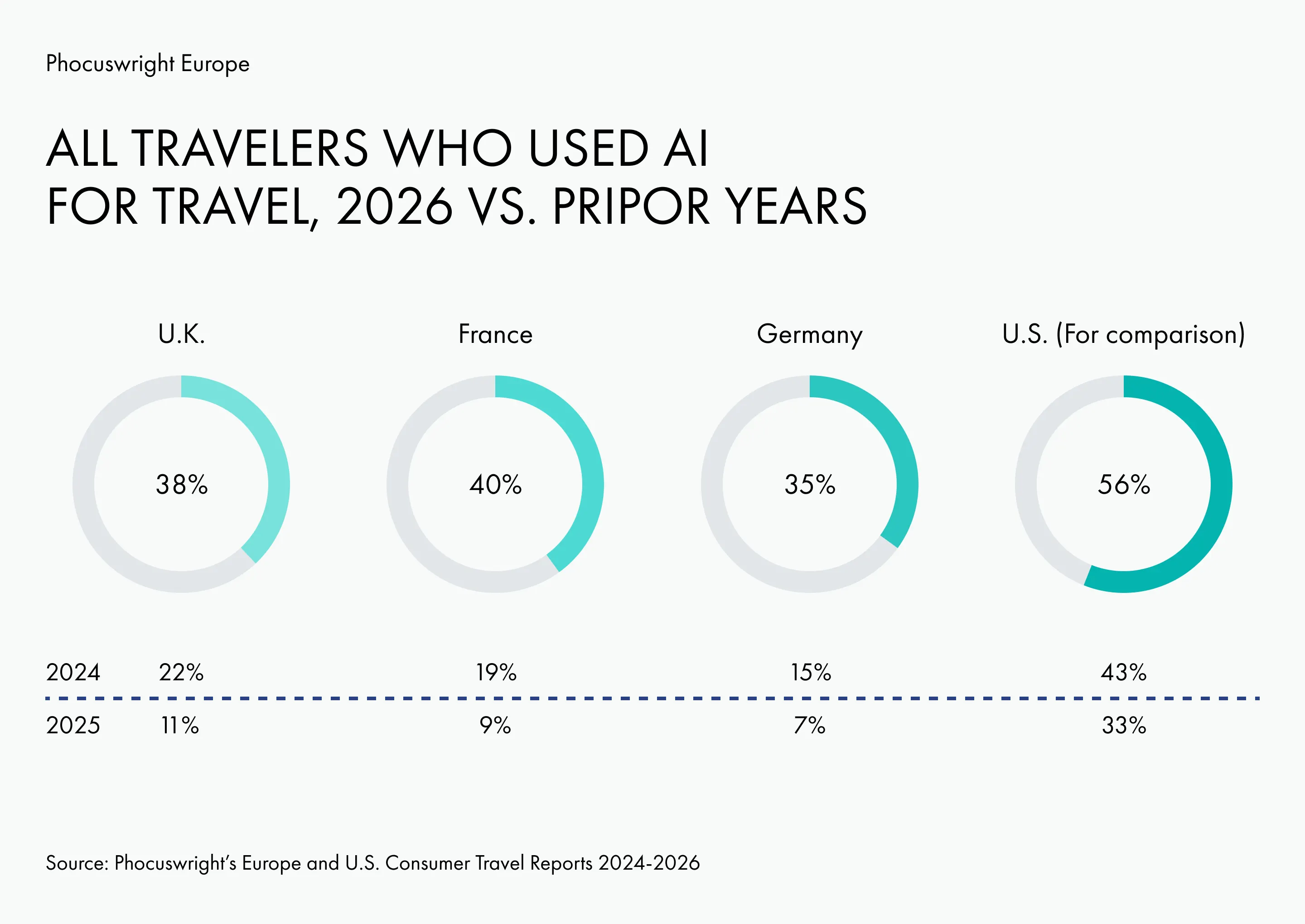
The numbers tell the story plainly. U.S. use of AI in travel planning rose from 33% to 56% between 2024 and 2026, while use in Europe roughly tripled over the same period. Travel remains one of the categories people most want to spend on, AI-assisted or not.
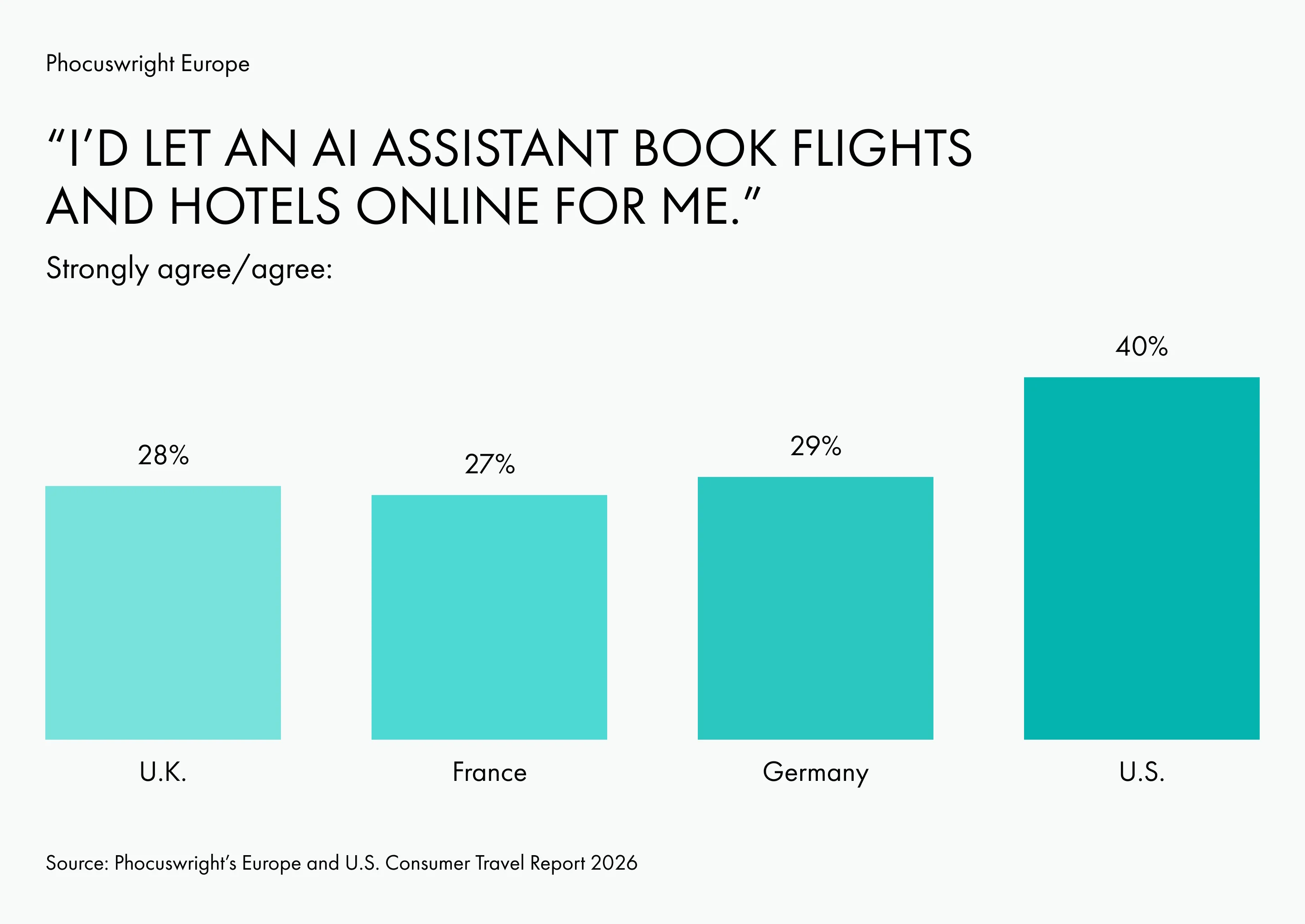
Trust hasn’t kept pace. Only about a quarter of European travelers say they would let AI book a trip on their behalf, and only an estimated 6% of firms have scaled agentic AI into production. Add a fragmenting supply landscape and a frontier model pulled under export controls, and it’s clear that access to AI is not guaranteed even for the well-funded.
That trust lag isn’t a problem to wait out. It’s the AI trust gap travel leaders should race to close: rising capability is outpacing crawling trust, and that gap is the planning window. Whoever earns the right to act first, on real guardrails rather than blind automation, wins the advantage.
Three pillars support what to do about it: win the AI shop window while trust still lags, build the data and architecture that can’t be copied, and reset the commercial model for an agentic AI travel market.
Discovery is splitting across three coexisting webs: human search, LLM-driven answers, and now agentic browsing, a framing that Microsoft has set out clearly. Demand is regionalizing, shortening, and shifting from volume to value.
This is where generative engine optimization travel strategy becomes unavoidable, not optional. LLMs answer by searching the live web, so visibility starts with strong SEO fundamentals. But agents read information, not pictures, and most travel sites still block the very bots that agents rely on to “see” inventory. Brand, in this new environment, is becoming reviews, reputation, and reliability rather than just visual polish.
The practical first move: stand up a GEO program, make inventory genuinely machine-readable, let legitimate agents through instead of blocking them by default, and build trust with visible options, shown savings, and a human approval step before anything books. Automate the low-value, repeat, structured trips first. Corporate travel takes precedence over leisure here, since policy and predictability make automation safer.
AI is only as good as the data behind it — poor data in, poor results out: an unglamorous truth that still trips up otherwise well-funded programs. The lasting assets here are a memory of the product and a memory of the guest, combined with first-party data that travel businesses can actually own. That ownership is the one advantage the distribution middlemen can’t take away.
Model and provider choice will keep shifting. That’s why a model-agnostic AI architecture matters more than picking the “right” model today. The architecture needs to allow a business to switch between providers without a rebuild whenever the market moves. A thin abstraction layer, paired with portable prompts and evaluations, makes that achievable now, not in some future roadmap.
The economic reward scale, not cost-cutting. Compute costs are falling roughly tenfold a year while labor costs stay flat, and AI-first companies are already generating outsized revenue per employee with peers running on legacy processes. The practical first move: fund data hygiene as a real program, not a side project. Build or buy a single joined-up memory layer, own first-party data outright, and add a switching layer between products and the underlying models. The goal is to scale what people produce, not to replace them.
Loyalty is shifting away from points accumulation toward recognition, personalization, and graceful recovery when things go wrong. Payments are getting agent-ready, with capped virtual cards and programmable authorization doing the real work of agentic commerce. Smarter FX helps at the margins but isn’t the core prize.
Distribution, meanwhile, is fragmenting further as banks, card networks, and super-apps start selling travel directly on their own infrastructure. Much of the growth and much of the defense now sit in B2B, where the real moat is supply relationships, owned data, and execution speed.
The practical first move: redesign loyalty around recognition and proactive recovery, enable agent-ready payments such as capped virtual cards, and choose deliberately whether the business is the front door to the customer or the infrastructure behind someone else’s front door.
Not every move carries equal weight or equal difficulty. Phocuswright’s framing, mapped against value at stake, feasibility, and timeline, makes the sequencing clear: some moves are cheap to start and pay back almost immediately, others demand real investment but compound over years, and a few are only worth attempting once trust and usage clear a threshold. Laying them out side by side, rather than treating the AI roadmap as one long list, is what turns a strategy into a sequence a team can actually execute against.
| Move | Value at Stake | Feasibility | Horizon |
|---|---|---|---|
| Data and memory foundation | High | Medium to hard | Now to 12 m |
| Model and provider switching layer | High | Medium | Now to 12 m |
| AI visibility and GEO | Medium to high | Easy to medium | Now |
| Reviews and brand as trust | Medium | Easy | Now |
| Operating leverage (do more with AI) | High | Medium to hard | 6 to 24 m |
| Agent-ready payments | Medium | Medium | 6 to 18 m |
| Loyalty redesign | Medium | Medium | 12 to 24 m |
| Agentic booking and marketplaces | High, but later | Hard | 12 to 36 m, staged |
The signal is straightforward: do the top four now, because they are no-regret moves regardless of how fast the rest of the market shifts. Build operating leverage and the commercial model through the middle horizon. Hold agentic booking and marketplaces as a staged bet, triggered by trust and usage thresholds rather than calendar dates.
A hotel group’s first move isn’t a TMC’s first move, and pretending otherwise wastes budget. Each part of the travel value chain sits in a different spot relative to the guest, the supplier, and the booking moment, so the same three pillars — AI shop window, data and architecture, commercial model — translate into different priorities depending on where a business plays. The table below breaks down where each segment should focus first and why, based on its position in the value chain. Segment shapes sequence:
| Hospitality Category | Where to Play | How to Win | First Move |
|---|---|---|---|
| Hotel group | Direct guest relationship | Own first-party data and guest memory; GEO and reviews to cut OTA reliance | Stand up a guest-memory programme |
| OTA / bedbank/ consolidator | B2B distribution and payments | Supply relationships, execution, agent-ready payments | Build the switching layer; get payments agent-ready |
| Airline | Retailing and loyalty | Be found in LLMs, retail ancillaries, automate disruption | Prepare LLM visibility |
| TMC / corporate travel | Managed, structured trips | Unified, corporate memory, human approval, lead on compliance | Pilot agentic booking, on-policy bound trips |
| Vacation rental | Host relationship and matching | AI matching plus human support, trust and service | Clean and structure messy inventory |
| Destination / DMC | Value over volume | Experience discovery, dispersal, align the private sector | Shift measures from volume to yield and spread |
The common thread across every row is that AI is already doing real work, not just piloting. Hotels are using it to protect revenue per bed night, airlines to manage yield, and corporate travel managers to automate the structured, policy-bound trips where compliance matters most. What differs is the moat. For a hotel group, it is the guest-memory layer and the direct relationship it protects. For an OTA or consolidator, it is the supply and execution speed. For a TMC, it is the ability to hold both the corporate data and the human approval step that regulators and risk managers still require. Each of those positions is defensible, but only if the business chooses it deliberately rather than arriving there by default. The businesses that name their position now and concentrate their AI investment behind it are the ones the table above describes as having a clear first move. The ones that don’t risk being the infrastructure behind someone else’s front door without ever having decided to be.
It’s worth stress-testing the bear case rather than assuming the trend carries itself. Agentic booking could stay niche for years if trust simply doesn’t move. Right now, only about 25% of travelers say they’d trust it, and roughly 6% of firms have scaled it into production. Incumbents might reinvent themselves rather than cede ground; the big players are not going away quietly. Integration friction, namely access, certification, and inconsistent versioning, could keep holding the industry back regardless of how good the underlying models get. And data security, the single most-cited barrier among large firms, could continue slowing adoption from the inside.
Here’s why the strategy holds anyway: no-regret moves, clean data, owned first-party data, AI visibility, agent-ready payments, internal literacy, and a switching layer improve the business today, regardless of how quickly the agentic future arrives. None of them bet the firm on a single scenario. If the fast scenario plays out, the contingent bets scale quickly. If the slow scenario holds instead, the business ends up tighter and better instrumented regardless. That’s the test of a strategy actually built for uncertainty: it wins either way.
Phocuswright’s framing resists turning this into another committee exercise. Three concrete decisions, not three more rounds of review, are what separate the businesses that move from the ones that talk about moving.
Decision 1: Own the data foundation. Appoint one accountable owner and a ring-fenced budget for the data and unified memory layer, and run it as a capital project rather than a side initiative. The alternative, distributed ownership, tends to produce a foundation that never quite ships.
Decision 2: Mandate a switchable architecture. Require a second model provider behind a thin abstraction layer, with portable prompts and evaluations, before scaling AI into production. The alternative is single-provider lock-in, where any provider’s withdrawal becomes an operational crisis rather than a routing change.
Decision 3: Choose your position in the stack. Decide on purpose whether the business is the front door to the customer or the infrastructure behind someone else’s front door, and concentrate moat spend, first-party data, supply, and execution on that choice. The alternative is spreading resources thin and ending up commoditized by whoever did choose.
These three decisions also shape travel AI investment strategy for the next budget cycle. Treat data and memory as the priority capital project, because nearly everything else depends on it. Keep the architecture switchable so provider volatility becomes a routing change rather than a crisis. And choose a deliberate position in the stack, then defend the moat that fits it.
DataArt partners with travel and hospitality businesses to turn this thinking into working systems: data and memory foundations, model-agnostic AI architecture, AI-ready datasets, and agent-ready visibility and payments. For leaders who want a clearer picture of where they stand, DataArt also offers an AI readiness assessment that travel organizations can act on as a starting point. From there, our teams can help design the data foundation, build the switching layer between AI providers, and pilot the first agentic use cases on the segment that matters most to the business, whether that’s a hotel group’s guest-memory programme or a TMC’s policy-bound booking pilot.
It really is game on. Those who bet and experiment now will stay ahead, and the gap for the laggards widens every week they wait. If this is a problem your organization is looking to solve, contact us.
Subscribe now to get a monthly recap of our biggest news delivered to your inbox!