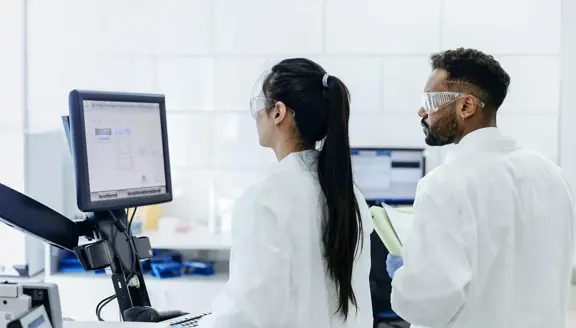


Throughout this period, terabytes of data are created. Medical writers need to compile and organize these gigantic data sets into comprehensive 1,200+ page dossiers to submit a new drug for approval to the U.S. Food and Drug Administration (FDA), European Medicines Agency (EMA), India’s Central Drugs Standard Control Organization (CDSCO), or countless other regulatory bodies.
And after billions of dollars and thousands of personnel hours are poured into this process, most drugs that go through this process are not approved.
So, what can you do? You need to smooth out as many roadblocks as possible when it comes to the time-consuming medication approval process, including the daunting preparation of regulatory dossiers.
AI as a Powerful Tool for Medical Writers
Automation and AI-powered tools are at the forefront of every sector in almost every major organization. Microsoft’s large language models, including OpenAI tools like GPT-4 or GPT-4 mini, provide robust capabilities that are becoming more advanced every day.

But what does this continued evolution of Generative AI mean for Healthcare and Life Sciences?
Well, first, it’s important to talk about what advanced technology like Generative AI is not doing: It is not acting as a replacement for medical writers. According to Andrey Sorokin, a Solution Architect at DataArt, Large Language Models powered by Generative AI cannot blindly compile content and create clinical study reports.
“Giving these models such a prompt that includes extensive datasets from multiple scientific articles and research studies conducted in various settings can lead to Generative AI hallucinations — confusing or outright false outputs,” he says. “To prevent this, it is essential to carefully maintain the relationships between documents, entities, and articles, thereby minimizing context poisoning and inconsistencies.”
The ramifications of using Generative AI in this way are dangerous to think about, with disastrous potential for error and delays when it comes to trial data and the completion of regulatory dossiers.
“If we blindly took these chunks of data, these texts, we would end up with some factually incorrect result, especially if the input data isn't properly prepared,” Sorokin says.
Think of it this way: Would you want to use a medication with test data that was organized and completed without the presence of humans?
No, Generative AI tools are precisely that: tools. The hammer doesn’t build the house, but it sure helps.
How Can Medical Writers Best Leverage Generative AI?
Sorokin says that just because Generative AI is not yet ready to take in terabytes of data and pump out a dossier, doesn’t mean it cannot greatly improve the overall efficiency of the dossier process.
“Researchers cannot squeeze everything into a single context window that they have accumulated over the years,” he says. “So, they need to use some other approach by picking relevant pieces of context, and crafting really precise prompts before feeding them into a Large Language Model.”
“Medical writers can and should embrace Generative AI-powered retrieval generation to streamline their workflows,” he adds. “This means researchers first have to somehow retrieve this data, then we need to apply the correct prompt and generate content.”
To embrace Generative AI, it is advisable for medical writers to take the initiative in learning the basics. This includes researching the fundamentals of prompt engineering, as it will be a career-defining skill for medical writers moving forward.

And as Generative AI models become more and more advanced, writers can use their new knowledge to tackle these dossiers module by module.
Perhaps the biggest area where this solution can add value is in organizing data and formatting these documents. According to the American Medical Writers Association1, 77% of agency reviewers writers say poor document quality delays the approval process.
For example, medical writers can leverage Generative AI to validate the structure of each dossier module, cite relevant documents, ensure that all core report elements are present, and reorganize module paragraphs to align with the required document template — all without altering the facts. This reduces redundant, time-consuming manual tasks involved in creating, formatting, and translating massive regulatory dossiers, thereby accelerating analysis and streamlining the approval process.
Reducing Errors and Delays
Implementing Generative AI can help teams tackle the gargantuan amount of data, organize it into the appropriate modules in their dossiers, and format it in a more legible way.
Once the Generative AI model ingests this data, it helps researchers build a structure and relation between large tanks of data. This has the potential to save countless hours at every stage of drug development, from processing trial data, writing, and even post medical writing and post market research.
Sorokin says that no matter when you use Generative AI in the research and development process, the right prompt is key.
A highly specific, well-crafted prompt can help direct the AI to generate content for the right dossier modules using the appropriate data. Doing this will help writers complete regulatory dossiers for the Food and Drug Administration (FDA) more rapidly and accurately at every stage, and lead to less back and forth due to missing or incomplete information.
And that is no small thing. These dossiers are huge, often going well beyond 1,000 pages. Their structure is also very fixed; every paragraph in every module has to be right.
Global Reach: Repurposing and Translating Dossiers
Though it’s a huge time savings on its own, Generative AI can go beyond the creation of a single dossier. It can also save teams hours of work when it comes to preparing the same drug for approval by the European Medicines Agency (EMA), India’s Central Drugs Standard Control Organization (CDSCO), or countless other regulatory bodies.
These dossiers are not only completed in different languages, but they can also have vastly different structures and unique modules to complete. Rather than having writers start from scratch, Generative AI can help slash the number of hours it takes to repurpose and reorganize data.
“Reorganizing and translating the original dossier without losing factual information is an enormous benefit,” Sorokin says.
He says this alone can help filter as much as 30% of the content for another regulatory body’s dossier, which amounts to thousands upon thousands of hours of work. It also allows writers to focus on region-specific regulations and laws.
Using Advanced Queries for Faster Data Retrieval
Beyond the rapid completion of these gigantic documents, Generative AI can be used to help medical writers find what they need and compile it faster. They can input advanced, highly specific queries into their AI model to easily locate data sets within a clinical trial for a specific test group.
The model can then be used to find relationships between paragraphs in the same research and build graph representations of data over the entire 10+ year research period. A multi-modal Generative AI model can even be used to craft easily searchable text descriptions for medical images gathered during research.
Implementing Generative AI Rapidly and Responsibly
Embracing the capabilities of Generative AI now — not a month, 3 months, or a year from now — can help medical writers, and the organizations they work for, stay ahead of the curve. But it’s vital that organizations adhere to the same high standards that they use when it comes to researching and developing new prescriptions.
The Role of AI in Clinical Trials
Watch the RecordingThat’s why it’s essential to partner with an experienced team that can not only develop and implement a Generative AI model rapidly, but responsibly. Navigating the intricate intersection of AI and Life Sciences requires robust knowledge of not just how Generative AI can enhance workflows, but how it can do it while adhering to stringent security, compliance, and data privacy protocols.
It’s also key to work with someone who can help you beyond just that initial engagement. Because AI will only continue to evolve and, cliché or not, that means it is here to stay.
Ready to see how Generative AI can transform the medical writing process at your organization? Contact us for a free brainstorming session.
Why DataArt for Generative AI?
| 20+ year Microsoft partner | A wide array of Azure-based AI solutions for all business needs | Comprehensive AI support, from and custom solution development to implementation and ongoing optimization | Over 1,500 technology experts with robust healthcare & life sciences experience |
About DataArt
DataArt provides medical software development services that help organizations not only elevate the standard of living, but also save precious human lives. Guided by our vast industry-specific experience and proven track record with Microsoft solutions, we partner with clients to cultivate innovation and digital transformation. Together, we enhance health outcomes and solve complex business challenges.
Since 2000, DataArt’s experts have helped companies around the globe leverage Microsoft technologies. As a Microsoft Solutions and Azure Consulting Partner, DataArt has extensive expertise with the Microsoft stack. We help clients develop, integrate, and optimize Microsoft-based solutions that drive innovation and growth.
1Regulatory Affairs Professionals Society. "The Value of Medical Writing in the Regulatory Environment." Last modified May 2023. Accessed November 25, 2024