
While the pandemic's impact had been extremely hard on the entire travel industry, which resulted in many companies slashing their IT budgets, some players leveraged the crisis to recalibrate their investments in technology and improve or automate technological operations. For these companies, the pandemic was a chance to accelerate IT measures rather than an obstacle to advancement. In the post-pandemic era, global spending on IT is growing: the latest forecasts by Gartner project that it will total $4.5 trillion in 2022, an increase of 3% over 2021.
As travel and hospitality companies continue to recover, let’s look at trends in technology cost allocation that will be useful to consider as the time for 2023 budget planning approaches.
Budget Line: Staff Management and Automation Systems
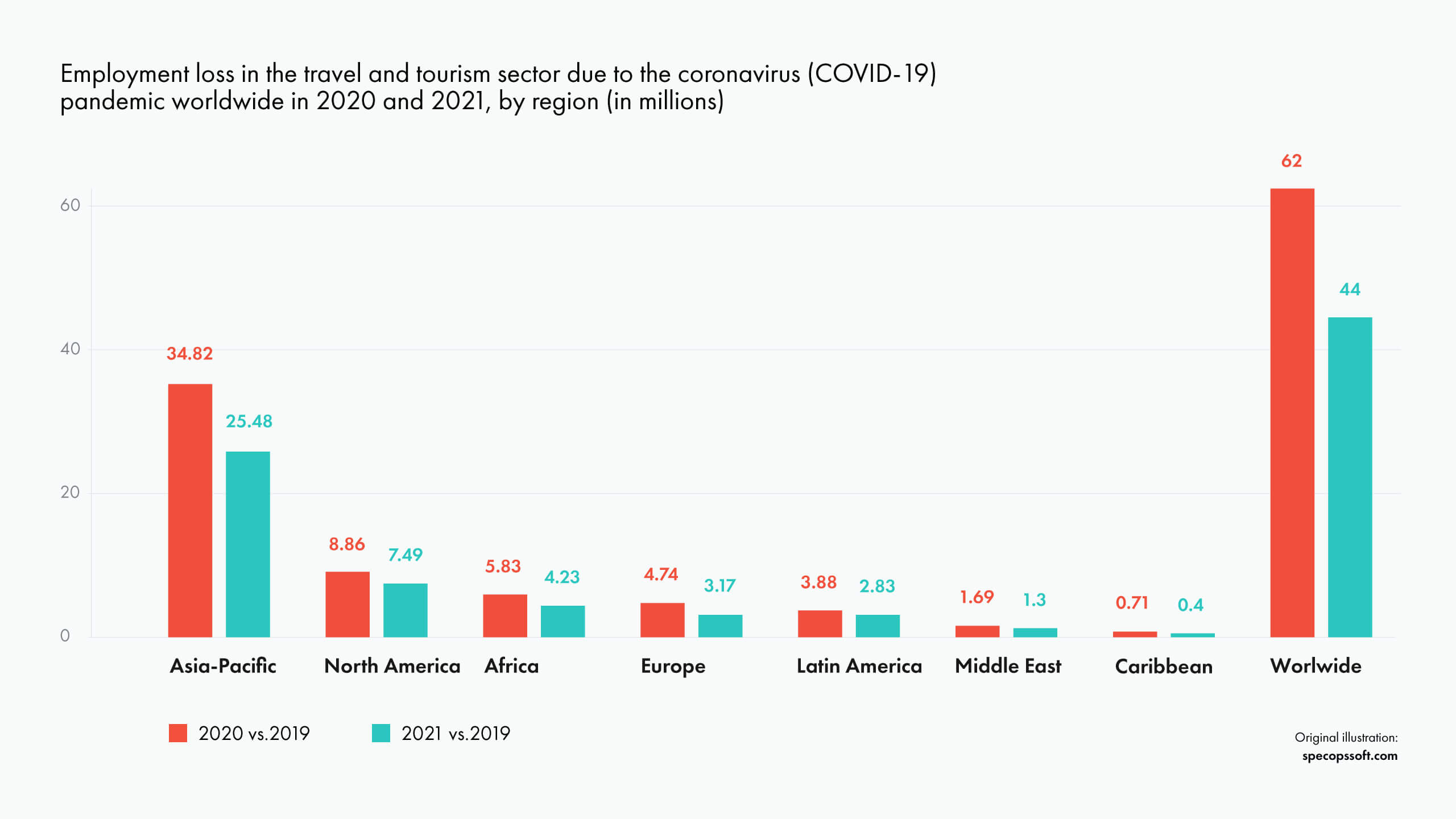
The travel and hospitality industry experienced unprecedented “brain drain” during the pandemic: millions of skilled and capable professionals left their jobs for other industries, and others took early retirement. According to the Statista’s estimates, the global travel and tourism market lost roughly 62 million jobs in 2020. While this scenario improved in 2021, the sector still reported around 44 million fewer jobs worldwide compared to 2019.
There is still a long road to recovery ahead. As travelers resume pre-pandemic travel practices, hotels and airlines are struggling to hire employees for customer-facing and service roles. Labor shortages are a major driver for travel companies to improve staff management systems and automate routine processes.

Manual Process Automation for Hotels
As of October 2021, there were 300,000 fewer workers in the hotel industry than two years prior. This called for a need to eliminate some routine tasks in order to concentrate on maintaining the guest experience. Automation at hotels is not only about using robots for check in, there are other automation opportunities, including call-center automation and machine learning-driven logic for self-service assistance. Many situations that usually involve an in-person interaction with the hotel personnel can be automated.
Revenue management automation will be another huge area of investment for hotels in 2023. Historical data on seasonal room occupancy that was accumulated pre-Covid is no longer fully relevant, so hoteliers need to train their revenue management algorithms based on newer data. This requires more sophisticated, ML-based algorithms, that can identify and accommodate for repetitive patterns in smaller amounts of data. A smart revenue management system takes into account future pace of recovery, price sensitivity, external data points, unconstrained demand, and even prices by room type and/or market segment to help a hotel generate more revenue in the long term.
Crew Management Systems for Airlines
Two major items of expenditure for the airlines remain unchanged through years: labor and fuel costs. As airlines face challenges filling their needs for pilots and mechanics, they should plan to invest in smarter crew management systems. According to a study by Dartmouth College, airlines can avoid up to 80% of crew-related delays and save billions of dollars annually through advanced crew shift planning and flight scheduling.
Smart crew management systems are designed to meet thousands of complex rules at a time, including workload variables due to seasonal traffic fluctuations, legislative and contractual conditions, crew member preferences and certification expiry dates. Machine learning algorithms take all these variables into account and perform what-if scenario analyses. Airlines can use these models to improve crew management system accuracy and airline profitability.
Budget Line: Elastic IT Team
Along with the shortage of customer-facing and service employees, travel and hospitality companies face a shortage of in-house IT professionals with travel industry experience. This gap can be addressed by forming strategic partnerships with experienced software development and consulting vendors. These partnerships can help provide flexibility for 2023 IT budgeting strategies and execution.
With an external tech partner, it is easier for travel companies to scale up or reduce their IT teams as technology priorities change.