

Data Everywhere, Answers Nowhere
Businesses today are swimming in data but starving for answers. Despite investing heavily in data collection, from customer behavior and marketing performance to operational metrics, most teams still struggle to get timely insights when needed. Leaders often find themselves stuck in a familiar, frustrating cycle: submitting requests to technical teams, waiting for custom reports, and hoping the data arrives before the opportunity is gone.
As a result, teams lose time, overlook opportunities, and struggle to respond when it counts simply because the data doesn’t reach them fast enough.
From Complexity to Clarity: A New Way to Use Your Data
Snowflake's Cortex AI platform changes the equation of enterprise data analytics, offering a comprehensive ecosystem of AI-powered tools that make advanced data insights accessible to users regardless of their technical background. This integrated suite combines natural language processing, document intelligence, and foundation model capabilities to transform how organizations interact with their data warehouses.

Imagine asking your data warehouse a question in plain text and getting instant, intelligent answers without writing a single line of SQL or waiting for your analytics team. And that's not all. You also get instant dashboards and visualizations that transform those answers into charts for better data perception and decision-making. This isn't a distant future. Right now, organizations are cutting their time-to-insight from days to seconds.
And it gets better: this solution is fully customizable to fit your organization's specific needs and can be integrated with the tools your teams already use, like Microsoft Teams, Slack, or Copilot. With Streamlit, businesses can build tailored "Talk-To-Data" applications that bring all these capabilities together in one intuitive interface.
Let’s take a quick look at the Cortex AI Highlights driving this transformation:
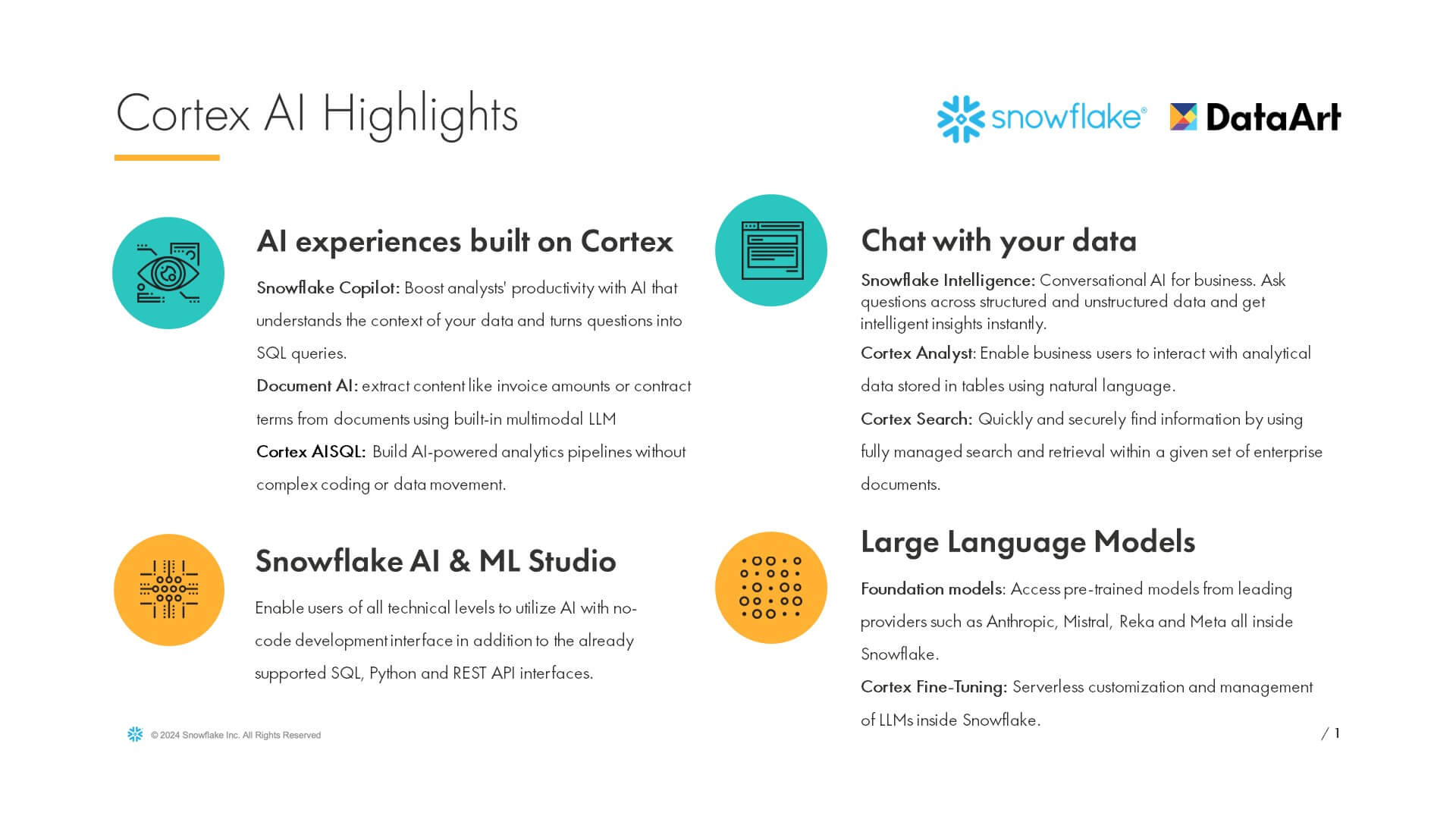
Snowflake Copilot transforms plain-language questions into complex SQL queries, boosting analyst productivity with AI that understands the context of your data.
Example: A marketing analyst asks, "Which campaigns generated the highest ROI last quarter?" Copilot automatically generates complex SQL queries across multiple tables, joins campaign data with conversion metrics, and calculates ROI without the analyst needing to write any code.
Document AI extracts structured content, such as invoice amounts or contract terms, from documents using a multimodal large language model designed specifically for document processing.
Example: An accounts payable team can upload hundreds of vendor invoices and automatically extract invoice numbers, amounts, due dates, and vendor information into structured data for immediate processing and approval workflows.
Cortex AISQL enables AI-powered analytics pipelines without complex coding or data movement through simple interfaces.
Example: A retail operations manager can create an automated pipeline that monitors inventory levels, predicts stockouts, and generates reorder recommendations -all by describing what they want in plain text rather than building complex data workflows.
Snowflake Intelligence provides conversational AI for business users, allowing them to ask questions across structured and unstructured data and receive intelligent insights instantly.
Example: A product manager can ask, "What are customers saying about our new feature in support tickets, and how does that correlate with usage metrics?" The system analyzes both unstructured support text and structured usage data to provide comprehensive insights.
Cortex Analyst makes natural language querying of data tables possible for non-technical users.
Example: A sales director can ask, "Show me our sales performance by region for Q3, highlighting territories that are underperforming compared to their historical averages," and receive a detailed analysis with visualizations without involving the analytics team.
Cortex Search quickly and securely finds information using fully managed search and retrieval within enterprise documents, providing relevant context for every query.
Example: A compliance officer preparing for an audit can ask, "Find all documents related to our data retention policies from the past two years," and instantly retrieve relevant contracts, internal policies, and regulatory filings from across the organization.
Foundation Models: Snowflake offers pre-integrated access to leading providers' models like Anthropic, Mistral, Reka, and Meta, powering intelligent, contextual responses that understand nuance and business logic.
What Used to Take Months, Now Takes Hours
Building AI-enabled applications used to require weeks of engineering time, costly infrastructure, and multiple teams. Think processing thousands of documents, analyzing vast datasets with mixed data types, or building intelligent systems that need to understand relationships across your entire data ecosystem. With Cortex and Streamlit, those processes can now be deployed in days or even hours.
Cortex AI SQL and the broader Cortex ecosystem excel particularly in scenarios requiring enterprise-scale multimodal data processing, handling volumes far beyond what traditional LLM context windows can accommodate.
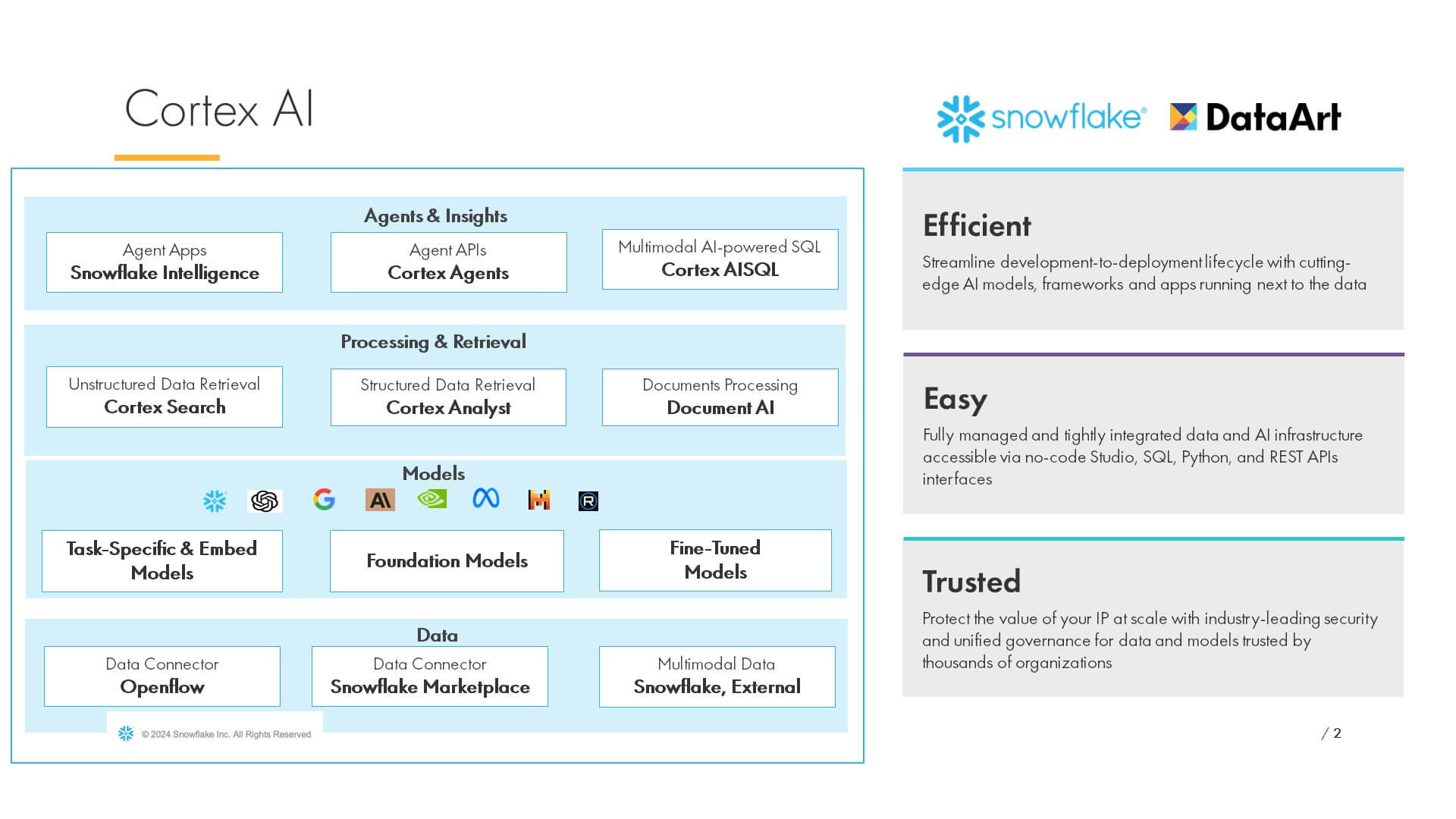
While each of these components offers powerful standalone functionality, the fundamental transformation occurs when these AI capabilities are seamlessly integrated into custom applications using Snowflake's native Streamlit platform. This comprehensive exploration will provide an overview of the Cortex AI ecosystem and its “Talk-To-Data” capability.

Everyday Use Cases, Solved in Seconds
Consider how this transformation plays out across different business functions:
Marketing Teams can analyze campaign performance, identify successful tactics, and optimize spend allocation based on real-time results rather than waiting for monthly reports.
Sales Organizations can identify at-risk deals and adjust strategies based on immediate market feedback and customer behavior patterns.
Operations Leaders can monitor efficiency metrics, identify bottlenecks, and implement process improvements based on continuous data insights rather than periodic reviews.
Technical Support Teams can instantly gather comprehensive customer information when requests come in, asking questions like "Show me all account activity, transaction history, and support tickets for user John Smith in the past 90 days" or "What's the source of funds for this customer's recent large deposit?" This immediate access to complete customer profiles enables faster issue resolution and better customer service without switching between multiple systems.
Security Teams can quickly identify suspicious transactions, unusual user behavior patterns, and potential fraud indicators by asking natural language questions like "Show me all transactions above $10,000 from new accounts in the past 48 hours" or "Which users have accessed sensitive data outside normal business hours?" This instant threat detection capability prevents business damage by enabling rapid response to security incidents.
Executive Teams can access comprehensive business intelligence for strategic planning, with the ability to drill down into specific areas of interest during actual board meetings and strategy sessions.
Why the Semantic Model Is Your Real Competitive Edge
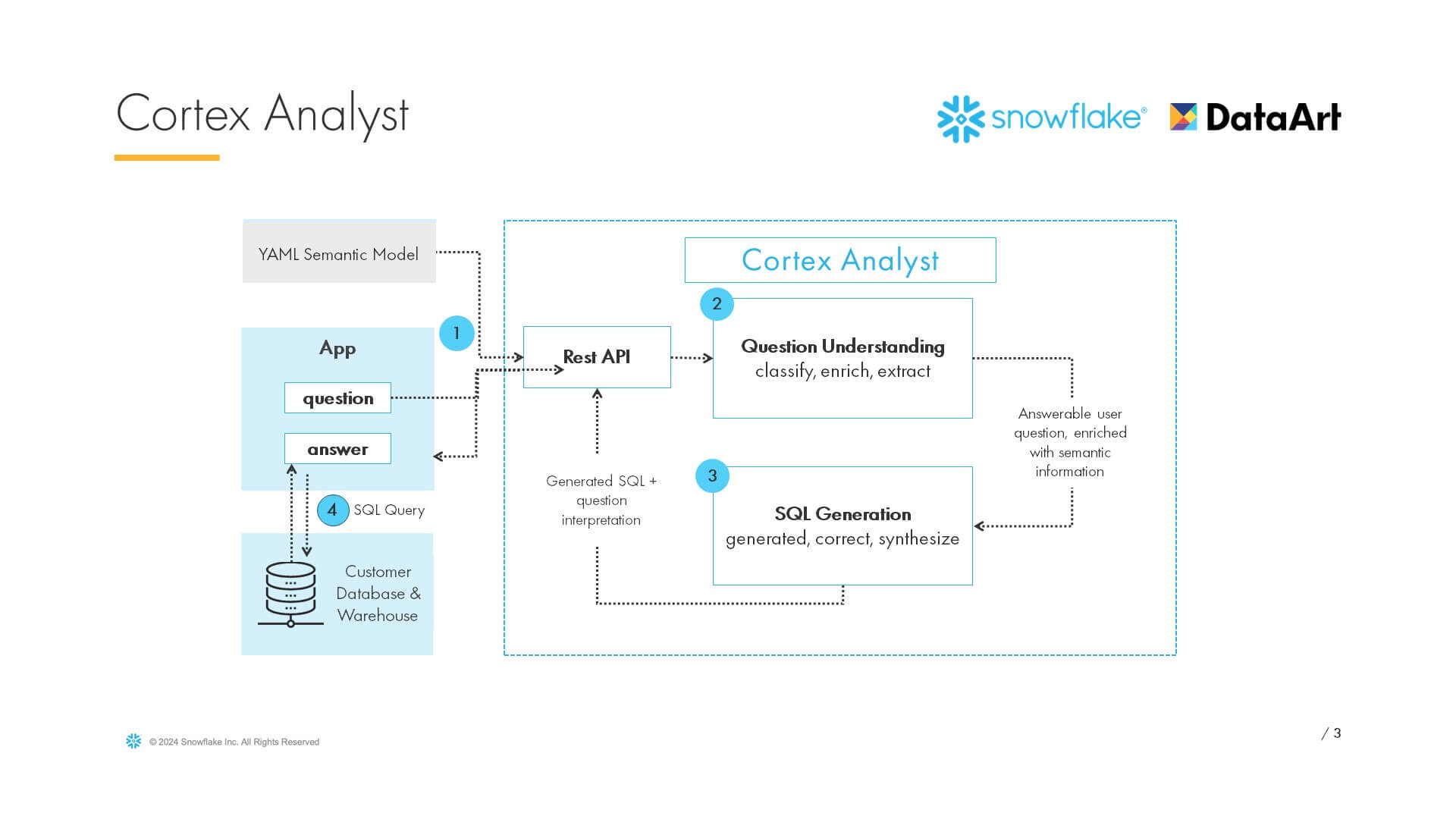
The Cortex Analyst unites business users with complex data by leveraging a YAML semantic model to interpret questions and translate them into accurate database queries, eliminating the need for technical SQL knowledge.
At the heart of this natural language interface is a semantic model, a structured layer that maps business language to your actual data infrastructure.
Think of it as teaching your data to speak your company's language. The better you define the semantic model, the more confident responses you get. Semantic models map business terminology to database schemas and add contextual meaning by adding synonyms, respective descriptions, examples, and formula explanations. For example, how to calculate total revenue by applying tariffs.
Benefits of the semantic model:
- Reusability: Share it across users, roles, or even departments or tools, including BI platforms (will probably require some workaround.
- Consistency: Centralizes business logic to avoid discrepancies across reports, creating a single source of truth for your data definitions.
- Clarity: Makes it easy for non-technical users to interact with complex data structures.
Say Goodbye to Fragmented Analytics
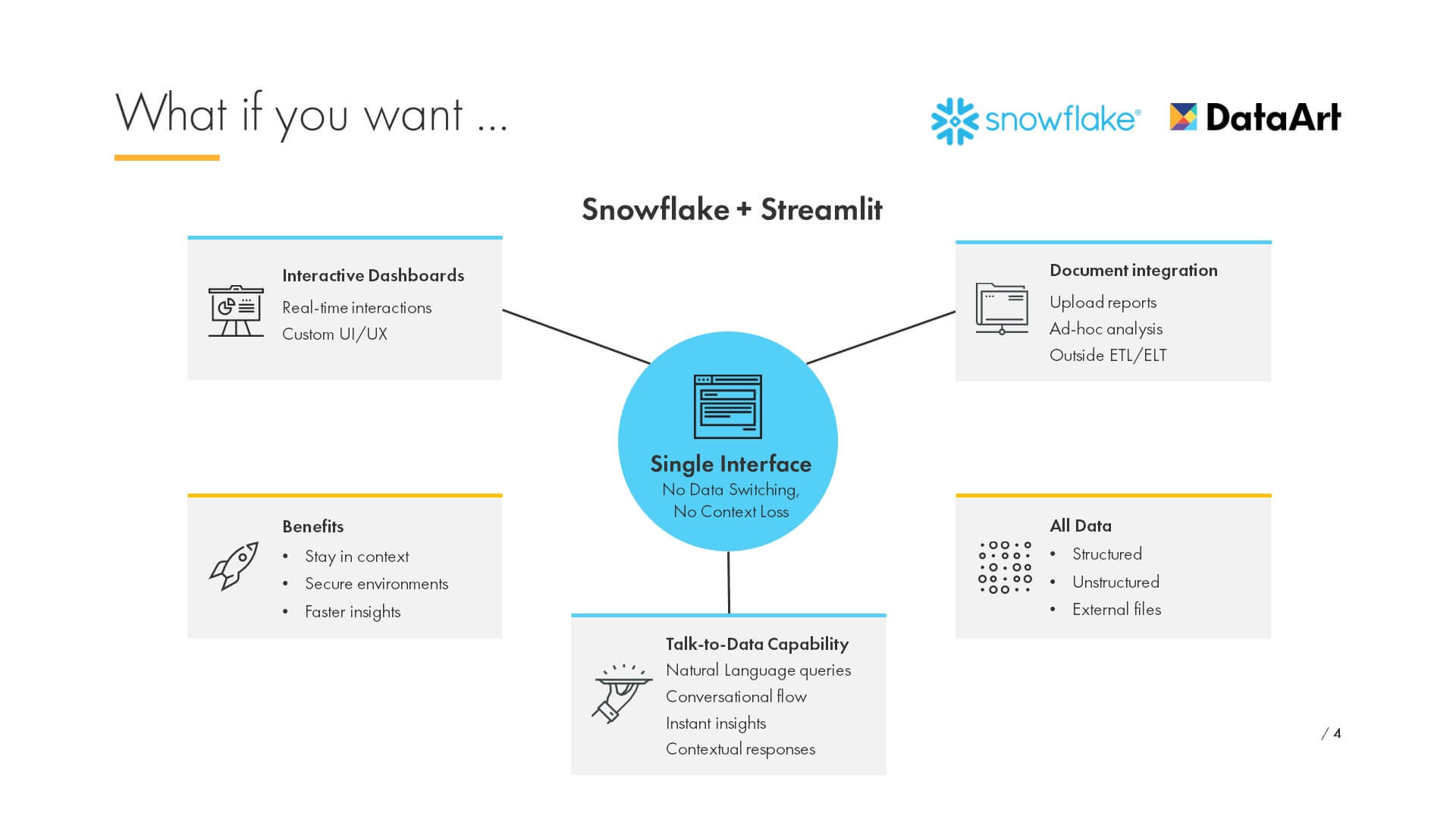
What if you want a single interface that combines all your data capabilities, from data analysis to interactive dashboards, without switching between multiple tools and losing context? The Snowflake Cortex and Streamlit integration addresses this exact challenge by providing a unified platform that eliminates data isolation and application scatter. Now, instead of jumping between tools for querying, analyzing, and visualizing data, users can do everything from one place. They can seamlessly work with all data types (structured, unstructured, and external files) while receiving instant insights and contextual responses, all without losing context throughout their analytical journey.
Breaking Down the Benefits: Key Features That Change the Way You Work with Data
Key capabilities of this unified experience that transform how organizations approach data analytics include:
Talk-to-Data Capability: Provides natural language queries with conversational flow, delivering instant insights and contextual responses that make data exploration as simple as having a conversation.
Security and Governance: Ensures enterprise-grade protection throughout your analytics journey, with role-based access controls automatically applied to each attempt to interact with data. Users can explore AI-driven insights with confidence, knowing the highest standards of privacy and governance protect their sensitive information.
Document Integration: Supports seamless upload and ad-hoc analysis of reports and external files outside traditional ETL/ELT processes, bringing all data sources into one accessible workspace.
Comprehensive Data Access: Handles both structured and unstructured data along with external files, ensuring that users can work with their complete data ecosystem without technical limitations.
Interactive Dashboards: Enable real-time interactions with custom UI/UX components, allowing users to explore data through intuitive visual interfaces without switching between multiple tools or losing context.
Ready to See It in Action?
We’ll walk through a hands-on demo that shows exactly how this works, building a custom “Talk-to-Data” app that connects your teams with your data in real time.
No waiting. No switching systems. Just better answers, faster.
Enjoy it!