
The healthcare industry is at a turning point—data fragmentation, integration challenges, and limited real-time insights are slowing down innovation and patient care. Recently Microsoft and DataArt held an exclusive in-person event where top industry experts discussed how to break down data silos, improve integration, and apply AI in ways that drive real value for healthcare organizations.
The list of speakers included:
- Ian Morrison, National Director of Data & Artificial Intelligence Solutions for the Healthcare Payor and Provider Verticals, Microsoft
- Steve Roberts, Board Advisor, myphantompath Cybersecurity
- Dmytro Baikov, Head of AI Lab, DataArt
- Susan Protos, Global Healthcare & Life Sciences Practice Lead, DataArt
- Alexey Utkin, Head of Data and Analytics Lab, DataArt
- Ilya Korover, Project Manager, Healthcare and Life Sciences, DataArt
In this article we summarized highlights from their discussion.
Data Challenges in Healthcare Industry
Data Quality
It's important to ensure that the data being managed by healthcare organizations is both accurate and cleansed, particularly when utilized in conjunction with large language models (LLMs) for AI applications. The effectiveness of AI in healthcare is directly correlated to the quality of the input data, making this a pivotal area for organizations to address.
Data Sharing among Various Entities and Managing Consent
One of the primary challenges is the intricate nature of consent management. In today's healthcare ecosystem, consent must be secured not only at an organizational level but also, crucially, at the individual business unit level. This means that entities must negotiate and establish consent chains between various divisions when handling sensitive patient data. It complicates the integration efforts necessary to effectively leverage data for proactive patient care.
The implementation of the Trusted Exchange Framework and Common Agreement (TEFCA) regulations, set to take effect on January 1, 2026, will introduce new requirements for healthcare organizations. These include rigorous identity management protocols mandating the validation of individual identities prior to data exchange. The convergence of these forthcoming regulations with existing data-sharing frameworks—such as those utilized in SMART on FHIR—creates complex challenges that healthcare companies must navigate.
Data Management and Integration for Effective Use
To effectively derive value from any data initiative, organizations must first ensure proper management of their data before using it. The integration of disparate data sources proves to be more crucial than the functionality of any individual application. Having all pertinent data unified in one location creates the foundation from which organizations can glean actionable insights and then leverage AI to maximize efficiency.
Role of Technologies in Addressing Healthcare Data Challenges
Microsoft Azure
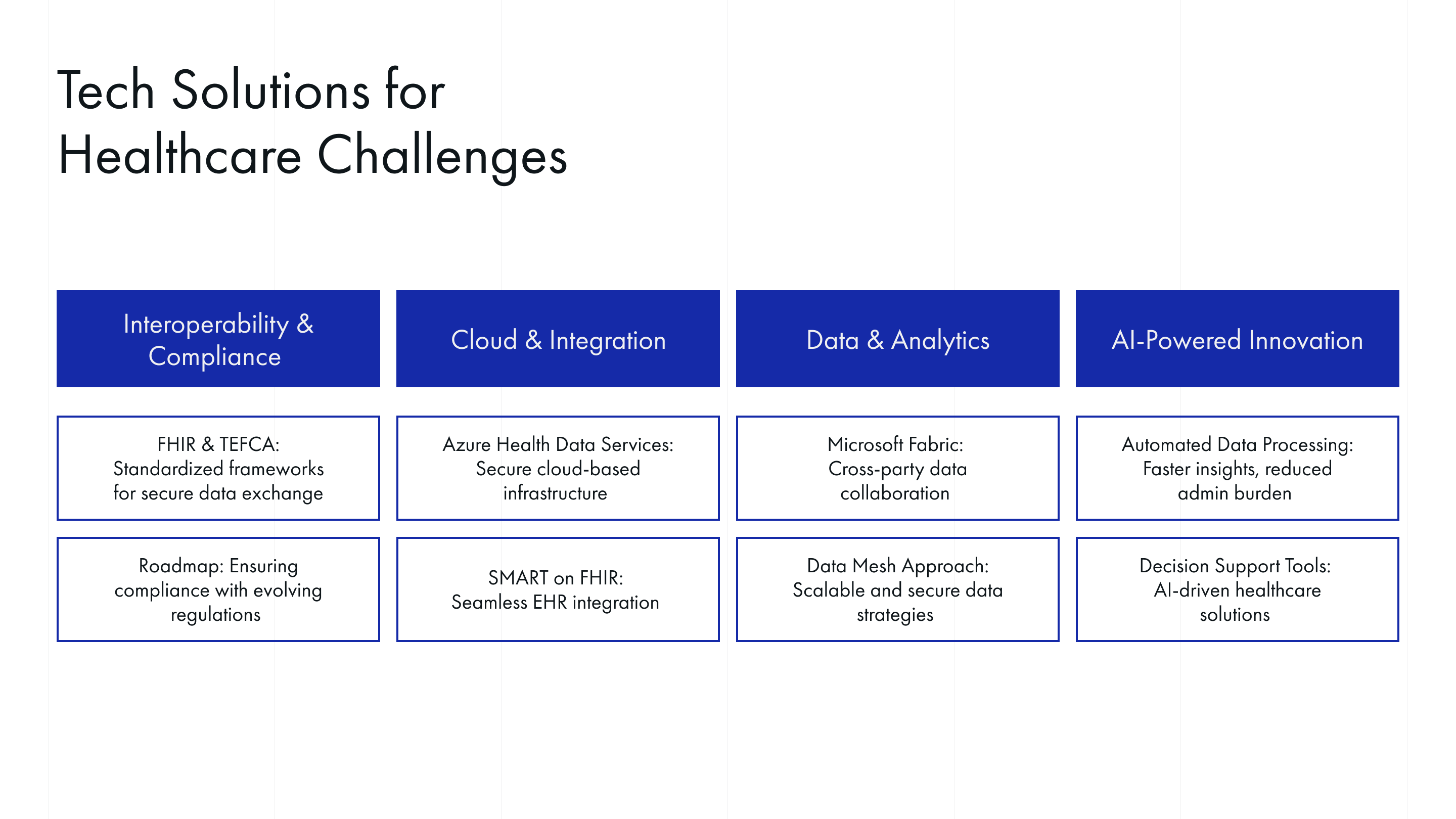
Microsoft Azure Health Data Services enables organizations to effectively handle and manage sensitive healthcare data. The platform offers a secure, cloud-based infrastructure that facilitates the storage and management of healthcare information while ensuring compliance with industry standards. By supporting SMART on FHIR, Microsoft allows healthcare applications to securely interact with Electronic Health Records (EHRs), enhancing the overall interoperability of healthcare data. Additionally, Microsoft Entra ensures seamless integration and stringent access control, making it easier for organizations to manage user permissions and data security effectively.
Effective Tools for Better Data Management
Certain modern approaches to data management are gaining momentum in the healthcare industry. One example is data mesh, which enables the integration of diverse data sources across an organization. Another is Microsoft Fabric, offering a robust infrastructure for scalable data management. These models empower healthcare organizations to connect multiple systems and applications, effectively distributing their data landscape while maintaining control over sensitive information.
Role of AI
AI is quietly reshaping healthcare data engineering – doing in minutes what once took weeks.
It automates various aspects of data handling so that organizations can focus on higher-level strategic objectives. For instance, AI can streamline data integration by automatically mapping out API structures and identifying how different data sets interconnect to accelerate the data integration process. Of course, AI has its limitations and may not be able to completely automate the process in all cases, especially when dealing with highly complex or poorly documented data sources. Human oversight and expertise are still necessary to ensure accuracy and handle exceptions.
Also, AI plays a critical role in exploring the potential of existing data within a company's architecture, whether it's housed in a data mesh or a data fabric. Once organizations have successfully integrated their data, AI can facilitate advanced analytics and provide actionable insights for decision-making.
As organizations bring more of these moving parts together, the complexity grows. Managing multiple tools and growing data volumes, coordinating between teams, ensuring compliance, and scaling successful efforts—all require more than clever automation. They require structure.
That’s why many are adopting AI platform. Not because AI can’t function without it—but because scaling and sustaining AI across the full data lifecycle requires a unified, well-governed foundation. An AI platform brings together data integration pipelines, machine learning workflows, infrastructure, and governance controls into one environment. It ensures that both external and internal technical data can be processed, shared, and activated consistently and securely.
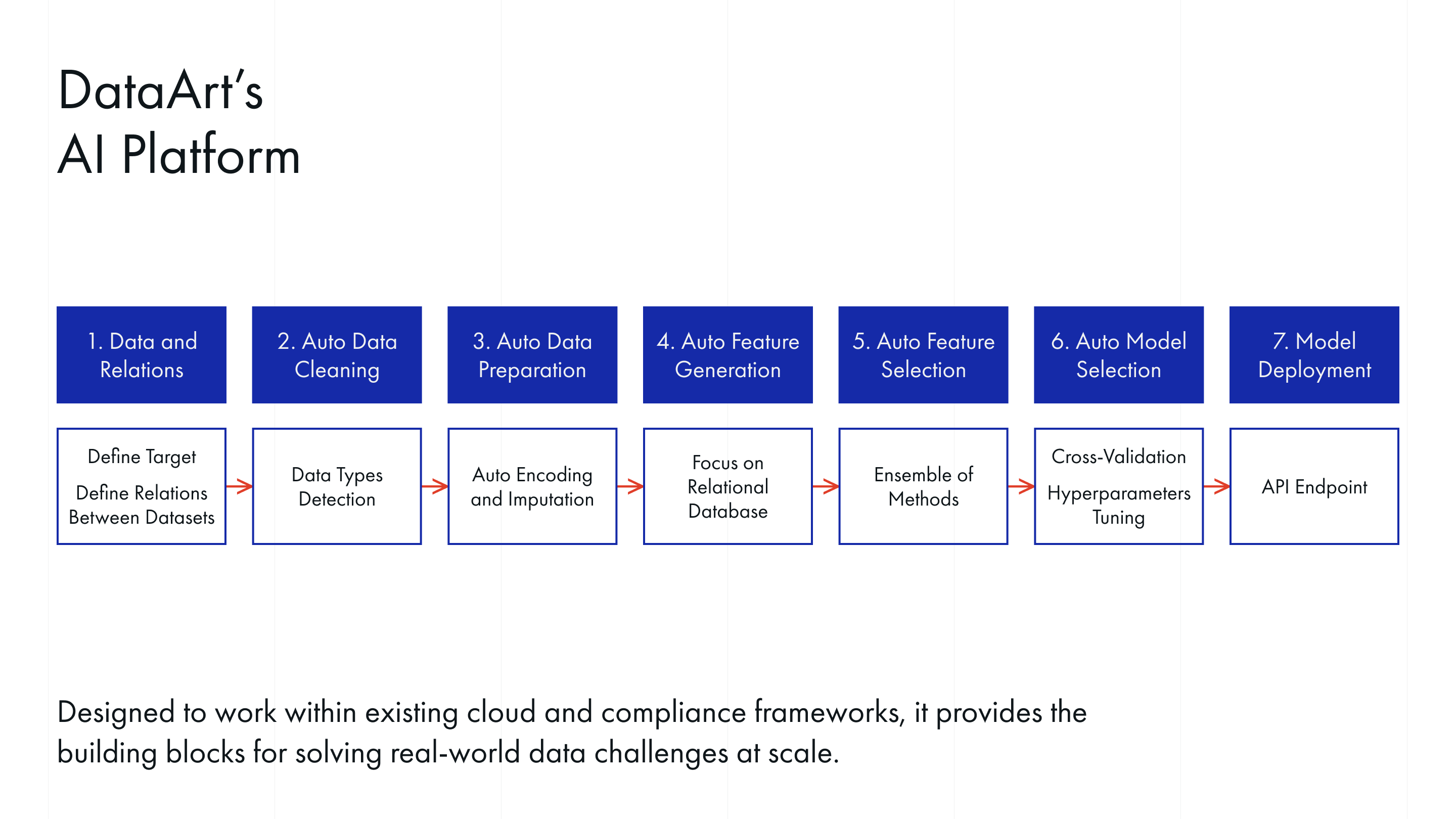
The DataArt AI Platform is one such environment. It enables healthcare organizations to manage the end-to-end AI lifecycle—from ingesting and preparing data, to training and deploying models, to monitoring outcomes and surfacing insights.
The diagram below shows just a small part of the DataArt AI Platform’s functionality that automates each step—from defining relationships between datasets to deploying a model as an API endpoint. The stages in yellow are fully automated, minimizing manual intervention:
How Technologies Enable Consent Management
By embedding consent management processes within the data architecture, organizations can create a more responsive and adaptive framework that caters to the varying timelines associated with data lifecycles and consent validity.
As healthcare organizations modernize their data architecture—whether through a data mesh or data fabric approach—they must be diligent about embedding governance practices within these frameworks. This holistic approach ensures that valuable consent management mechanisms are integrated seamlessly into the broader data ecosystem, thereby enabling secure and confidential data sharing.
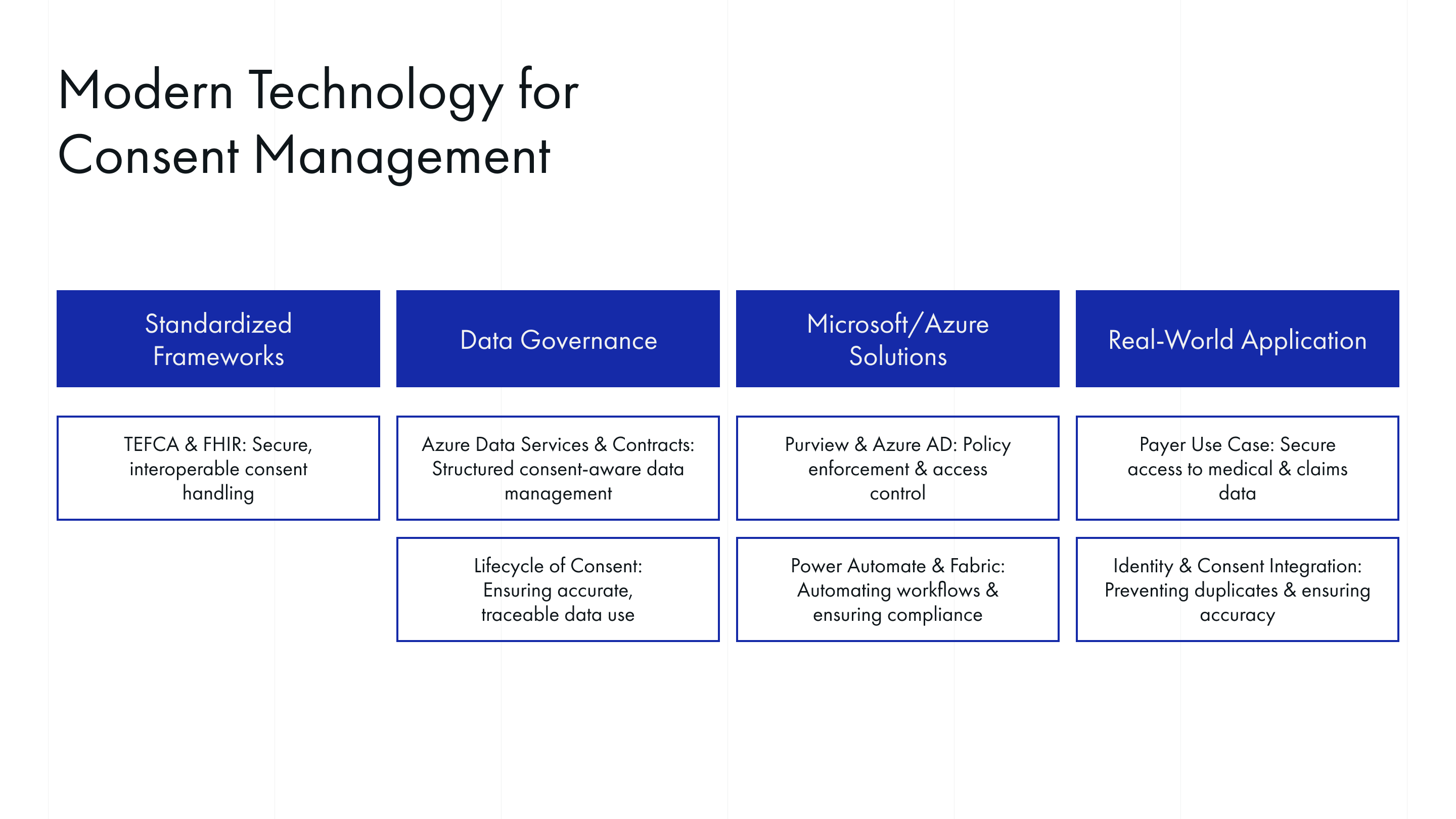
Microsoft Azure offers a range of technologies to facilitate seamless consent management for healthcare organizations. By utilizing Microsoft Purview, companies can define and maintain global policies that classify sensitive data and tag resources with consent metadata, establishing a clear framework for data usage. Microsoft Entra enforces identity and access management through role-based permissions to ensure that only authorized personnel can access sensitive healthcare data. Power Automate can help healthcare organizations further streamline the consent management process by automating consent approvals and capturing user agreements in real-time, which can subsequently trigger downstream workflows. The integration of Microsoft Fabric's unified analytics platform with Purview empowers organizations to inherit consent policies efficiently, thus ensuring that all insights derived from data are compliant with stored consent permissions.
Identity Management in Healthcare: Challenges and Solutions
Identity management poses significant challenges in the healthcare sector, especially when it comes to verifying identities during the sharing of sensitive data. Healthcare providers must ensure that identity verification processes are not only accurate but also user-friendly, allowing patients to easily navigate the system. Furthermore, once identities are verified, maintaining accurate and reliable records at the entity level becomes crucial for supporting informed decision-making and ensuring compliance with data governance standards. The complexities are further compounded by the absence of standardized identity verification solutions within the industry, making it difficult to implement consistent practices across different organizations.
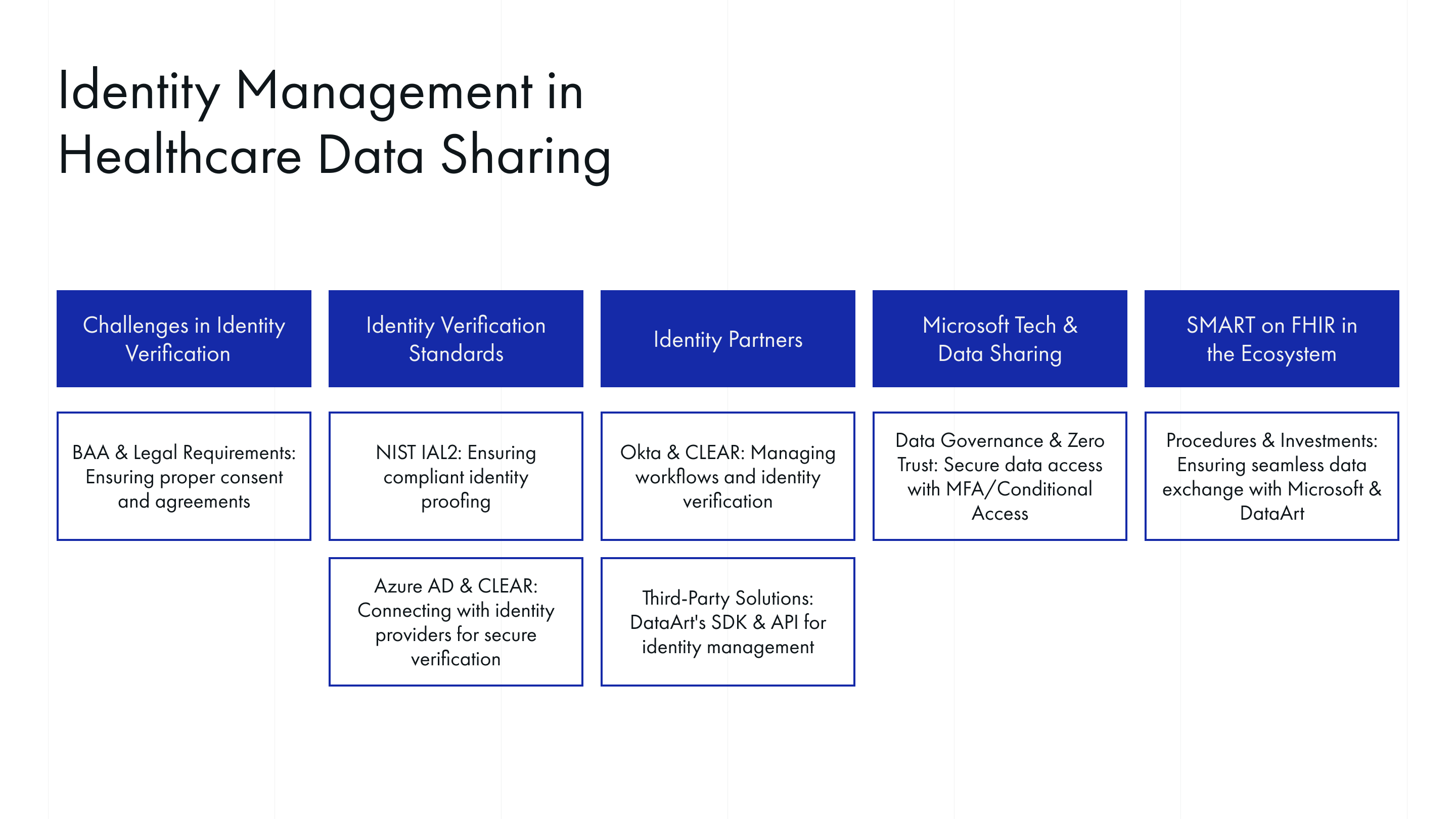
Microsoft helps address identity management challenges in various ways. For example, it streamlines identity verification and data sharing in the healthcare sector by establishing partnerships with a variety of vendors. These collaborations enable healthcare organizations to leverage a comprehensive array of identity management tools and services. One such solution is myphantompath, which is a zero trust SaaS platform that protects data in transit making your IP address invisible. The tool provides the next level of security working in coordination with existing security protocols with little or no overhead across any network, machine, or device. It is an API first platform, so it can easily integrate with existing activity-based monitoring systems or identity management systems.
Also, Microsoft is committed to creating a secure and efficient framework for data access through the adoption of a zero-trust model. This approach establishes that no access to sensitive data occurs without a clear contractual agreement outlining the conditions under which data can be requested. By implementing conditional access protocols, organizations can ensure that data sharing is both secure and compliant with privacy regulations.
Data Management for AI Readiness
One of the foundational elements for preparing an organization for AI is ensuring robust data governance and data quality measures are in place. For AI systems to derive meaningful insights, the data they rely on must be accurate, timely, and available in adequate quantities. Organizations must also focus on the structure and semantics of their data. This involves creating a semantic layer or knowledge graph that organizes data in a meaningful way, enabling more predictable outcomes when AI is applied. Preparing for AI is not merely a technical issue—it requires a comprehensive approach that synergizes data governance, ethical standards, and continuous monitoring to foster trust and efficacy in AI-driven solutions.
Microsoft is well-positioned to assist organizations in preparing for AI readiness through its powerful suite of services and tools, particularly Azure AI. Microsoft supports clients by automating and digitizing data from various sources, including PDFs, and emails, which are often unstructured. Then organizations can transform low-quality data into structured, high-value information suitable for AI models.
Microsoft's Azure AI also provides robust frameworks for ensuring the accuracy and reliability of AI outputs. Organizations can utilize Azure’s capabilities to validate results and eliminate inaccuracies using Large Language Models. By grounding AI models with high-quality data, healthcare organizations can apply AI to various use cases, including clinical decision support and operational efficiencies. Microsoft’s platforms also support compliance and ethical considerations, ensuring that organizations not only harness the power of AI but do so responsibly, enhancing trust and value in their AI initiatives.
Conclusion
Enhancing healthcare data integration is imperative for driving innovation and improving outcomes, although the complexities surrounding data fragmentation, consent management, and identity verification can create significant roadblocks for healthcare organizations. However, by leveraging comprehensive tools as well as the expertise of technological partners, organizations can effectively overcome these challenges.
At DataArt, we have deep expertise in data, analytics and AI as well as extensive experience with Microsoft tools and technologies, having been a Microsoft-certified partner for more than 20 years.
Contact DataArt today to accelerate your transformation toward secure, AI-ready, and seamlessly integrated healthcare data systems.