Our panel included Steven Jacob, a partner and Head of Payments & Digital Banking at Arkwright Consulting with a wealth of strategic advisory experience, and his colleague Jannik Lücking, who specializes in growth strategies and the execution of innovation projects. From DataArt, Dmitry Baikov, our AI Lab leader with extensive financial services and technology expertise, shared his strategic observations on Generative AI. Overseeing the dialogue as moderator was Alexander Golovanev, Solutions Consultant at DataArt. The collective expertise offered a varied perspective on leveraging AI to enhance operational capabilities and strengthen competitive positioning in the financial sector.

AI Implications and Applications in the Banking & Payments Sector
A presentation by Arkwright Consulting illuminated the advancements in AI, especially those related to the banking and payments sector. The key focus areas involved the remarkable growth in AI model performance, growing multi-modal capabilities, and the trend of miniaturization within AI technologies. As demonstrated by the Stanford AI Index, AI models are rapidly approaching and, in some instances, surpassing human proficiency in various tasks, including complex problem-solving scenarios. Additionally, advancements in multi-modality now allow AI to process numerous types of inputs—text, voice, image, and more—offering sophisticated, nuanced interactions that were previously unattainable.
This technical progress poses significant implications for financial institutions, illustrated by industry leaders like JPMorgan Chase's CEO, Jamie Dimon, who acknowledges the potentially extensive impact of AI on the banking landscape despite the current uncertainty surrounding its precise trajectory. Measurements of AI readiness among banks, such as those offered by the AI Readiness Index, highlight the disparities in preparedness, particularly between North American and European banks, stressing a need for strategic investment in talent, innovation, and leadership.

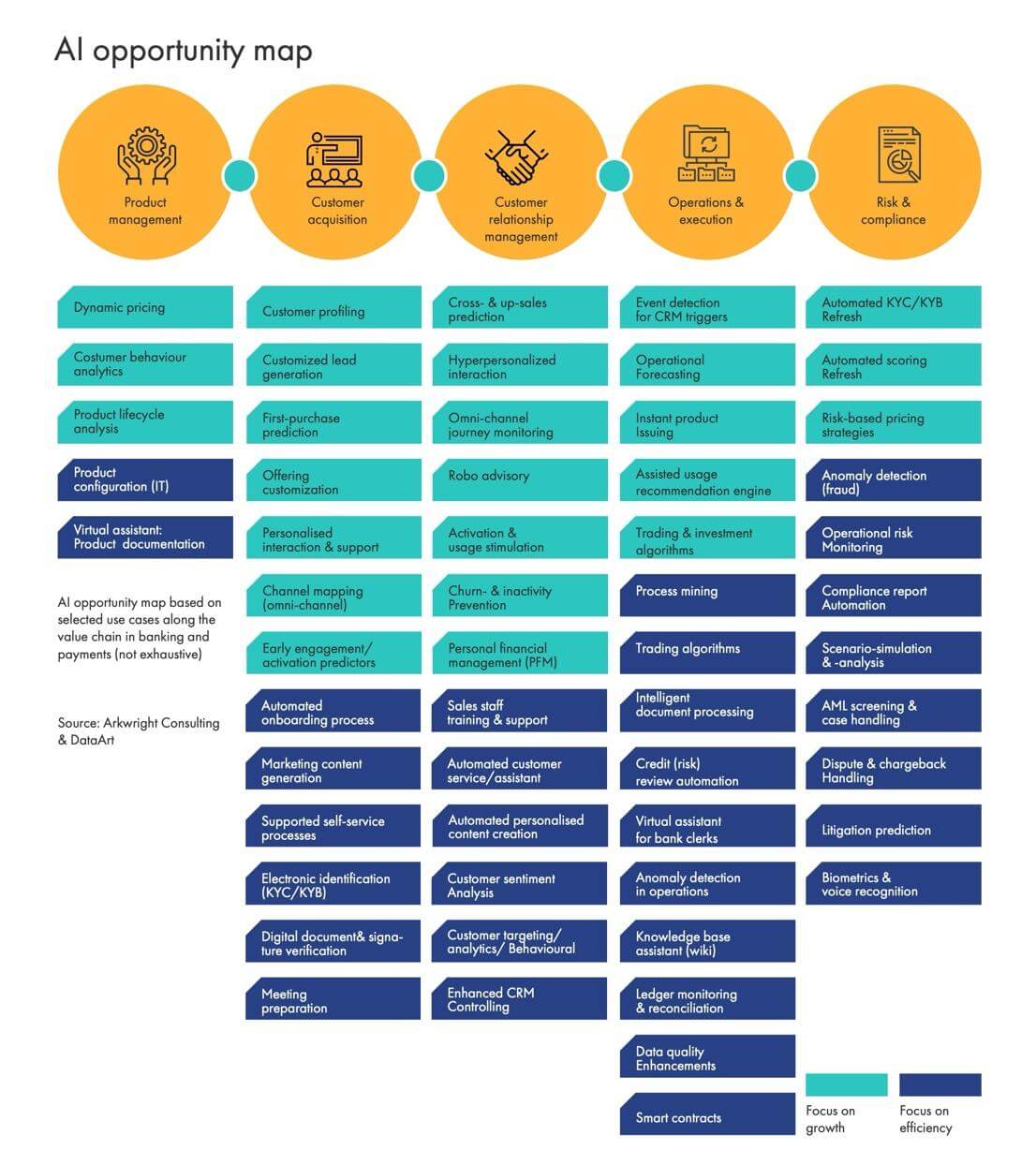
Arkwright's presentation suggested that AI technologies have the potential to significantly bolster revenues and reduce costs in banking, with applications ranging from sophisticated risk management to streamlined operations for cost efficiency to tailored growth strategies. Real-world examples, like Klarna's AI-driven customer service and HSBC's clever use of AI in credit limit adjustments, provided tangible evidence of AI's operational benefits. Finally, participants were introduced to an 'AI Opportunity Map,' a strategic tool designed to assist banks in identifying and seizing AI opportunities across their value chains, from product management to risk and compliance, thus empowering them to make informed decisions about integrating AI into their operations for enhanced growth and efficiency.
From Theory to Practice: DataArt's AI Use Cases
At the webinar, Dmytro Baikov from DataArt presented our rich experience in machine learning and AI in the financial sector, spanning over a decade. He highlighted several successful projects using advanced data processing techniques, including a model that predicts loan defaults with 80% accuracy. This innovation has streamlined the lending process, enabling faster and more accurate loan approvals.
DataArt's work also includes sophisticated document processing. By applying AI, we have transformed how financial documents are handled, extracting key data points from unstructured content and vastly reducing manual effort. Additionally, our virtual assistant technology automates email responses in customer service, accurately classifying and responding to queries, thereby enhancing efficiency. This technology has led to automating a significant portion of routine customer interactions.
Dmytro demonstrated how these virtual assistants function, particularly in managing customer service emails for bank credit card clients. Our AI can determine an email's subject and tone and the appropriate team to handle the query and even draft a suitable response, optimizing the customer service workflow and improving customer engagement. This demonstration showcased DataArt's commitment to leveraging AI to streamline operations and customer service within the banking industry. Detailed descriptions of these use cases and more can be found in the full version of the joint Arkwright and DataArt report, available for download.
On the Key Strategies for AI Readiness in Organizations
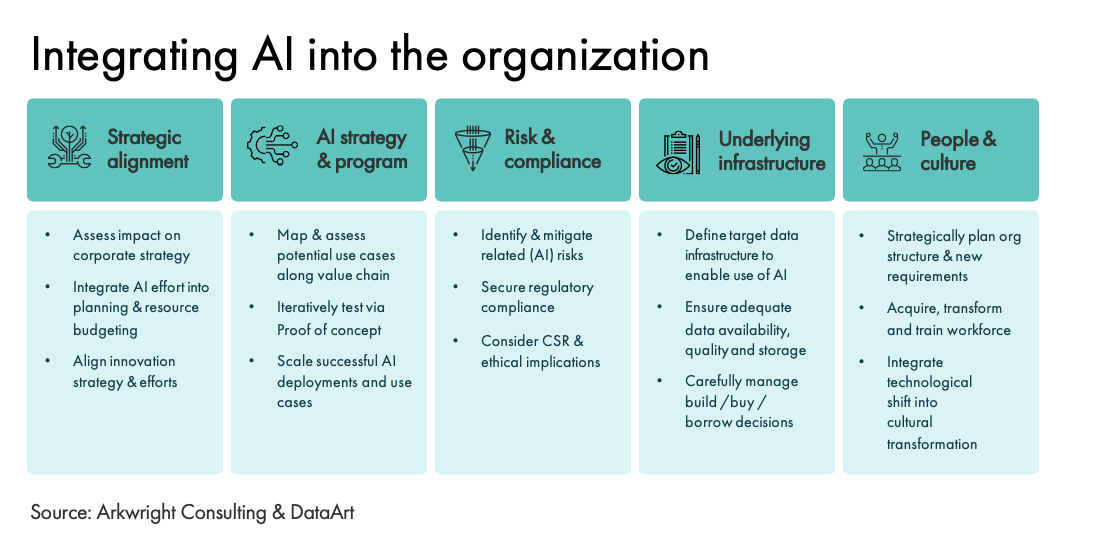
Steven Jacob from Arkwright Consulting concluded the webinar by addressing the essential steps for transforming organizations into AI-prepared entities. He highlighted the need for a visionary approach championed by top leadership, the development of an AI playground free from tight regulations and legacy IT constraints, and fostering adaptability across the organization. These 'soft' success factors—crucial yet often undervalued—are foundational for instigating passion and momentum for AI initiatives. Robust governance structures are necessary to navigate potential conflicts and dilemmas across departments, such as IT, compliance, and growth-oriented functions.
Steven also emphasized the significance of structured approaches alongside these soft factors for AI transformation. It's a continuous process that involves mapping potential AI use cases, developing and testing proofs of concept, and implementing successful pilots organization-wide while iterating upon the company's AI portfolio. This structured cycle requires prioritizing AI use cases, assessing their potential impact, and ease of implementation. Throughout the POC process, organizations refine their approach, validate hypotheses, and pivot as necessary—a practice that fosters organizational familiarity with AI and drives the transition towards leveraging its potential for both cost efficiency and growth opportunities.
Key Takeaways from the Q&A Session
During the Q&A session, the panelists explored why artificial intelligence has gained prominence in recent years. Dmytro and Jannik agreed the key factor is accessibility. Advancements in technology have led to more user-friendly AI tools, which now influence our daily lives. Contributing to this progress are better computer processors, cloud services, and increased capital investment. To organizations keen to embrace AI, Dmytro advised creating an 'AI playground' where teams can experiment with real-world data away from rigid regulation. Steven underscored the importance of leadership in fostering a culture ready for AI while both stressed the need for a structured, iterative approach to implementing AI use cases.
When discussing common pitfalls in AI adoption, Jannik highlighted the dangers of inaction and the misuse of AI for problems it may not be suited to solve, reinforcing the idea that AI is a powerful tool but not a universal solution. Dmytro added that hesitance to experiment and an overemphasis on finding the perfect use case can hinder progress. As for operational challenges in banks, proper planning and a willingness to innovate are essential. On the competitive landscape of AI models, Jannik speculated that while there’s a current race for supremacy, it may end with several similar-level models due to limited available data for training. Dmytro concurred, suggesting improvements in AI will continue, though major leaps could be years apart, depending on data availability and model innovation.
Conclusion
For a more in-depth understanding of generative AI's impact on the banking and payments industry, check out the full webinar recording below or learn more by visiting our generative AI services page.