





You are opening our English language website. You can keep reading or switch to other languages.

GCP Migration Services by DataArt

DataArt offers Google Cloud Platform migration services for businesses and enterprises operating in any industry.

Moving apps from one environment to another is challenging, so you need to plan and execute your migration carefully. If you plan to migrate your services to GCP, contact us.
We are a Google Cloud Partner with certified architects, developers, data, security engineers, and account managers on staff.
GCP Logos Horizontal@2X

Benefits of Migrating Your Services to GCP

Migrating your services and applications to the cloud offers several key advantages that can significantly enhance your overall business operations. These benefits include:
Image

Improved Security

Image

Optimized Performance

Migrating to Google Cloud boosts the performance of core systems and applications, outperforming legacy infrastructure. This improved performance enhances customer experience and frees internal resources for higher-priority tasks.
Image

Improved Infrastructure Management

Organizations streamline infrastructure management by refactoring workloads and modernizing operations through cloud-native tools like Kubernetes.
Image

Accelerated Application Development

Organizations often witness a boost in developers’ efficiency and faster application development after migrating to the cloud. Cloud-native apps can also perform more reliably with reduced downtime.
Image

Cost Efficiency

Migrating to the cloud shifts spending from capital to operational, facilitating ongoing cost management. Adopting tools like SaaS apps and elastic usage models enables flexible scaling based on real-time needs.
Image

End-of-Life Cycles Management

In the cloud, organizations efficiently handle end-of-life cycles for hardware and software, overcoming historical challenges tied to rigid licensing agreements and long-term contracts. The flexible infrastructure and payment options enable a smoother transition to the next technology without the usual cumbersome and costly processes.

GCP Migration Process

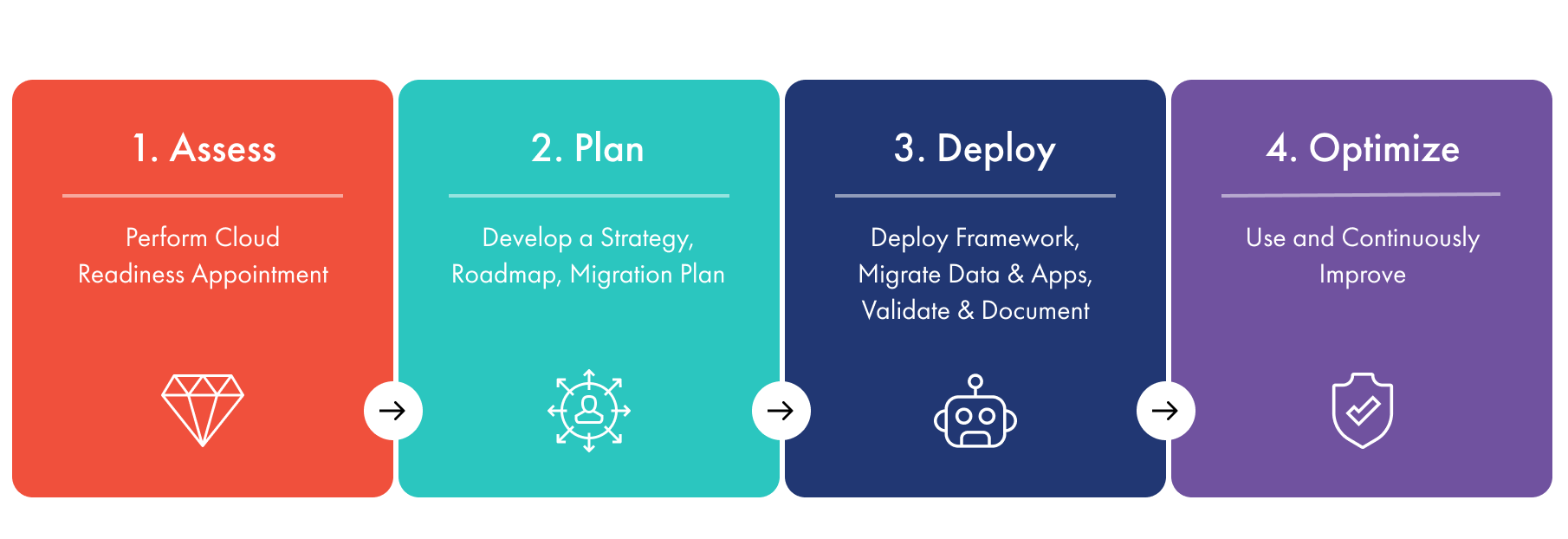
GCP Migration Process

This picture illustrates the four phases of the GCP migration process; each comprises several steps that should be followed for a successful migration.

1

Assessing Phase

  • Within this phase, it is essential to assess the workloads to be migrated and determine the requirements.
2

Planning Phase

  • During this phase, you will need to plan the foundational pieces of the new cloud environment.
3

Deployment Phase

  • After completing the planning phase, the next step is to determine the best approach to deploy your workloads to your cloud environment based on your knowledge.
4

Optimization Phase

  • During this phase, you refine your environment to make it more efficient than your initial deployment.

Why Choose DataArt as a Google Services Provider?

DataArt’s GCP-certified specialists have extensive experience designing, building, and deploying versatile cloud architectures to meet your long-term business goals.

Google Cloud Partner Logoat2x
What Are Your GCP Migration Needs?
Chief Innovation Officer / New York, USA
Yuri Gubin
Chief Innovation Officer / New York, USA

F.A.Q.

1. What is the Process Involved in the Assessing Phase?

Discovering your apps and services inventory and mapping their dependencies can help you develop an ordered migration plan. After gathering this information, you should be able to create an app catalog highlighting the amount of effort to migrate all the different workloads.

Key activities involved in this phase can be summarized as follows:

  • Knowledge of your current environment
  • Knowledge of your applications and workloads
  • Determination of hardware and performance requirements
  • Determination of the users, licensing & compliance needs

2. What Are the Necessary Steps to Complete the Planning Phase?

These are the necessary steps for the planning phase to be concluded:

  • Establishing user and service identities (determination of how users and services accounts will be created and managed)
  • Designing a resource organization hierarchy
  • Defining groups and roles for resource access
  • Designing your network topology and connectivity

3. What Type of Deployments Exist?

There are different types of deployments, which can be categorized as follows:

  • Fully manual deployments
  • Configuration management tools deployments
  • Container orchestration tools deployments
  • Automatic deployments

4. Which Are the Other Aspects that Can Be Optimized?

There are critical pieces that should be completed before cutting over live traffic. Other aspects can be optimized once the workload is serving production traffic, such as:

  • Cost optimization with autoscaling
  • Moving to managed workloads to reduce operational overhead
  • Automating the deployment process