Get Your Business Ready for the Digital Product Passport Era

Key Facts about DPP

The clock is ticking

Compliance requires deep data work

It is not just a compliance burden
Industries Accelerating Toward Digital Product Passport

Batteries – 2027
Digital tracking of performance, carbon footprint, recycled content, and sourcing across the entire lifecycle.
Strategic opportunity:
- Build end-to-end visibility across supply chains
- Enable circular models (remanufacturing, reuse, recycling)
- Turn compliance into a real-time data asset

Textiles & Footwear – 2027
Standardized data on materials, origin, durability, and recyclability.
Strategic opportunity:
- Gain full transparency across multi-tier suppliers
- Strengthen ESG reporting and consumer trust
- Unlock resale, repair, and circular business models

Metals – 2027
Tracking origin, emissions, and recyclability of critical materials.
Strategic opportunity:
- Strengthen supply chain resilience
- Meet decarbonization targets with verified data
- Enable cross-industry interoperability

Electronics & ICT - 2028
Mandatory data on repairability, components, energy efficiency, and lifecycle.
Strategic opportunity:
- Extend product lifecycle through service ecosystems
- Improve after-sales, repair, and upgrade models
- Leverage product data for new revenue streams

Furniture & Consumer Goods - 2028
Digital data on materials, durability, repairability, and reuse.
Strategic opportunity:
- Design for reuse, refurbishment, and recycling
- Build new service-based business models
- Increase product lifetime value
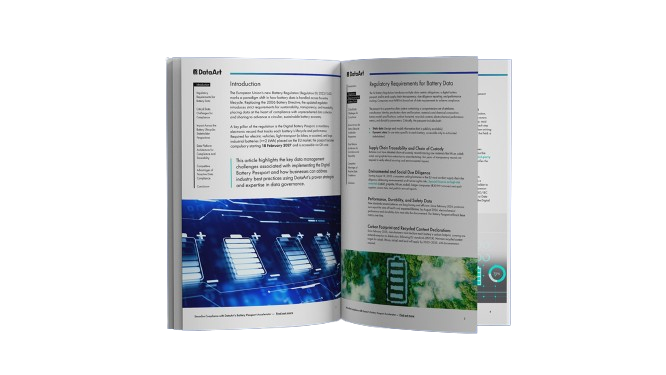
Get Your Battery Data Management Guide
Challenges You May Face
How DataArt Can Help
| ✓ Build modular, API-first data pipelines to connect actors | ✓ Design adaptable DPP data models tailored to your products |
| ✓ Develop connected platforms for repair shops and service centers | ✓ Create interoperability layers for seamless cross-actor data exchange |
| ✓ Implement standardized data validation workflows | ✓ Automate extraction and transformation from existing systems (ERP, PLM, other) |
| ✓ Enable secure product ID-linked updates (QR/NFC/API) | ✓ Implement DPP traceability through linked identifiers and logs |
| ✓ Integrate with certification bodies and material databases | ✓ Deliver governance dashboards to manage schema and versioning |
| ✓ Build mobile/web portals for in-field data capture and validation | ✓ Support GS1/EPCIS, EUDPP protocols and EU-compliant handover logic |
Well-designed DPP System Attributes
Our End-to-End Engagement Model
DPP Readiness Assessment
- ✓ Requirements elicitation
- ✓ Process and data audit
- ✓ Business and IT gap analysis
- ✓ Circular Audit (LCA, PEF, PCF, CBAM, other)
DPP Concept & Architecture Design
- ✓ Future-State DPP Process Blueprint
- ✓ Target Architecture & Data Model Definition
- ✓ Interoperability & Integration Design
- ✓ Non-Functional Requirements
DPP System Selection
- ✓ Custom vs. Off-the-Shelf Solution Comparison
- ✓ Costs & Effort Assessment
- ✓ Core DPP and Added-Value Specification
- ✓ Implementation Roadmap
DPP System Implementation
- ✓ Detailed Specifications & Technical Design
- ✓ System Development/ Deployment
- ✓ Integration with IT, Data & Business Processes
- ✓ Testing, Validation & Compliance Assurance
- ✓ Training, Change Management & Ongoing Support
Our Clients








Our Partners












Partner with DataArt
Proven Supply Chain & Compliance Expertise
With 800+ engineers, 270+ supply chain projects, and 35 active enterprise clients, DataArt designs and delivers complex digital ecosystems for regulated industries.
Deep Integration & Technology Capabilities
We specialize in PLM, ERP, PIM, MES, and SCM integration, building interoperable platforms that work across every actor in your value chain.
Collaborative, Human-Centered Delivery
We work closely with sustainability, operations, IT, legal, and product teams to ensure your Digital Product Passport initiative is both compliant and commercially valuable.
Talk to our experts to explore how DataArt’s tailored solutions can accelerate your path to secure, scalable, and regulation-ready DPP data management.
F.A.Q.
What is a Digital Product Passport (DPP)?
Which industries are affected by the EU Digital Product Passport regulation?
When will Digital Product Passports become mandatory?
What data is required for a Digital Product Passport?
How can companies prepare for DPP compliance?
What are the main challenges in implementing a Digital Product Passport?
Is the Digital Product Passport only about compliance?
How does DPP impact supply chain and data architecture?
What technologies are used to implement Digital Product Passports?
Can existing systems (ERP, PLM, PIM) support DPP requirements?
How long does it take to implement a Digital Product Passport solution?
How can DataArt help with Digital Product Passport implementation?
What is the business value of implementing DPP early?
Will DPP requirements evolve over time?



