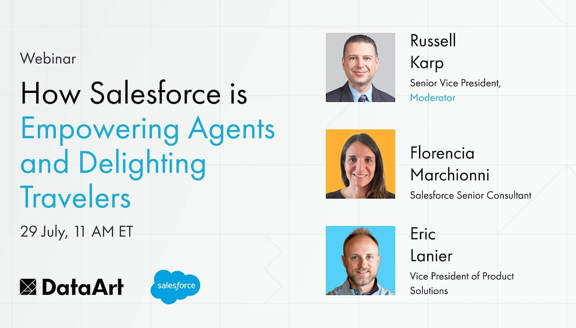
Russell Karp: Hello, everyone. Welcome to our webinar today, "How Salesforce is Empowering Agents and Delighting Travelers.” My name is Russell Karp, Senior Vice President at DataArt. I'm joined by Florencia Marchionni, Salesforce Consultant at DataArt, and Eric Lanier, VP of Product Solutions at DataArt. Thank you, everyone, for attending. Today, we'll cover how Salesforce is empowering the travel industry.
To kick us off, I'll pass it to Eric to discuss our travel practice and travel in general. Eric, please.
Eric Lanier: Thank you, Russell, and welcome, everyone. We're delighted to have you along and very excited to be talking about travel, the changing nature of travel, and how Salesforce is helping to navigate the changing and more complex needs of the travel landscape.
Let me put some numbers to the narrative to set a bit of context, and set the scene with things that many of you would be familiar with, such as why you're here. As things have started to evolve in the travel space, certainly coming out of the pandemic and now we're five years on from the beginning of that, what we see is this rise of complex and curated travel products, especially in the luxury market, becoming in higher demand, especially among the younger segment, which is looking for trusted travel advisors.
Even with the proliferation of online tools, there's this question: How do I know where to go? What's the most unique experience? How can a luxury travel experience help me? The luxury travel market itself, at $1.3 trillion, with an estimated growth rate of 7.9% through 2030, reflects this demand.
This higher-value, more complex demand has led to a significant surge in the ability of travel advisors to serve that market. As an example, within some industry networks, Virtuoso, a leading luxury travel consortium, saw first-quarter 2025 sales up 14% year over year, and bookings for next year are already 17% higher than previous years.
So we're already seeing this advanced planning, and across regions, different agencies are hiring more and more staff to meet soaring demand. This is an interesting trend, especially against the backdrop of technology and where we are with AI tooling. Despite concerns about what this means for business, what we're seeing is that the demand is actually driving a skill set that is augmented by the technologies we're talking about today.
This is global. It's not just in North America, it's also in Europe, where Europe alone captures about 38% of the luxury travel market. Travelers are starting to expand beyond traditional hubs and go everywhere.
It's also not just air travel, hospitality, and cruises. We're seeing demand for luxury cruises continue to go up. Cruise travel, in particular, is riding a wave. 31.7 million passengers sailed back in 2023, exceeding volumes by 7%. It continues to rise. Here we are midway through 2025, and we continue to see a record 19 million Americans expected to cruise this year, which is up 4.5% year over year.
Within that backdrop, you see a lot of demand. But there's another issue, and that is supply. It's fragmented in the supply chain. Many of us are familiar with things like NDC, particularly on the air side. But I also want to make sure we set the scene on all the other modes of transportation.
It's not just about the air segment, it's also about the proliferation of different modes of lodging and hospitality, with the full adoption of room sharing and services. So, how do you get that content as an agency? Do you go with the direct connect? Do you go through the GDS? Do you go through an aggregator? Do you do all of them? What are we doing about deduplication in the NDC space for air alone? How many fares are available? How do I change my processes around the new technologies to do maybe a direct connect or go through the GDS? And how do I ensure I'm offering the right, unique retailing and merchandising offers?
This shift leads to a concern: Will I need to scramble for an NDC integration? Or will I risk losing access to important content? We all probably remember the American Airlines push to try to move everyone to NDC by removing very important content and loyalty incentives to travelers who weren't booking NDC.
Thanks to pushback, that got rolled back. But this is the kind of distribution ecosystem pressure that we're facing. How do we address that? And how can we have a good technology suite that enables us to make good decisions for our business, but also to meet that travel demand that we see in the luxury segment? Currently, only 38% of TMCs have begun making NDC content available to clients.
Why? How do we make that better? How do you need to try to incorporate NDC? Or why do you need to? Do you need to? So air, in particular, has really pushed this. In the car space, we're still dealing with a lot of the legacy systems when it comes to how we consume the car content. But again, ridesharing apps and services like Turo all start to change consumer demand and consumer behavior.
How can we as an agency accommodate that demand while still consuming artifact files with car rental information and connecting to APIs for ridesharing services or peer-to-peer sharing services?
On top of all of this, now you have one other component: the rise of business and leisure travel, or "bleisure." As an agency, you must be able to service your corporate clients. We know this. There's your leisure demand, and OTAs must also deal with this. How do you know when somebody is going to do bleisure?
54% of business travelers took more than two leisure trips last year. We all know that an individual travels for business and for vacation. More and more, we see this leisure blend, where people are adding the leisure side to their business trip. That, of course, leads to a different kind of complexity.
How are you serving that corporate customer? How can you help them with the leisure element? A recent study reported that 84% of travelers are looking for leisure time during their work trips, and 48% actually did something about it during their trip. 66% of corporate travelers extended their business trips for leisure.
That market alone reached somewhere between $700 and $800 billion last year and is projected to reach over $4 trillion by 2034, with a 19% cost-adjusted growth rate. That is staggering and just shows the type of complexity that we're up against.
So, with all of this as background, we are here today to discuss how Salesforce can augment the toolsets you need to navigate this and appropriately service your clients.
I'm going to turn it over to Florencia now, who will be able to give a demo of some of the work we've done with Salesforce to help push this forward and give us some good ideas to meet the right people at the right time.
Florencia Marchionni: Thanks, Eric. At DataArt, this is about Salesforce, together with Agentforce, Salesforce's AI application that provides 24/7 support to employees and customers. It allows companies to develop, customize, and deploy autonomous agents that can serve different functions such as sales, marketing, service, and e-commerce. What we are going to look at now is how Agentforce can be implemented through two use cases in the travel industry.
The first one is related to a travel request. We can see here an example of a customer asking for a flight to a specific city but providing very little information. So, the AI agent here is tasked with gathering the information needed to perform the travel request. It could be this information, but it can also be more information, like what cabin class or any preferred airline.
Once the customer provides all this missing information, the agent is instructed to try to upsell. So, even if the customer asks only for a flight, the agent will try to see if the customer needs additional services like a hotel or a car rental. Once the agent gets all the necessary information, a case in Salesforce will be created and routed to the next available agent.
This is an example of a use case, but it can continue in a second phase, where we can connect Agentforce to any booking tool that can then provide a quote and even perform a booking. So what we are doing here is avoiding all the back-and-forth between a customer and a travel agent, and we make sure that we have all the information necessary to perform a booking before we hand it over to a travel agent.
We are getting a lot of time reduced. Also, this is very useful because we let travel agents handle complex requests. Maybe the customer just wants to know the flight schedule. So this can be perfectly handled by an agent. And once the customer is ready to book, that can be handed to a travel agent.
Also, we can leave travel agents for more complex tasks like disruptions, refunds, or changes that may require human intervention. In this example, the agent can handle several tasks, but the situation can escalate to a human agent.
The second use case we see now is related to a cruise advisor. In this scenario, the customer wants to get advice for a cruise. So, the agent will look for all the products available in their portfolio. However, the system will ask additional questions to narrow down the customer search. Once the customer provides these answers, it will try to retrieve all the different cruise options that the customer can choose from, according to the portfolio.
It will not only provide different options but also give information regarding the cities that will be visited on this cruise, the type of cruise that it is, whether it is an excursion, a relaxing cruise, or an expedition cruise, and the activities that are included in it.
This means we are trying to help the customer learn about all the products the company offers and make the right choice. In this example, we can see that the customer is asking for help because they are traveling with a family and want to know which is most suitable for traveling with kids.
The agent is capable of answering that and not only providing an answer but also an explanation and reasoning of why that is the cruise that should be chosen. This can continue, and then it can create a travel request in the same case, a case that is handled by a human agent. But we can see here that, mainly for leisure travel, a lot of the decision-making or talks about vacations are done during the weekend.
So this is perfect when the family needs to decide where they are going on holidays. And this could be a very good example of an agent helping within the different products that the company has to offer. And then it creates a travel request that's handled by a human agent. So this is how Agentforce can help with some of the scenarios that we talked about that are related to travel.
These are two examples that we can give, but there are more cases in which this can be applied to travel. As we said, automated quoting and booking can go further. It can provide a quote and also perform a booking. It can inform about cancellations and change fees.
It can provide personalized travel recommendations. We saw the example of a cruise, but it could be any – it could be a safari, a honeymoon destination, an excursion, or a city tour. We can provide 24/7 customer support for travel inquiries. So this means that we don't need to have human agents available 24/7. Some tasks can be handled by agents and then escalated to human agents when needed.
We provide real-time travel itinerary updates so we can proactively inform the customer if there's any update on their flight schedule or a gate change. All these things can be scheduled, and any agent can help handle that.
Proactive disruption management – you can get on your phone while you are traveling to the airport that your flight has been changed, your flight has been canceled, and also get alternatives so you can instantly, at that moment, change your flight or ask for a hotel, and the agent can start handling all that part. Same thing for case management for complaints and service issues that have to do with lost baggage or anything that can be tackled by an agent supporting customers in those scenarios.
Expense management for corporate travelers is always a task that takes a lot of time. Loyalty program optimization and support: We can inform customers how to redeem their points, and also, when they reach a certain milestone, Agentforce can provide multilingual support for global travelers. So, for any company that's global, it can service customers in different languages.
It can also be used as an assistant for travel agents. So, as I said before, it is not only for customers but also for employees.
Now we are going to see what the key benefits are that we see about Agentforce. It definitely optimizes the customer experience because, as we said, it provides 24/7 support. It's quick, it's fast, and it can be connected to any source of data. It's easy to build and customize. So all the instructions that we give to agents are provided using natural language.
It's really easy to build, and it's actionable. It's not just a chatbot. It's an agent that takes action. It can create a case, perform a booking, or make a change. It's fast to launch and test. So what we recommend is that we find a small use case, deploy it, test it, and iterate on that. So we can start small and then scale.
It works with human agents because it can escalate to human agents when needed and provide context to them so that they have all the information they need. It's grounded in trusted real-time data. It retrieves information, as I said before, not only within the Salesforce platform, but also with any other system. So, if, as in the example of the cruise, the information about the products lives in another system, Agentforce can get information from there and use it when replying to customers. And it definitely reduces operational costs.
So that's a quick look at how Agentforce brings value to travel operations with automation, personalization, and scalability.
With that, I hand it over to Russell to continue.
Russell Karp: Thank you, Florencia. That's really cool. I appreciate you going through all of that—great examples there. Before we move forward, just a reminder to the viewing audience: please post your questions or comments, and we'll get to them. We'd like to hear what you have to say, and we'll be happy to address any questions or comments that we can answer.
So what Florencia showed is a result of a lot of hard work on the back end, so it takes a bit of effort to ensure your data is in line. For example, in the cruise industry, the cruise-specific platforms that integrate very well with Salesforce empower Salesforce and provide the necessary data to get us to something as cool as Florencia just demoed for us, getting Agentforce to learn and learn better over time to provide more precise results as more data is available in Salesforce.
The result is always nice to look at, but let's not lose sight of the fact that there was a lot of hard work in the background that happens to get us to that point. And that's absolutely necessary with Agentforce or any AI initiative you take.
To get a little bit deeper into the cruise side of things, we've run several programs for clients that focus on using a platform called Seaware, which is specific to the cruise industry, and ensuring that the integration is tight and accurate with Salesforce. That will allow us to implement Agentforce confidently and provide accurate results to customers.
Eric, any comments from you? I know you have a lot of depth on this.
Eric Lanier: Thanks, Russell. That's a great callout. And again, it goes back to some of these pain points. So data drives the successful implementation of Agentforce, or any AI tool. And what we know is that the data across the travel sector is highly fragmented. So it does start with that effort to say: How do we pull that data together? How do we normalize that data? And how do we leverage that data?
Another key pain point: servicing has historically been a highly manual process, and we know there's a lot of opportunity for automating this kind of work we were showing here today. Again, that requires a high degree of knowledge of not just the data but also the existing workflows and content types. There's still a lot of nuance when it comes to each of these different content types in the different travel sectors.
So it's very important to do that pre-work in the background. Another key pain point is the personalization at scale issue. How do you actually take the data and offer personalization at scale to the consumer to meet that demand for luxury travel? I think it's such a good example to see the end result, like Russell said, but to recognize that in the background of all of that, it's fundamentally driven by your data strategy, your ability to bring all of that together into the right platform, then the ability to integrate into both Agentforce as well as any other downstream tools and systems that you have.
It's largely an integration and data problem. We've seen it across the board, whether in the cruise space, the air sector, or hospitality. What we have been able to do with our customer base is help with these problems and then leverage what we see through Agentforce as well – a lot of blurred lines between the different product types and client expectations. And I think that we all experience that.
This just goes back to what Florencia and Russell have been talking about. How do we take that and enhance and augment our operations and processes? The good news is that Agentforce is here to help with that. The technology exists now, and that's nice. The challenging thing is that it doesn't necessarily mean we're always ready for that. And that's where we find ourselves right now, at that precipice of technology.
All these questions that people ask about AI and how these tools can help, Florencia did a great job walking through the different ways Agentforce can help and the benefits. This is true about all of the technologies that are coming out now, and many of the concerns people might have about the human touch. Again, these tools help with the human touch to help you be more efficient in your operation. And what we've been able to see is that exact kind of return as we implement these technologies into an ecosystem that can help.
So I think it's very important to consider that as a backdrop.
Russell Karp: Thank you for that, Eric. As a rule, when clients approach us about AI initiatives, we first ask: What state is your data in? Based on Agentforce being out in the market and all the news about other AI tools, specifically Agentforce, customers are excited about it. They're looking to find ways to automate tasks, to reduce overhead, and ultimately reduce costs. But is the data there? And that's the first thing that we analyze and ensure – that the data is available for Agentforce to consume and, as Florencia demonstrated, provide accurate and smart responses based on that data. If the data wasn't there, you would probably get some weird things happening with those results.
But again, the number one factor is: Do you have the data? Florencia, do you have anything else on that, or should we go to questions?
Florencia Marchionni: No, I totally agree with what you're saying. We are also seeing that with projects that we are working on – having our house in order is the first step. So yeah, totally agree with what you're saying.
Russell Karp: Okay, great. Thank you. So we can move to the Q&A part of the webinar right now.
Russell Karp: First question: How do we balance offering hyper-personalized recommendations via Agentforce and maintaining proper internal controls? Eric, do you want to take this?
Eric Lanier: I think it comes back to data a little bit in the sense that the hyper-personalization is dictated by the rules and the data sets that we give the tools. To maintain operational controls, there are really good examples around this. We use corporate travel as a good example. There are things like corporate traveler policies. There's a lot of margin management and net fare negotiated rates. In the hotel space, many of these different business controls need to be in place at the individual and corporate levels.
What that tool becomes aware of is all of that information. So again, this comes back to knowing what the systems are that live inside of your house and being able to take those different operational constraints and use them to inform what Agentforce can do and the context in which it's able to do it. Then you get personalized results and personalized service that is context-aware of your person or corporate client.
That's how you can manage your operational controls. There is also an element of quality checking when we roll this out. There's still a QC element to make sure that what's happening is indeed accurate and adhering to not just policy but other operational controls.
In some of the sectors we work in, we've seen that the agent needs to be able to make a choice dynamically based on what the customer is asking for. Maybe they need to override the system because it's necessary to say, "No, it's okay. It's an IRA scenario," or whatever it might be.
So, in letting that happen, you're still allowing the human to go over and around the right controls. But again, you put in—it's almost like a different set of operational needs and controls. It's a different way of thinking. And this is what makes this all exciting—it's not that we can't do the things that we've done. It's how we think about those problems differently, and we can solve them in ways that are actually more effective and efficient in the long term. So that's certainly my point of view and my experience in doing this with a few different clients of ours.
Russell Karp: Great. Thank you. Next question. I think this one's for you, Florencia: In your experience, how much time and effort can Agentforce shave off routine or mundane tasks?
Florencia Marchionni: I would say it depends on the business, but definitely, it's a lot. What we are seeing is that travel agents are expensive resources. They need to get very well trained, be good at working with a lot of systems and content, and be able to handle travel policy. We are talking about corporate travel, so these agents need a lot of training and experience.
We see that they usually work with a lot of low-value inquiries. Things like: Do I need a visa to travel? What's the luggage allowance? Or, I just want to know the flight schedule—I will probably decide later.
So, an AI agent can handle many low-value tasks, and we can leave travel agents to handle the more complex tasks that add more value, such as bookings themselves, group bookings, changes, cancellations, and other complex tasks.
So, I would say that the time and effort depend on the business, but definitely, around 30-40% of their time is spent on low-value inquiries that can be perfectly suited to an AI agent.
Russell Karp: Thank you for that. That sounds about right. Most of us ask similar questions when we're booking travel, and those most common questions can absolutely be handled by Agentforce. But then we might get into some intricacies where it might require a live person to intervene and provide guidance, something that Agentforce cannot handle, which is perfectly fine.
We're not looking to eliminate everybody. But we are looking to give our contact center folks a little more freedom and provide the ability to focus on the more complex questions or issues with booking, adjusting travel, or planning travel.
Eric Lanier: Russell, I want to add to that because it touches directly on what we discussed at the top, which concerns luxury or high-touch demand. What it does is it actually empowers our call center agents to become more like that concierge type of assistant, even at the lowest level, because they're given the right data to be able to handle the right situations and be smart about how they respond within the boundaries that they're given.
I think that's important because you're considering turning a cost center into a revenue center. That's one of those shifts that can happen because the questions start to filter out and can be answered easily through patterns. Now what? Well, now it's great. So we can help you with more complex questions. We can help you see where to do something more creative with your travel. It's a very important point because it's part of that evolution of the workforce as opposed to the replacement of the workforce.
Russell Karp: And that's not to say that Agentforce cannot eventually handle even more complex requests. As we mentioned previously, the more data, the more that Agentforce can learn and eventually tick off and increase the complexity of the requests it can handle.
Okay, great. Thank you. My next question – Florencia, this might also be yours – is how personalization works with Agentforce.
Florencia Marchionni: So this is something that we showed, and it also depends on the business, right? But if we know the customer—so we may know the customer from their previous and past experiences, what they like—we can then offer based on that. So that was also tied to what we were saying about the data that we have about our customers.
Salesforce also offers this: We can have a 360-degree view of our customers, which allows us to push the correct messages. We were talking about marketing agents. I showed you the example about service, right? But if we were talking about marketing agents, they could send the correct mailings based on each of our customers. Also, when the customer reaches out to us for recommendations, we already know the customer.
So that's something that can also be done. Or if we are talking about corporate, we may want to know that person – what's their preferred airline? What is the alliance that they are earning points with so that we can recommend based on that? Seat preference—all those kinds of recommendations. So we have the data and know the customers, and Agentforce can help with that.
Russell Karp: Thank you for that. Okay, next question: If it's being handed off to a TMC or travel agent, do they need a specific technology?
Eric Lanier: I think this question is asking: Is there a closed ecosystem that Agentforce can hand off the information to if it's handing off information to a travel agent? Is there a specific technology, or does it integrate broadly? Florencia, this might be a question for you.
Florencia Marchionni: Yeah. So in this case, we are talking a lot about Salesforce. So in this scenario, the technology will be Salesforce. And when, in the example that I was showing, it's handing off to a travel agent, a travel agent using Salesforce, specifically Service Cloud, where they get a case assigned. Then, that goes into Salesforce's routing model, and they get all the information that I was saying about the context of this person—past trips and everything – that can be built within the Salesforce ecosystem. Yeah, the technology will be Salesforce.
Russell Karp: Right. Thank you. This is a follow-up to the previous question: Does the use case contemplate a traveler booking leisure travel through a corporate platform like Salesforce? And if so, how would they avoid company travel policies that don't apply to personal travel?
Florencia Marchionni: Well, this one – so it depends. Usually they are not done with the same, as far as I know, I don't know what your opinion is, Eric – but this wouldn't be within policy. So broadly, this won't be something the agent can handle.
Eric Lanier: Actually, I love this question. That's a good answer, Florencia, because it probably doesn't just handle that scenario out of the box. But I love the question because we already talked about the demand in bleisure travel, which is what this is. And we know this is why the ability to customize workflows and the type of information we're giving, maybe Agentforce, but also your workflows as an agency in general, is so important.
I like it because it's a product question. It's about how we take this very valid and in-demand use case, how we meet it using the combination of the data and the tools that we have, and how we can bring all that together.
Florencia, you can correct me if I'm wrong. I believe the platform is probably flexible enough to make that possible. It's just not necessarily push-button-and-go. It would require some discovery work and effort to ensure we see: Okay, we know the rules set for the corporate traveler. And then we can put context into the workflow and into the tool to say, "Okay, this is the corporate journey. They're going wherever they're going for their business trip. And now I have a new context that I want to give the system to say, now we're going to search for a leisure context on the back of it." And at that point, there's no reason we can't go around policy and rules because we have that context now.
This also requires different kinds of controls to be introduced to make sure agents aren't doing that as a means of going around policy, or individual users aren't using that as a means of going around policy. So now you've got to put in different rule sets. You'll hear me say over and over again, it's an evolution of a different kind of problem. It's solvable, it's just different. How do we keep those contexts separate? But how do we join up the journey?
We've all heard about this super app mentality to be able to drive how we're actually booking. This all fits that same thing: How do I be context-aware enough to use the right tool set and restrictions at the right time? Florencia, you would have to speak to the specifics of that, but I would say that's probably case by case, client by client, where we go in and we would try to work on that for sure.
Florencia Marchionni: Like you were saying, we just need to define what the user journey is, what the business needs is, and how we can answer that. So, if Agentforce wasn't within that policy in this specific scenario, how can it generate a case for another part of the company that can take care of that leisure inquiry? So yeah, perfectly capable of doing that.
Eric Lanier: And still unify the case, right? You still have one interface to access all the information for that journey for that individual.
Florencia Marchionni: Right. Exactly.
Russell Karp: One more comment was added regarding the demo again, Florencia. So, everything that is collected within Agentforce now can go to a customer service representative to process. And the question is: Can you plug that data directly into a system that will make the booking?
Florencia Marchionni: Yeah. Exactly. That's what I was saying. So it's capable – of course, you can gather the information, create a case, or go further and provide a quote. So you are saying, "Okay, from these options, which one is the one you prefer?" You can go further and make the booking. So yeah, that can be perfectly done.
Eric Lanier: When you say perform the booking, Florencia, do you mean you can integrate with an API, for instance, from a GDS system, and create the booking programmatically using an API interface so that you can automate the entire workflow?
Florencia Marchionni: Yeah, you could do that for sure. Also, it sounds like you have your own booking tool, right? So if we are talking about cruises or we are talking about any other service, it can perform a booking directly, or make a change. So, of course, that depends on the business, the company, and what's available. But yeah.
Eric Lanier: So maybe the answer is: If there are web services available for whatever tool it is that we're trying to integrate with to perform the booking or the transaction, then the answer is yes. It's an open system from that perspective.
Russell Karp: Going back to what we discussed previously, as long as the work is done on the back end, it's absolutely possible.
Thank you, everyone, for joining. We'll see you soon. Thanks, Eric. And thank you, Florencia. Great job.
Eric Lanier: Thank you. Thank you, everyone.