While travelers demand increasingly complex, curated experiences, especially younger segments seeking trusted advisors, the industry faces a critical bottleneck: skilled agents spending 30-40% of their time answering routine questions about visa requirements and baggage allowances.
This contradiction between surging high-value demand and operational inefficiency is driving a fundamental shift in how travel agencies approach customer service automation. New AI-powered platforms like Salesforce's Agentforce are allowing agencies to handle routine inquiries automatically while freeing experienced agents to focus on complex, revenue-generating activities.
Corporate Bleisure Travelers Just Redefined Service Expectations
As things have evolved in the travel space, coming out of the pandemic and now five years on, we see this rise of complex and curated travel products, especially in the luxury market. The younger segment in particular is looking for trusted travel advisors.

The numbers tell a compelling story about changing traveler behavior. Last year, 54% of business travelers took more than two leisure trips, with 66% extending business trips for personal activities. This "bleisure" market reached $700-800 billion in 2024 and projects to exceed $4 trillion by 2034 – a 19% compound growth rate that dwarfs traditional travel segments.
This bleisure trend creates operational complexity that legacy systems struggle to address. Corporate travelers now expect seamless transitions between business and leisure contexts within a single booking experience, requiring agents to navigate different policy frameworks, pricing structures, and approval processes, often within the same conversation.
The challenge extends beyond policy management. Travelers increasingly expect personalized recommendations that account for both corporate constraints and personal preferences, delivered through their preferred channel, available 24/7.
Smart Automation Amplifies Human Expertise Rather Than Replacing It
The most successful travel agencies are discovering that AI implementation works best when it handles pattern-based inquiries, freeing experienced agents to focus on complex problem-solving and relationship building.
There are a lot of low-value tasks that can be handled by an AI agent, leaving travel agents to handle more complex tasks that add real value – group bookings, changes, cancellations. About 30-40% of agent time can be switched to AI.

The scope of automation possibilities extends across every customer touchpoint. Modern AI agents, such as Agentforce, can handle everything from initial quote generation and booking completion to proactive flight disruption management and multilingual customer support. They can process expense reports for corporate travelers, optimize loyalty program redemptions, and even serve as intelligent assistants to human agents during complex negotiations.

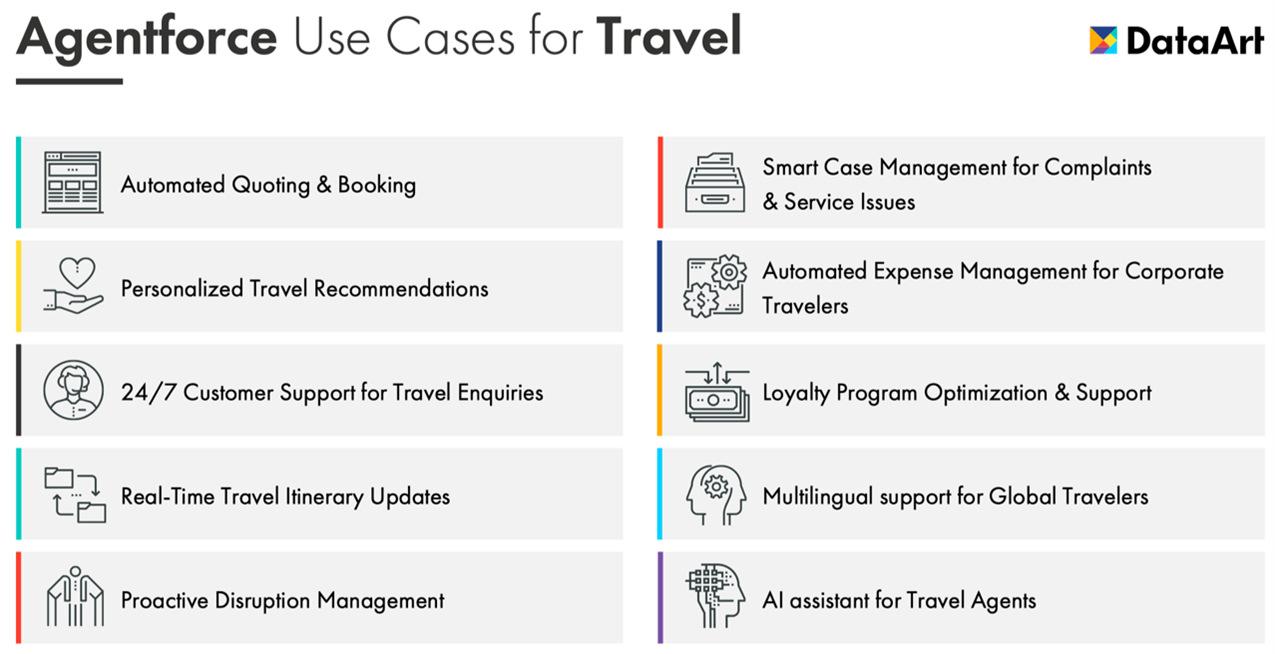
This workload redistribution produces a measurable business shift: cost centers can evolve into revenue centers when agents shift from answering routine questions to providing concierge-level service for complex itineraries. The technology enables agencies to offer luxury-level attention across their entire client base, not just premium accounts.
Real-world implementation reveals three critical automation opportunities that deliver immediate impact:
- Pre-Qualification and Information Gathering: AI agents can collect complete travel requirements before human handoff, eliminating the frustrating back-and-forth that characterizes traditional booking conversations.
- Contextual Upselling: Systems can analyze traveler profiles and suggest relevant add-ons, like hotels, car rentals, and activities, based on past behavior and current trip parameters.
- Proactive Disruption Management: Automated systems can monitor flight changes, gate updates, and cancellations, then instantly provide alternatives and rebooking options through preferred channels.
Data Architecture Determines AI Success More Than Algorithm Sophistication
The travel industry's fragmented data sources create both the most significant implementation challenge and the highest reward opportunity for agencies willing to invest in proper foundations.
Modern travel agencies must integrate content from multiple sources: NDC connections for airline inventory, direct APIs for boutique hotels, GDS systems for traditional content, and specialized platforms for cruises or adventure travel. Each source uses different data formats, update frequencies, and access protocols.
Whenever clients approach us about AI initiatives, the first question we ask is: What state is your data in? Customers are excited about Agentforce and are looking to automate tasks and reduce costs. But is the data there? That's the first thing we analyze.

Even the most sophisticated AI agents become useless when working with incomplete or contradictory information. Successful implementations require agencies to first establish data normalization processes, then build integration layers that can adapt as suppliers change their systems. Platforms like Salesforce have gained adoption in this space precisely because they excel at creating unified customer views from fragmented sources.
The payoff for solving these data challenges extends far beyond automation. Agencies with clean, integrated data can offer dynamic pricing, real-time availability, and personalized recommendations that competitors using legacy systems simply cannot match.
Forward-Looking Strategy: Start Small, Scale Smart
Travel agencies pursuing AI implementation should resist the temptation to automate everything immediately. The most successful rollouts begin with a single, well-defined use case that can be thoroughly tested and refined before expansion.
Consider starting with routine inquiries that follow predictable patterns: flight schedules, baggage policies, visa requirements, or basic availability checks. These interactions generate consistent data that helps train systems like Agentforce while delivering immediate value to both agents and travelers.
Once the initial automation proves reliable, agencies can gradually expand to more complex scenarios: multi-city itineraries, group bookings, or corporate policy navigation. This incremental approach allows teams to build confidence and expertise while minimizing risk.
The agencies that successfully navigate this transition will be uniquely positioned to capture the luxury travel market's explosive growth. They'll offer the personalized attention that high-value travelers demand, delivered through the channels and timeframes that modern expectations require, all while maintaining the operational efficiency that competitive markets demand.
The question isn't whether AI will transform travel agency operations. The question is whether your agency's data and processes are ready to support that transformation.