
Our team will reach out within 24 hours to gather your project requirements, clarify your business objectives, and outline the next steps in our collaboration.
Client
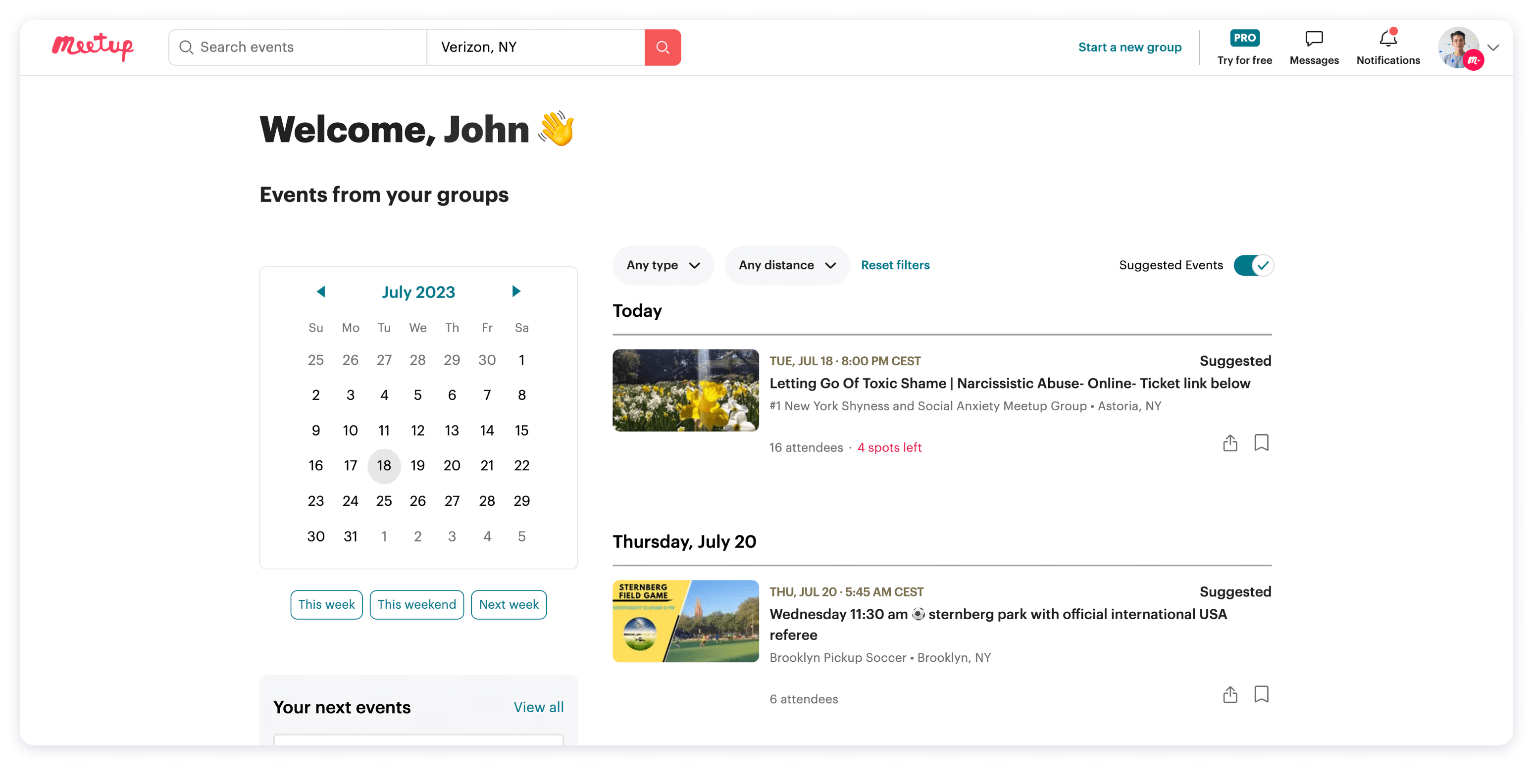
xMeetup is the social media platform for finding and building communities of people who meet about common interests. Established in 2002, the company remains true to its mission of helping people grow and achieve their personal or professional goals through authentic, human connections. Meetup has more than 60 million registered members across 330,000 groups active in 193 countries and 10,000 cities around the world.
Business Challenge
The client was looking for an opportunity to replatform core parts of their infrastructure and services, shift into cloud architecture with security, cost management, and streamline feature delivery through faster deployments. DataArt, as Meetup’s partner that previously built them a resilient system for recurring subscription management, was happy to help the client address their new challenges.
Meeting Business Challenge
Migration from the hosted to serverless infrastructure
Meetup, which historically has been a self-hosted platform, transitioned to a cloud-based infrastructure and later migrated to Amazon Web Services (AWS).
Currently, the primary infrastructure is hosted on AWS. This move enabled the utilization of AWS-managed solutions, including a cloud-based database, eliminating the need to hire extra administrators.
Later, the company opted to move away from cloud hardware management. It was decided to migrate to Amazon’s serverless computing capabilities, where applications could be packaged into containers and run on hardware without the need to handle physical servers.
This transition resulted in optimized infrastructure expenses, as maintenance, updates and direct hardware costs were reduced.
CI/CD automation and migration to serverless infrastructure
By implementing CI/CD automation and transitioning from a hosted to a serverless infrastructure, Meetup achieved several outcomes. These included simplified system configuration, enabling faster release cycles, and reducing infrastructure maintenance costs.
The adoption of CI/CD was motivated by the goals of accelerating feature delivery to production and minimizing overhead expenses associated with infrastructure. The path towards CI/CD involved moving from a self-hosted setup, with Jenkins running on a virtual machine in the customer’s office for infrastructure deployment, to utilizing GitHub Actions.
With GitHub Actions, the CI/CD process became more streamlined, eliminating the need to worry about the underlying infrastructure. Developers could now describe their deployment requirements in a declarative manner, allowing the infrastructure to execute the specified script and deploy the application.
These changes not only simplified the configuration process but also made it more accessible to individuals without prior system administration experience. Additionally, it contributed to faster deployment times eliminating the need to write complex scripts.
Business benefits
Migration from the hosted to serverless infrastructure allowed the reduction of infrastructure expenses for the client. Additionally, CI/CD automation helped to simplify system configuration, streamline the process, and ensure faster application release, ensuring lower maintenance costs.
The DataArt team helped us migrate the Meetup platform to cloud infrastructure and streamline the continuous delivery processes. Now, we can release new features and updates faster and in a simpler way. DataArt has been a great partner to us through the years. Wonderful architects, specialists and team players.
Rajib Ahmed
Chief Technology Officer at Meetup
Technology
Java
Scala
OpenAPI / Swagger
Kubernetes
Node.JS
React.JS
Next.JS
Google Cloud
GCD, BigQuery
AWS
Lambda, ECS Fargate, RDS, DynamoDB, SQS, SNS, and many otherservices
GitHub Actions
Fastly



