

When implementing a new AI system, prototyping is not just beneficial; it's crucial. Determining whether a machine learning model can effectively tackle a specific problem, assessing if there's enough data for model training, deciding on the appropriate approach, and choosing the right type of model are all key considerations. However, predicting them in advance can be difficult.
Understanding this challenge, the DataArt AI Lab has created MIA DAMA™, a framework that encapsulates best practices in the machine learning model lifecycle, tailored to deliver faster results within a defined timeframe.
DataArt's MIA-DAMA™ framework is designed to optimize the prototyping process by providing a structured methodology for crafting AI Proof-of-Concepts (PoCs). It allows teams to progress through the intricacies of AI development with a systematic method, ensuring each step is tightly aligned with the project's technical requirements and business objectives. This alignment is vital to delivering POCs that are both technically sound and commercially viable, ultimately enabling a faster and more efficient route from concept to deployment.
This approach, divided into Proof-of-Concept, Implementation, and Maintenance stages, provides a structured and accelerated path from concept to deployment, ensuring clients gain maximum value from their AI ventures.
The MIA-DAMA™ Framework
MIA DAMA™ stands for Management Integration and Action for Data, AI, ML, and Analytics and reflects the three sequential phases of a machine learning model lifecycle:
- Proof-of-Concept (PoC) Stage: In this phase, the team defines the client’s business objectives and AI use case, explores the data, builds the baseline model, experiments and enhances the model, builds a simple API or UI, and creates a production solution design.
- The Implementation Stage: This stage is required to move the validated PoC into Production with scalable model deployment, external systems integration, clients’ rollout, data pipeline creation, retraining, A/B testing, and monitoring.
- The Maintenance Stage: Used for ongoing model development, improvement, monitoring, and support.
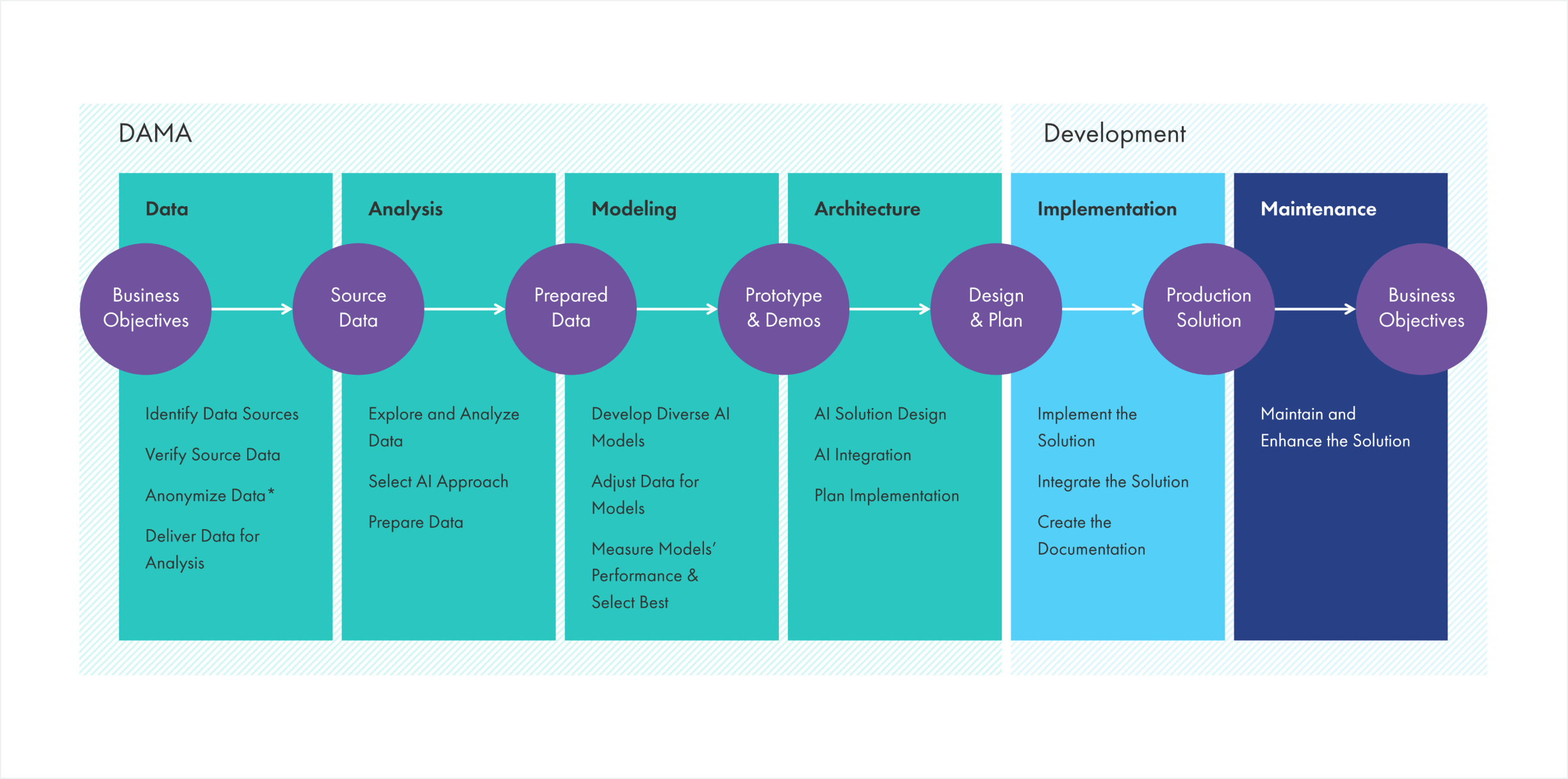
Let's delve deeper into each step of this process.

Phase 1: Data
The initial phase revolves around data procurement and preparation, a critical foundation for any AI endeavour. It includes:
- Identifying and verifying data sources
- Anonymizing data for privacy compliance
- Delivering analysed data for model development
Phase 2: Analysis
This phase involves:
- Exploring and analysing the data to unearth patterns and insights
- Selecting the appropriate ML algorithms
- Preparing the data for model training
Phase 3: Modeling
This is an iterative process where the theoretical meets the practical, with activities such as:
- Training different models to evaluate the performance of data
- Experimenting with data preparation for different models
- Evaluating and selecting the best-performing models
The outcomes from this phase may necessitate revisiting prior phases (Data and Analysis) if they do not align with the desired or expected results.
Phase 4: Architecture
Here, the focus shifts to:
- Designing the AI solution architecture in Production
- Planning for seamless integration with existing systems
Phase 5: Implementation
This execution phase encompasses the following:
- Development of the designed production-ready solution
- Integration into the current technological ecosystem
- Creating comprehensive documentation
Phase 6: Maintenance
Post-deployment maintenance ensures:
- The solution remains relevant and efficient
- Continuous enhancements are made
- Deliverables and de-risking investment
The MIA-DAMA™ framework not only streamlines the development process but also offers deliverables that include ML prototypes, AI solution designs, and integration plans. These deliverables are pivotal in de-risking client investment by providing a clear vision and plan before committing to full-scale implementation.