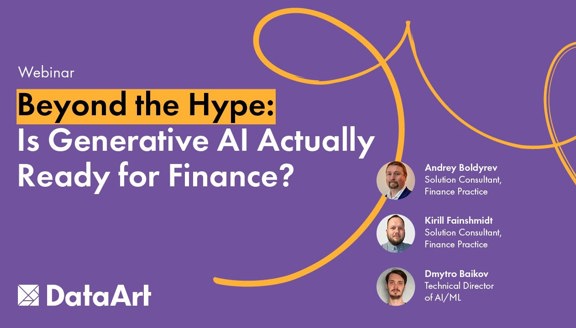
Kirill Fainshmidt: Hello everyone. Welcome to our webinar, "Beyond the Hype: Is Generative AI Actually Ready for Finance?" We are happy to have you here. Let’s dive into the details and discuss a couple of topics that might be interesting for you and for us as well. We all see different articles and discussions about how the technology landscape is changing over time.
Right now, it looks promising, but is generative AI actually ready for finance? Let’s discuss that together today. We’re going to take you on a journey and look at practical examples of what we do here at DataArt and what we can offer. I’m not the only one here today. Please welcome Andrey Boldyrev and Dmytro Baikov. Maybe a quick roundtable—could you both introduce yourselves before we dive in?
Andrey Boldyrev: Let me start. My name is Andrey. I’m a product manager and solution consultant in the finance practice, and I’ve been in the industry for many years. I focus on a wide variety of finance areas, such as compliance, payments, trades, and risk assessment. Honestly, I was surprised to be invited to this webinar because I’m quite skeptical about artificial intelligence in general. I’ve never used ChatGPT, mainly because I don’t believe it’s secure yet.
This webinar might answer some of my personal questions that I’ve collected over the last year, and maybe some of yours as well. Dmytro, over to you.
Dmytro Baykov: Thank you, Andrey. My name is Dmytro. I’m working as a Technical Director, AML, here at DataArt. We’re doing a lot of interesting projects, and we’re happy to challenge your understanding of what is possible and impossible with AI. Today, I’ll dive into finance, show a couple of our use cases, and explain how we do POCs and what things are really working for years. Thanks for having me.
Kirill Fainshmidt: Thank you, Dmytro and Andrey. Let’s dive into the details and see what you have for us. Dmytro, the floor is yours.
Dmytro Baykov: Thank you very much. I have a quick deck of about 15 slides. Let’s start from the second one. What I want to highlight is that machine learning in finance is a very active field. At DataArt, we’ve been doing machine learning for the last ten years, and you can see examples of what we’ve done for different clients in various countries and organizations of all sizes.
We’ve covered a range of cases, from default prediction, customer churn prediction, and financial asset classification, to sales revenue forecasting, client onboarding optimization, commodities processes, fraud detection, and outlier detection, which are crucial for transactional banking and trading activities.
Our use cases are mostly targeted at routine optimization, revenue optimization, and workforce optimization. That’s the main reason machine learning exists. This work is mostly related to tabular data, natural language processing, and computer vision. Generative AI has touched on these, but tabular data remains an area where classic algorithms are still effective and have been used for years, even before production implementations.
One area I want to focus on today is financial document processing. This is a huge domain, and we see a lot of clients wanting to adopt it, even if they don’t realize it at first. The benefits of intelligent document processing are significant.
This field is about automating the handling and management of electronic and physical documents—recognizing data from scanned images, emails, Word documents, PDFs, and extracting useful information. The benefits include increased efficiency, cost savings, better customer experience, and structuring unstructured data for analytics.
With intelligent document processing, you can build analytics on top of your data, extract entities, classify documents, and decide what actions to take next. This structuring process is complex: it starts with data ingestion, understanding your data sources, processing images with OCR, extracting text and table structures, and then applying machine learning to classify and extract data.
For example, you may have documents of 100 pages, but what you really need to know is whether they’re signed or not. With this workflow, plus human validation and integration into production environments, you can bring value to various departments, from HR and support to development.
Integration and delivery are crucial – they are how you convert and transfer structured insights within your organization. To address these needs, we developed our own accelerator at DataArt. It’s a great foundation for starting projects, enabling faster production and results. This solution supports both OCR and NLP techniques.
We have extensive experience in this area, and the industry demands these solutions. Our website provides more details and a video. Extracting textual data from images and tables is complex, but with the right tooling, you can achieve 80–90% accuracy in extracting structured text from documents.
All of this was possible even before generative AI. For example, we did a project for a large financial institution where we improved operational efficiency and sped up document review by up to 80% without generative AI.
With generative AI, the impact is even greater. We’ve worked on POCs across different technology stacks, starting with code generation, knowledge-based chatbots, and email intent detection to bring more value to support teams and developers. Document processing has also seen significant improvements with generative AI.
Now, we can confidently ask questions of documents, define sentiment or emotions, extract entities, and summarize or highlight key points – all with just a text instruction. POCs that used to take months can now be built in weeks with small teams.
Many services are available – OpenAI, Amazon, Google Cloud, and open-source models. You can build solutions on-premise or in the cloud, not depending solely on OpenAI or Azure. Chatbots, conversational search, and image generation are all available across these platforms.
For example, we did a POC for a real estate client to extract entities like addresses, prices, and contact information from advertisements. With just one document, you can start building and tune accuracy over time. The model’s broad training enables it to understand concepts without extensive pre-training.
In finance, we’ve extracted liabilities and entities from tables using OCR and generative AI, converting unstructured images into structured data formats like Excel, CSV, or JSON for analytics and reporting. Generative AI enables faster and more accurate document classification, summarization, key point extraction, and even sentiment analysis—all in a single API call.
You can now perform functions that used to require multiple models and tools with just one request. This opens up many opportunities and applications, even without a dedicated data science team – just engineering skills and proper security.
Let me show you a demo. Here’s a simple UI where we’re working with healthcare insurance documents. These are multi-page documents with information about premiums, insurance classes, and procedures. I’ll upload a document and ask questions like: How do I change my insurance class? When does my insurance begin? What should I do in case of an emergency? The system provides quick answers, pulling relevant text from the document. For example, it tells you how to change your insurance class, when coverage begins, and what to do in emergencies, including phone numbers and addresses. This information can be automatically summarized and sent to support agents, tailored to business needs.
Let’s look at a finance example – an electricity account bill. It’s a scanned document, so we use OCR to extract the text, which is unstructured. We then use generative AI to answer questions like: What is the total amount? What is the total amount with the discount? What is the address? The system understands the context and provides accurate answers, even skipping questions if the information isn’t present.
This approach works across different document types and formats, demonstrating the current capabilities of generative AI. Such solutions can be implemented in as little as two months, with just a few weeks needed to validate the idea and get initial insights.
Now, let’s talk about compliance and security, which are critical in finance. At DataArt, we do not use the OpenAI platform for building our policies, nor do we use ChatGPT. There’s a clear separation between client-facing products like ChatGPT and B2B products. For client-facing products, data may be used for training, which is not secure for enterprise solutions.
However, the same OpenAI models are available inside Microsoft Azure, with the same billing but full security and compliance. Your security team can validate data retention policies—by default, retention is only 30 days, after which data is deleted except for abuse monitoring. For production, Microsoft provides options to avoid logging requests and responses, ensuring no one has access to your data.
Google Cloud and AWS have similar policies. It’s important to read these carefully and validate them with your teams. Open-source models like Llama 2 from Meta are also becoming competitive. They allow on-premise deployment without using cloud services, which addresses many compliance and security concerns.
Each use case should be validated with your teams, and it’s important to understand how these systems work within your engineering departments. That’s all from my side. I’m happy to answer any questions.
Kirill Fainshmidt: Thank you so much, Dmytro. That was fantastic. We’re now in Q&A mode. We have some topics to discuss, and we want to hear your questions. Feel free to drop messages in the chat, and we’ll answer them. Let’s kick off.
Andrey Boldyrev: Let me start with a more generic question. Many years ago, I saw Siri on my iPhone 5. Now, everyone knows Siri, Alexa, and similar helpers. However, I never considered Siri intelligent. In the last couple of years, something has changed—we see ChatGPT version 2, now version 4, and some say it’s like a 30-year-old human. What happened in the last two years? Why didn’t this appear earlier? Do you know, Dmytro?
Dmytro Baykov: Sure. Let me break this down. Previously, Siri and Alexa were built like chatbots, with a tree of responses and some machine learning. They’re not generative models—they don’t invent, just respond with pre-built replies within a limited scope.
What’s different now is that machine learning has evolved. There were big challenges in training models, but advances in processors, GPUs, and new neural network architectures have enabled the creation of much larger and more sophisticated models. These models have been trained on massive datasets, including the entire Internet and proprietary datasets, so they understand many concepts.
They don’t have intelligence on their own, but because they’re trained on so much data, they can answer questions very well. For example, if you ask, “What is the capital of Great Britain?” the model responds with “London” because that’s the most common answer in its training data. So, the key changes have been new neural network architectures and advances in cloud technology and hardware.
Kirill Fainshmidt: All right. Thank you. We have a couple of questions from the audience. Dmytro, can you please talk about prompt engineering?
Dmytro Baykov: Absolutely. Prompt engineering is essential for using text generation models. It’s about describing your problem clearly, almost like coding your requirements. There are many great articles and courses on prompt engineering. You need to explain your problem carefully, specify the role you want the model to take, and provide examples of the desired output.
For instance, if you want to generate SQL code, provide examples. If you want a document summary, show examples of summaries. Experiment with different prompts, structures, and instructions to get the best results. There are advanced techniques like chain-of-thought prompting, where you set high-level goals and tools for the model to use. I recommend checking out resources on Coursera and OpenAI documentation for more details.
Kirill Fainshmidt: Thank you. Let’s move on. Which departments or processes within an organization are best suited for generative AI implementation to bring significant benefits? Maybe a couple that isn’t as suitable?
Dmytro Baykov: Andrey, do you have any ideas on departments and use cases?
Andrey Boldyrev: In finance, companies are usually structured into departments like operations (payments, trades, verification, accounting), compliance (KYC, onboarding, underwriting), and so on. These departments could benefit from generative AI, depending on their processes. Don’t forget HR—every company has one.
Dmytro Baykov: From a use case perspective, we’re researching where generative AI can bring the most value. For example, in HR and recruitment, there’s huge potential in processing documents and extracting data. Support automation is another area—classifying incoming emails, extracting intent, and generating follow-up emails automatically, which saves support agents time.
There are many applications in customer departments—predicting revenue per customer, click rates, and more. The use cases I described earlier apply here as well, but it depends on your company’s structure and needs.
Andrey Boldyrev: For compliance, a lot of effort goes into onboarding clients and performing checks like OFAC or sanction checks. For example, if a new client is named Osama bin Laden, it’s important to determine if it’s the same individual as the one on the sanction lists. Can AI help here, using large datasets and fresh information from the internet?
Dmytro Baykov: That’s more about fraud and outlier detection, which classical machine learning has handled for years. Generative AI can help explain decisions—why a client or transaction is flagged as suspicious, providing more human-understandable explanations. So, it’s a combination of classical machine learning for detection and generative AI for explanation.
Andrey Boldyrev: Perfect. That’s exactly what’s needed for compliance—explanations attached to cases. Thank you.
Kirill Fainshmidt: Thank you. We have more questions. Next: How do you deal with hallucinations from the model? I noticed your chatbot said “I don’t have enough information” when it couldn’t answer.
Dmytro Baykov: That’s a good question. I explicitly wrote in the prompt that if there’s no answer, the model should respond with “No information present.” This simple trick helps address hallucinations. You can also limit the data and provide more context to the model, so it only answers based on the information given. The model is good at extracting information from text but not at inventing answers when data is missing. So, work with your prompts and add context for better results.
Kirill Fainshmidt: Thank you. Next: Do you work with Lotus Notes and Domino?
Dmytro Baykov: We’re partners with Domino Data Lab, working with their MLOps capabilities and exploring other features. I can’t comment on Lotus as I’m not familiar with that company. But with Domino Labs, we have expertise and a partnership in MLOps.
Kirill Fainshmidt: Have you tried fine-tuning any models for the financial domain? Any feedback on price or performance?
Dmytro Baykov: Yes, we’ve experimented with fine-tuning, including with GPT-3 before GPT-3.5 and 4 were released. For example, BloombergGPT is a huge investment—hundreds of SageMaker instances running for weeks, costing over a million dollars. Usually, we start with prompt engineering, then add indexing and context, and only go to fine-tuning if necessary. Training a model from scratch is rare now, given the available tools. But yes, we’re running experiments, especially as clients explore this space.
Kirill Fainshmidt: How effective is AI in forecasting and risk assessment? Can you explain the methods and mechanisms?
Dmytro Baykov: Forecasting and risk assessment in finance were possible before generative AI, using models like Prophet (from Facebook), ARIMA, and deep neural networks. The choice of model depends on your data and forecasting horizon. Typically, we set up a POC in 4–8 weeks, analyze your data, train basic models, and provide insights. Forecasting in finance and retail is a common request from our clients.
Kirill Fainshmidt: How can I input spreadsheet data, such as a list of transactions, into the AI system for analysis?
Dmytro Baykov: The largest models now support up to 100k context tokens—about 75,000 words. If your dataset fits, you can upload it and ask questions. If not, aggregate or batch your data, or use indexing for documents. For table data, classical machine learning is still often used, as generative AI models are trained to predict words, not numbers. For document analysis, indexing approaches allow you to handle thousands of documents and ask questions across them.
Kirill Fainshmidt: Can the system provide references to specific document sections, pages, or paragraphs?
Dmytro Baykov: Yes, we’re currently building solutions that provide sources for insights, highlighting sentences and lines in paragraphs that relate to specific questions. It’s possible to go down to the sentence or phrase level, not just paragraphs.
Kirill Fainshmidt: Thank you. We have some questions from the chat. Andrey, do you have another one?
Andrey Boldyrev: Yes, two questions. First, about the document processing accelerator—is it free of charge, like other accelerators we provide to clients?
Dmytro Baykov: We use accelerators to move faster and bring clients to market more quickly. We have a set of reusable tools for specific use cases, which help us focus on solving the problem rather than building from scratch. These POCs can be tuned for your needs, making the project kickoff much faster.
Andrey Boldyrev: If I’m a client and want to start a new project using generative AI, can I use this accelerator to speed up?
Dmytro Baykov: Exactly. We’ll assign a team member to get you up to speed with your data, and you’ll have a working solution quickly.
Andrey Boldyrev: Now, a longer question about security. For custom solutions using open-source AI, you mentioned controls to limit data exposure. But what if I use OpenAI from Microsoft or Google? I have to submit my client data, which is valuable. How can I guarantee it won’t be leaked or accessed, even by Microsoft?
Dmytro Baykov: If you’re on Azure, you benefit from the platform’s security. Storing your client database or files there is similar to using their AI services. OpenAI on Azure is a B2B product with separate layers of internal security. You have access to all Azure security features—IP whitelisting, data logging, retention policies, and more. Microsoft is transparent about its practices, and you can consult with its security experts if needed.
Kirill Fainshmidt: Thank you. Another question: Have you seen analysis that ChatGPT is becoming less effective as more data gets uploaded? What do you expect from GPT-5?
Dmytro Baykov: I’ve seen research suggesting that ChatGPT is becoming less effective, but I haven’t compared this on Azure OpenAI services. If it were a widespread issue, it would be a concern for enterprise integrations. GPT-5 is expected to bring multimodality—handling images, text, and code in both input and output. This would eliminate the need for separate OCR, for example. I also expect more stability, compliance, and integration features.
Kirill Fainshmidt: One more: Does my data get sent to OpenAI if I’m on Azure OpenAI?
Dmytro Baykov: No, your data is not sent to OpenAI if you’re using Azure OpenAI services. Your data goes to Microsoft, which serves the models under their agreement with OpenAI. OpenAI is mentioned for branding and partnership, not for data sharing.
Kirill Fainshmidt: Thank you. One last comment and question as we wrap up. Finance and insurance are conservative domains with lots of legacy processes. What if I don’t want to use modern AI and stick with my current solutions? What’s your take?
Andrey Boldyrev: It’s a tough question. When challenger banks started using open banking APIs, traditional banks thought they were secure. Now, many people use fintechs like Revolut and Monzo, and traditional banks’ positions are less certain. New technologies can challenge established players, so I wouldn’t be surprised if AI brings even more change. I can’t predict the future, but clearly, things are evolving.
Dmytro Baykov: From a technology perspective, we’re ready to implement persistent solutions. Many finance clients are already using both classical machine learning and generative AI. My recommendation is to identify your use cases, brainstorm, select the top three, and consider a quick discovery POC—maybe a four-week investment to see the impact. Start with low-hanging fruit like document processing or forecasting to improve business metrics and reduce routine work. Then, expand if you see traction. My advice is to start experimenting now.
Kirill Fainshmidt: Thank you all for attending. If you have more questions, please contact us by email at aiandml@dataart.com or on LinkedIn. Let us know what topics you’d like us to cover next. See you soon. Thank you.
Andrey Boldyrev: It was a pleasure. Thank you so much.
Dmytro Baykov: Thank you.