El equipo de DataArt desarrolló un Asistente Inteligente de E-Movilidad para predecir cuándo y dónde los conductores necesitarán cargar sus vehículos y recomendar la mejor estación de carga cercana.
Porsche AG is a German automobile manufacturer specializing in high-performance sports cars, SUVs and sedans. The Porsche Next OI Competition offered contestants a unique opportunity to develop an innovative app or groundbreaking service for Porsche.
DataArt’s team developed the E-Mobility Smart Assistant to predict when and where drivers will need to charge their vehicles and recommend the best charging station nearby.
Business Challenge
The electric vehicle market is relatively new. The more popular electric vehicles become, the more challenges emerge. Some of these challenges exist at the intersection of the automotive and energy industries. One of the major tasks for electric companies is forecasting power demand. This plays an essential role in the power industry as it provides the basis for making decisions in power system planning and operation.
The rising number of e-cars is increasing the amount of electricity consumed by these customers, making this a significant segment of the market.
Challenges and issues anticipated:
Increased electricity consumption by e-cars
Greater energy consumption at peak times
Expansion of charging infrastructure
Possible blackouts due to grid overload
E-car market share is expected to increase dramatically over the next 5-10 years. The automotive industry must surmount these challenges as it adapts to the changing market.
The E-Mobility Smart Assistant will predict when and where one will need to charge a car and recommend the best charging station nearby. Integrating cars into this ecosystem will make it possible to forecast energy demand at a specific time and place.
Meeting the Challenge
The driving assistance solution monitors the charge of a vehicle’s battery and predicts the best time and place to charge. It collects and stores anonymized charging data to build a driver-specific ML model.
The approach is based on analyzing driver experience, preferences, the charging point network, traffic, charging fees, and a wide range of environment-specific factors. The data, collected, analyzed, and anonymized, allows the OEM to share a geo-referenced energy consumption forecast for a specific time.
The solution allows OEMs to better understand client needs based on analyzing driver interests, preferences, and behavior. As the result, it increases drivers’ brand loyalty. The centralized API facilitates improved planning and analytics, allowing OEMs to shift to a connected car data business model.
The machine learning algorithm gets to know the driving habits of each individual driver and determines the most convenient charging time and location. The system keeps track of power prices to suggest the lowest price among available options. Data is gathered anonymously and securely, keeping private driver info untraceable. The intelligent charging suggestions allow drivers to effortlessly keep their cars charged while saving money.
Charging predictions mean that power companies can plan their loads for specific times and locations. Intelligent charging suggestions will distribute loads throughout the day to avoid high demand. Charging predictions, along with historical data, will improve the process of planning infrastructure improvements to accommodate the increasing number of electric vehicles.
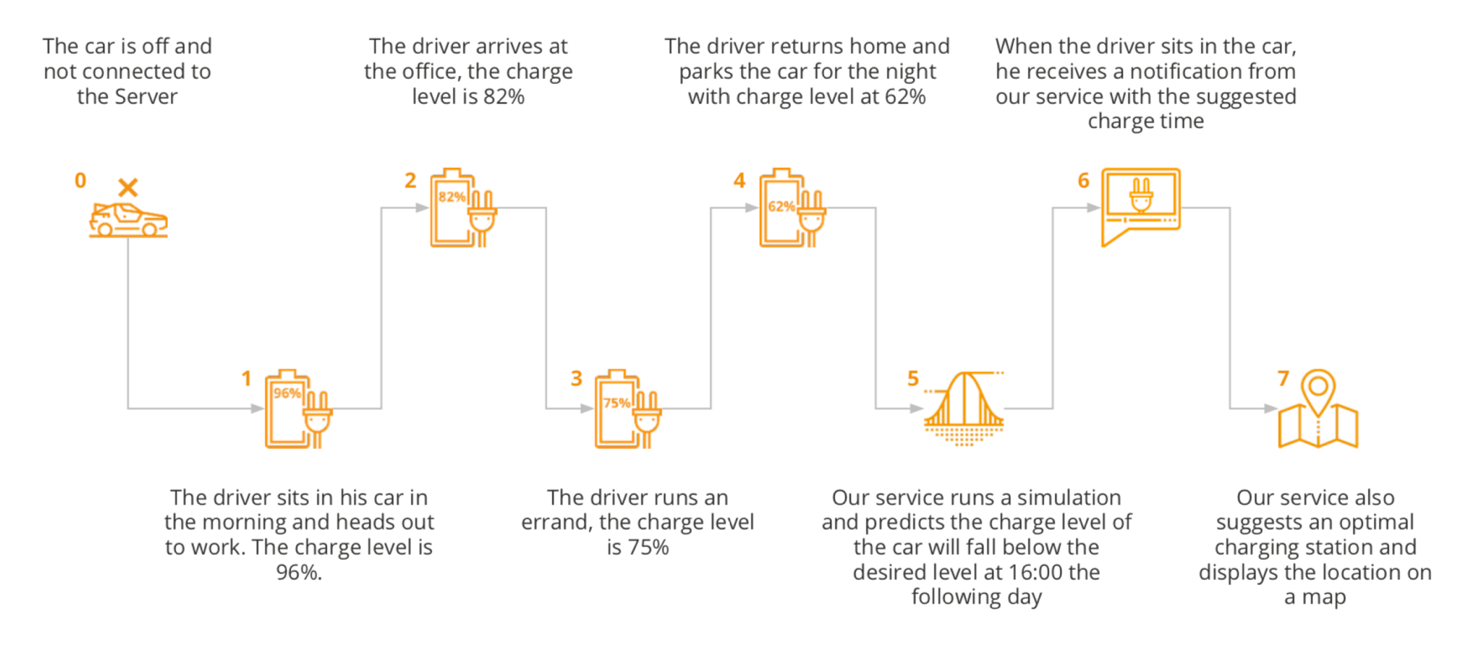
A driver user story is provided in the diagram below as an example.
Business Benefits
The solution combines a modern technology approach with a disruptive business vision addressing all the current electric vehicle industry trends.
The solution ties together the three main market participants, providing value propositions for all of them:
Car owners receive in-car smart e-routing that includes recommended charging location, charging time, electricity prices, weather, traffic, driving time, preferences, etc. For those who have a charger at home, it will take care of charging a vehicle at a most cost-efficient time; as an option the car owner may sell the excess power to other users, back to the grid or exchange it for other services
The car manufacturer can extend its service offering by creating lounge zones or other additional services at charging stations, attract new and younger car owners and increase customer loyalty as well, or even create their own network of charging stations or an energy supply organization
Energy supply organizations get a charging demand management tool including fare management, energy advanced booking, payments, etc. that allows them to seamlessly plan and run their businesses
Also, the solution allows other participants to enter the designed ecosystem.
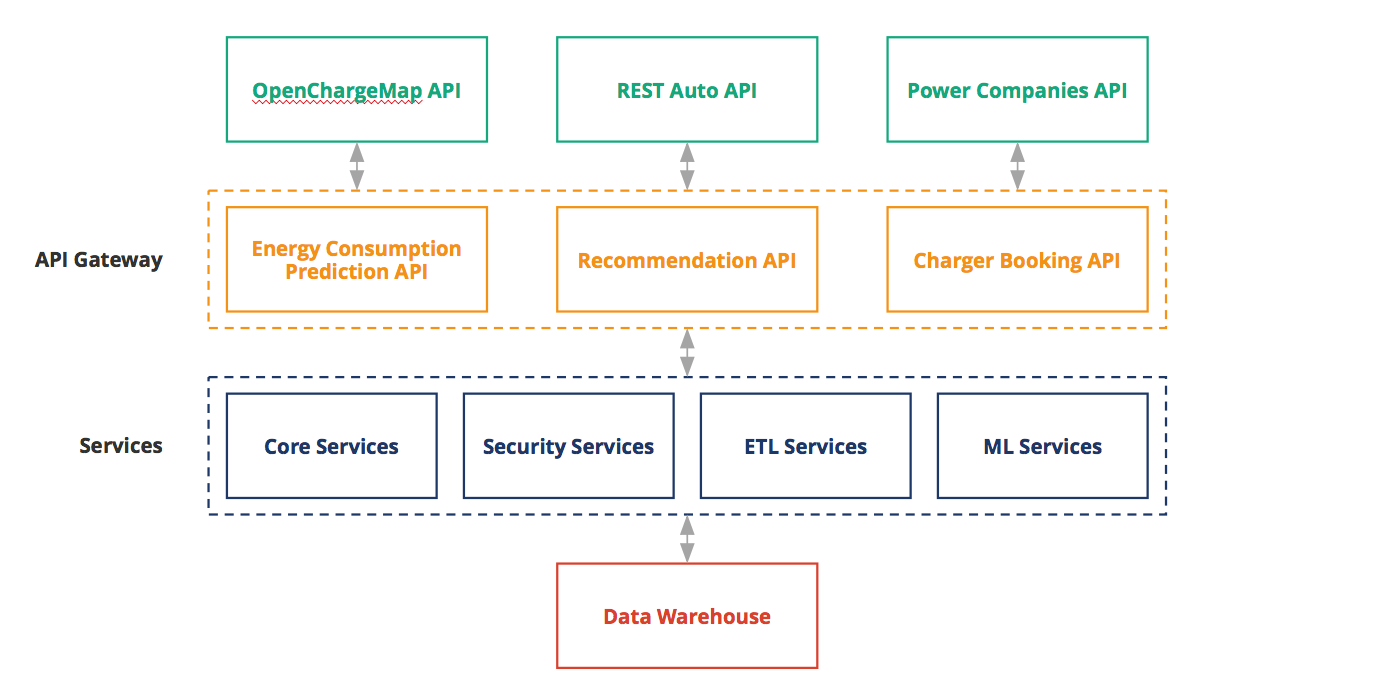
The Diagram Below Depicts the Solution’s Architecture.
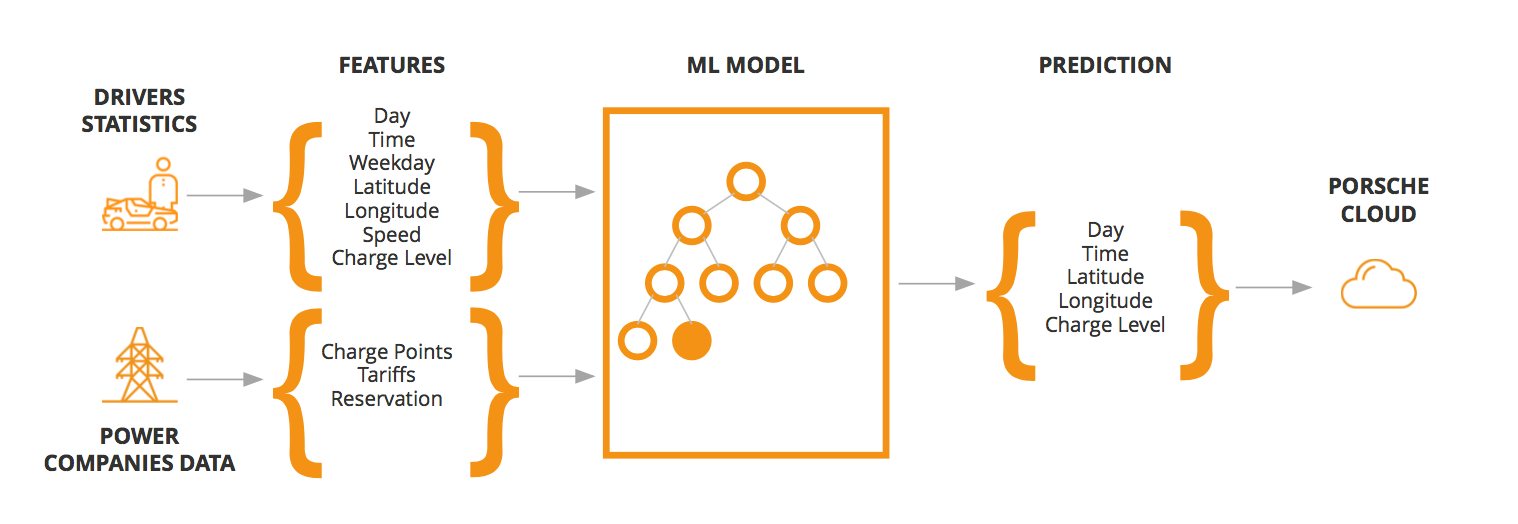
The machine learning service uses historical data and current conditions to make a detailed prediction about future energy consumption. Anonymized data is used to regularly train individual models for each driver and energy company so that the predictions remain tailored to the habits of a specific user. As the service evolves, it will become possible to use more complex deep learning systems to greatly improve accuracy and the prediction quality.
By clicking 'Accept All Cookies', you agree to the storing of cookies on your device to enhance site navigation, analyze site usage, and assist in our marketing efforts. More information
Privacy Preference Center
When you visit any website, it may store or retrieve information on your browser, mostly in the form of cookies. This information might be about you, your preferences or your device and is mostly used to make the site work as you expect it to. Because we respect your right to privacy, you can choose not to allow some types of cookies. More information
Manage Consent Preferences
Strictly Necessary Cookies
Always Active
These cookies are necessary for the website to function and cannot be switched off in our systems. They are usually only set in response to actions made by you which amount to a request for services, such as setting your privacy preferences, logging in or filling in forms. You can set your browser to block or alert you about these cookies, but some parts of the site will not then work. These cookies do not store any personally identifiable information.
Functional Cookies
These cookies enable the website to provide enhanced functionality and personalisation. They may be set by us or by third party providers whose services we have added to our pages. If you do not allow these cookies then some or all of these services may not function properly.
Targeting Cookies
These cookies may be set through our site by our advertising partners. They may be used by those companies to build a profile of your interests and show you relevant adverts on other sites. They do not store directly personal information, but are based on uniquely identifying your browser and internet device. If you do not allow these cookies, you will experience less targeted advertising.
Performance Cookies
These cookies allow us to count visits and traffic sources so we can measure and improve the performance of our site. They help us to know which pages are the most and least popular and see how visitors move around the site. All information these cookies collect is aggregated and therefore anonymous. If you do not allow these cookies we will not know when you have visited our site, and will not be able to monitor its performance.