You are opening our English language website. You can keep reading or switch to other languages.

Digital Battery Passport Readiness Assessment

Digital Battery Passport compliance is mandatory. Know what could delay your implementation. Get a clear view of your gaps and what it takes to implement without disruptions or rework.
DBP Readiness Assessment BANNER

Compliance Isn’t the Problem. Execution Is

Most companies know they need to meet digital battery passport compliance requirements. What’s less clear is whether their current landscape can support it in practice.
That gap creates risk.

Relevant data sits across ERP, MES, PLM, supplier systems, spreadsheets, and IoT platforms. Traceability may be incomplete. Interfaces may be missing or manual. Ownership may be unclear. Supplier dependencies may be underestimated.
The result: implementation starts before readiness is understood.

Typical Warning Signs

  • Critical data is spread across multiple disconnected systems
  • Product, sourcing, or manufacturing data is incomplete or difficult to trace
  • No clear view of which systems must be connected
  • Data ownership and governance are undefined
  • Battery data formats are inconsistent across systems, making consolidation and integration difficult
  • No prioritized plan for closing gaps before implementation starts

Why Projects Fail?

Most digital battery passport initiatives rarely fail because of technology. They fail because readiness issues are discovered too late.

By the time implementation starts, organizations often realize that:

  • Required data does not exist in the right form
  • Traceability breaks across systems and supplier tiers
  • Interfaces are missing or too manual
  • Governance is missing or unclear
  • Integration effort is higher than expected.

That leads to delays, rework, budget overruns, and unnecessary delivery risk.

Know Where You Stand Before You Start

Our digital battery passport readiness assessment shows you exactly: what data is already in place, what's missing or unusable, what may block rollout, where traceability breaks, what needs to be fixed first, what it will take to become fully ready.

The cost of not knowing is usually higher than the cost of preparing.
Without a readiness assessment, companies often invest in implementation before they understand the true condition of their landscape. That is when expensive surprises happen.


What We Evaluate

Our digital battery passport readiness assessment gives you a practical, implementation-focused view of your current state and a clear path to readiness by answering one key question: can you implement it successfully, and if not, what needs to be fixed first?

We assess the readiness of your organization across five critical areas:

Static Data Readiness

Can you meet battery passport data requirements across product, composition, sourcing, manufacturing, and compliance-related data?

Supply Chain and Traceability

Can you track required data across internal operations and external partners?

Dynamic Data Readiness

Can you capture and support lifecycle, usage, or telemetry-related data where needed?

Integration Readiness

Can your systems and interfaces support scalable, repeatable data exchange?

Operating Model and Governance

Do you have clear ownership, governance, and business processes controls in place to support implementation?

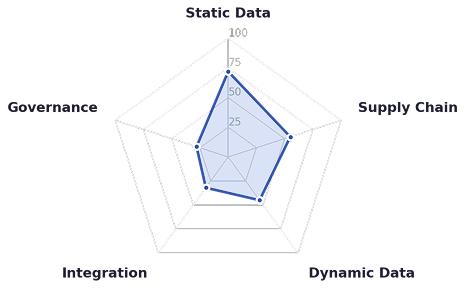
Example: Readiness Profile

A typical assessment reveals uneven readiness across the five dimensions. This example shows a common pattern, where static data coverage appears relatively strong, but governance, dynamic data capture, and supply chain traceability lag behind. Understanding this profile early helps you prioritize the right remediation actions before implementation begins.

What You Get

At the end of the assessment, you receive a clear and practical view of: where you are ready, where important gaps exist, where critical blockers may delay implementation, what actions are required to close those gaps, how to prioritize remediation and investment.

Key deliverables

Image

Implementation Readiness Report

A structured view of current readiness, key findings, and implementation implications.
Image

Gap and Action Register

A clear list of missing capabilities, blockers, risks, and required actions.
Image

Prioritized Readiness Roadmap

A sequenced plan showing what to address first and how to move toward full readiness.
Image

Operating Model Recommendations

Guidance on ownership, governance, roles, and capabilities needed for sustainable rollout.
Image

Executive Readout

A management-level summary of readiness, key risks, and recommended next steps.

From Assessment to Action in 4 Weeks

This digital battery passport readiness assessment is designed to give you a complete picture in 3–4 weeks.

1

Week 1

  • Map Your Data Landscape

  • We identify where passport-relevant data lives today and how it is structured across your landscape.
  •  
  • Outcome:
  • A clear picture of where the required data exists today, which systems matter most, and where the first major data gaps are likely to appear.
2

Week 2

  • Test Data Usability and Traceability

  • Having data is not enough. It must be complete, connected, and traceable across systems to support passport creation
  •  
  • Outcome:
  • You understand which data is already usable, where traceability breaks down, and which gaps in structure, completeness, or quality must be addressed before implementation.
3

Week 3

  • Assess Integration Readiness

  • We analyze whether your current application and interface landscape can support reliable and scalable digital battery passport data flows.
  •  
  • Outcome:
  • You see which integrations can be reused, which ones need to be built or redesigned, and where the main architecture and delivery risks sit.
4

Week 4

  • Define Your Readiness Roadmap

  • We translate the findings into an actionable plan focused on data, traceability, and integration readiness.
  •  
  • Outcome:
  • You leave with a clear view of what is blocking implementation and a practical roadmap for what to do next.
5
  • At the end of the assessment, you know three things: what data you have, what data you can trust, and what must change before implementation can succeed.

Why It’s Worth Doing First a Readiness Assessment

Because it helps clients:

  • Reduce implementation risk before major spend is committed
  • Identify blockers early instead of discovering them during delivery
  • Focus the budget on the right priorities
  • Align business and IT around a shared fact base
  • Accelerate implementation planning with confidence
  • Build the data governance foundation needed for long-term compliance and operations
You do not just get an assessment. You get the clarity to make better implementation decisions.
Before You Implement, Make Sure You Are Ready

Get a clear path to digital battery passport compliance, backed by real data, not assumptions, with our digital battery passport readiness assessment.