Our team will reach out within 24 hours to gather your project requirements, clarify your business objectives, and outline the next steps in our collaboration.
Business Challenge
When customers wait in line, it’s bad for morale. It reduces customer loyalty and profits while impeding productivity. It also impacts working processes. Effective data management software and data solutions can help mitigate such issues by streamlining operations and improving decision-making.
In one local office of a global company, a growing workforce resulted in long lines in the company cafeteria at peak times. As a result, employees wasted time and experienced declining productivity. With better business analytics and customer data integration, this issue could be addressed by optimizing lunch breaks and managing crowd flow efficiently.
Solution
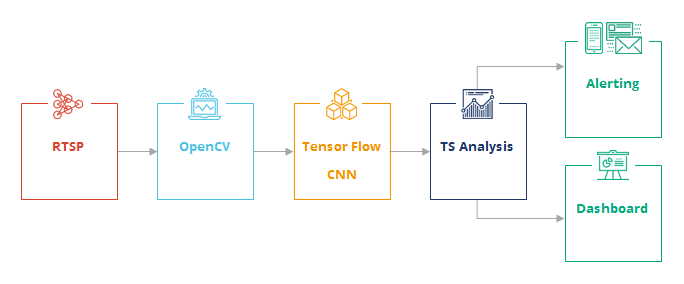
To overcome this challenge, DataArt’s team developed a continuous tracking system that included the following image processing steps:
STEP 1
DataArt team chose the OpenCV library to work with video which was streamlined from a camera with around a 1600x1200 pixel resolution.
Each frame got into the data processing pipeline. In many videos, the objects change much slower than the frames change (e.g., a person can stay in the same place in line for a couple of minutes, but the video runs on ~30 frames per second), so at the first step, the processing pipeline detected the objects/scene difference between sequential frames. It reduced the number of images (frames) for further processing and was connected with a limited amount of hardware resources.
The system developed is highly flexible and was designed to process both the entire video streaming and a certain number of images chosen according to specified criteria, highlighting the importance of effective data architecture.
STEP 2
The next step in processing was the engagement of a neural network trained to find and detect people in the image. The result of this step in our case was the number of people found in a certain area of the image. For more complex cases, location information can also be used. This step underscores the importance of utilizing advanced data analytics and data science consulting services to provide accurate real-time estimations.
STEP 3
The number of people found was processed during the next step, in which historical data was used for corrections (the previous several weeks - the same time, the previous few minutes). This allowed deviation recognition and more accurate data on the actual number of people in line displayed in real time.
Technology
OpenCV
Python
TensorFlow + Keras (CNN)
Google Cloud
Pandas (TS analysis)
Deployment: Ubuntu / Docker
Impact
The solution analyses the size of a line, displays the status in the internal corporate system, and allows the employees to plan their lunchtime correspondingly. As a result, the line became shorter and the employees were able to efficiently use their lunch time with no influence on their productivity. By leveraging the latest cloud data services and a robust data governance model, DataArt created a scalable solution that improved operational efficiency and employee satisfaction.



