

This spring, our business intelligence bot confidently informed us that "active engagements" and "open opportunities" were distinct KPIs, despite both originating from the same table. Minutes later, it double-counted "invoiced" and "billed" revenue as separate streams. The issue wasn't code – it was language.
Large language models (LLMs) speak fluently but often misunderstand the meaning. When business terms lack a shared ontology, synonyms collide, and results are distorted. We fixed it by adding a semantic layer – a shared business vocabulary that defines relationships between data and models. Accuracy rose to 98%, and, more importantly, trust returned.
AI Hallucinations Aren’t Glitches – They’re Business Risks
In enterprise environments, AI hallucinations are more than curiosities – they are business risks. During our AI Analyst Engine rollout, we identified errors that conventional testing had never detected: duplicate headcounts when "employees" and "users" were treated as distinct objects, and phantom revenue when "contacts" were merged with "accounts" across departments.
Recent data underscores this risk. A 2025 SAP survey found that 55% of U.S. executives now rely on AI-driven insights in place of traditional decision-making. Nearly half said they would override planned decisions based on AI recommendations, and 38% already trust AI to make some business calls autonomously.
Yet even OpenAI's internal tests show models hallucinate between 33% and 70% of the time. Without semantic controls—rules that define the meaning of every business term— organizations risk automating confusion instead of insight.
Beyond Data Catalogs: Why Business Meaning Matters More Than Metadata
Data catalogs organize what you have; semantic models define what it means. Traditional data models describe structure – tables, fields, columns – but not the business intent behind them. Semantic data models go further. They map how the business operates: customers, contracts, revenue streams, and the relationships among them.
A semantic layer sits above the physical database schema. It connects every field to a shared vocabulary and set of business rules. Integration becomes faster because applications and analytics speak the same conceptual language. Analysts query intent, not table names. LLM-driven tools utilize consistent context, rather than relying on guesswork or ambiguous joins.
Building a Shared Business Vocabulary
During our Q1 2025 rollout, we found that implementing technology was easier than introducing terminology.
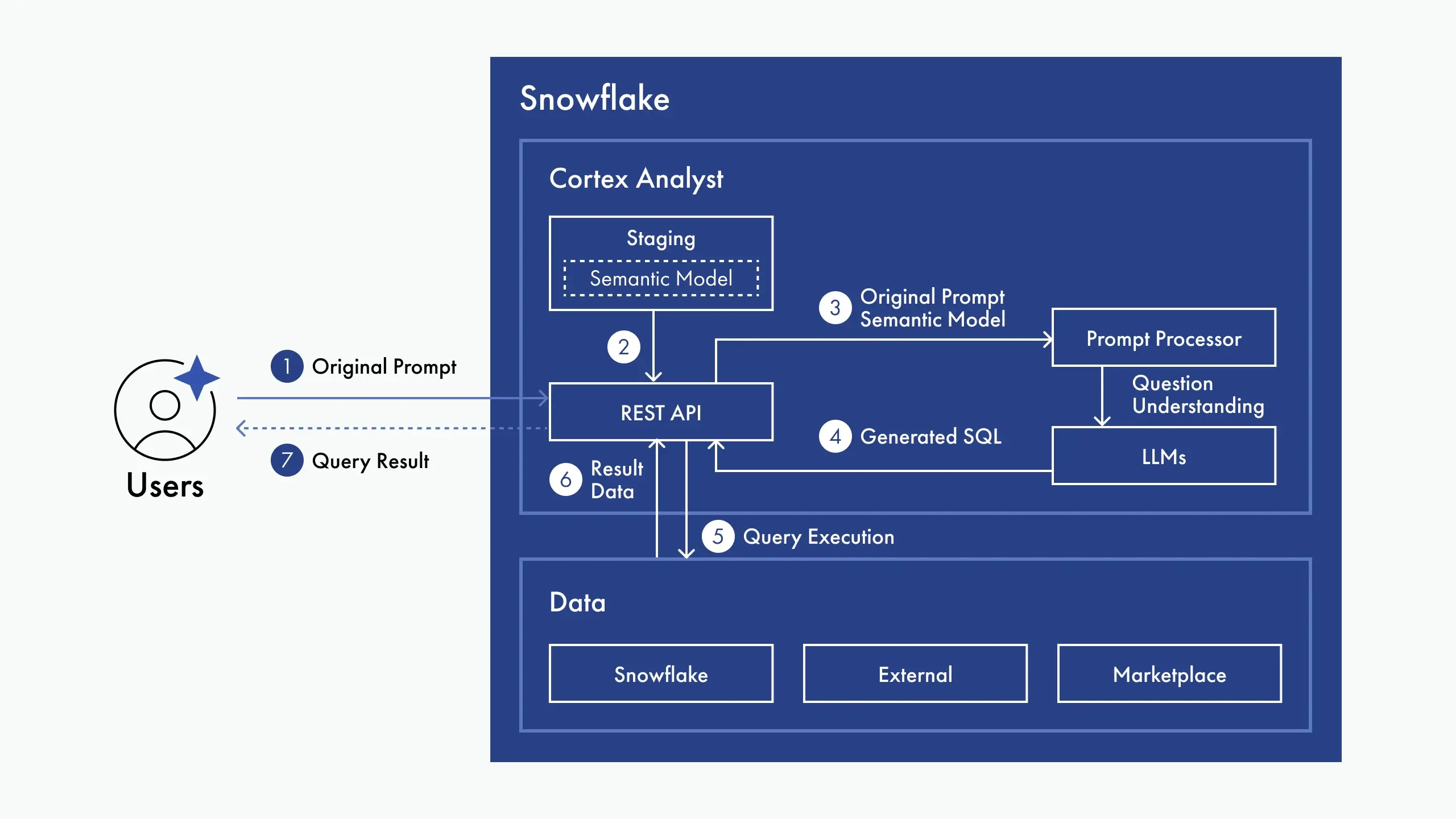
Sales called them "tickets." Support said "cases." Finance alternated between "net revenue" and "gross sales," each with different definitions. We built a semantic layer over our Snowflake warehouse using Cortex Analyst, starting with a unified vocabulary. Each business concept was explicitly mapped in a YAML-based ontology and reviewed with domain experts to ensure accuracy. "Tickets," "cases," and "service requests" all became one consistent object.
Our Streamlit workbench enabled teams to replay real LLM queries, surface misunderstandings, and resolve them in the Verified Query Repository – often on the same day. Within six weeks, AI-generated SQL accuracy reached 91.7%, while the time required for onboarding new analysts dropped by 35%. The semantic layer evolved into our company's authoritative data dictionary. When someone requests "receipts last quarter," the system now links their intent to the correct columns, time frames, and currency logic – eliminating guesswork across similar tables.
From Schemas to Semantics: Embedding Business Logic in Data Architecture
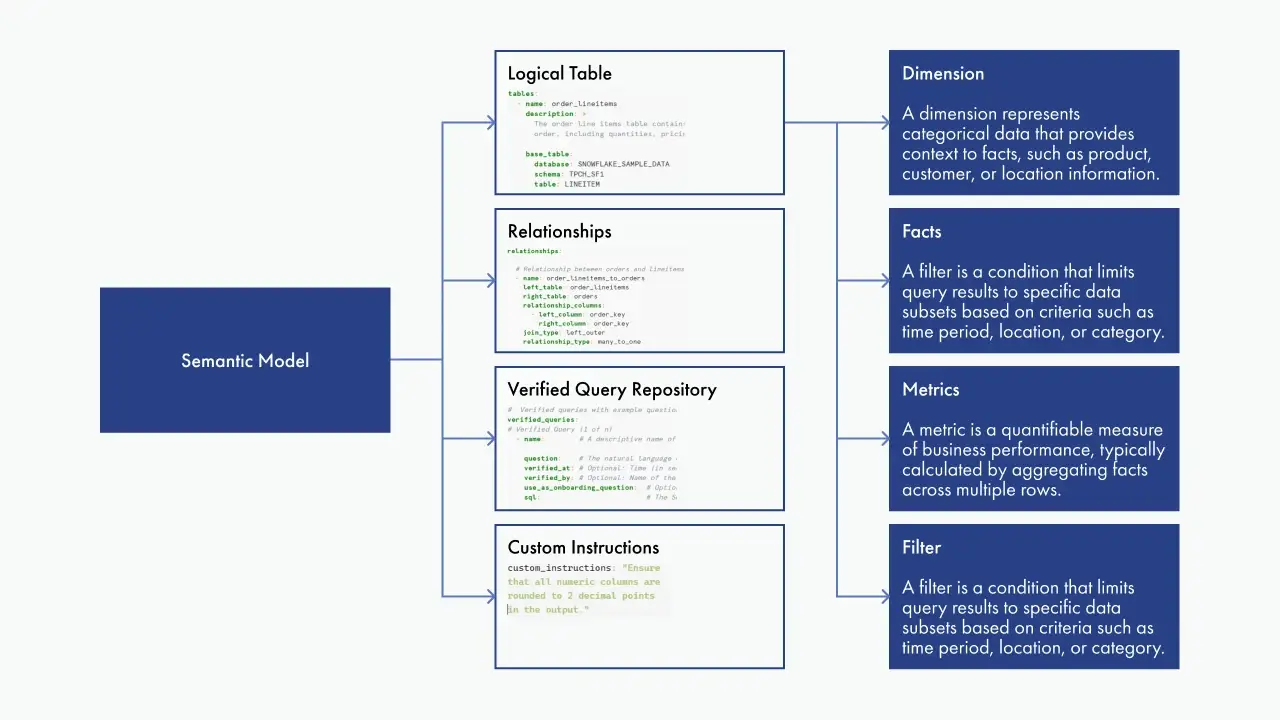
The semantic layer starts with modeling business entities as logical tables in Snowflake. Each logical table represents a familiar concept, such as "Customer" or "Order," aligned with the underlying warehouse tables or views.
These tables include:
- Facts: quantitative events, such as "order amount."
- Dimensions: attributes such as "region" or "product type."
- Time fields: date attributes, such as "purchase_date."
The real value comes from defining relationships at the model level. Joining "Customers" and "Orders" on "customer_id" enables clean analysis by segment without navigating raw schema complexity.
Query accuracy depends on Snowflake's Verified Query Repository (VQR). Business users ask questions in natural language ("Which customers had repeat orders last quarter?"). The repository stores validated SQL queries along with their intended meanings. Cortex Analyst utilizes these examples, along with our workflow logic, to accurately interpret new questions.
This structure gives precise control over business rules. Redefining an "active customer" or updating a lifetime value formula requires semantic adjustments, not code rewrites. Dashboards, analytics, and business rules stay synchronized across the organization.
The Measurable Impact of Semantic Alignment
Post-deployment metrics confirmed the value. Previously, Cortex double-counted revenue when "invoiced" and "billed" appeared as synonyms in different tables. It inflated reports by combining "customer" and "contact" as separate entities, resulting in duplicated enterprise accounts.
After semantic alignment, hallucinations dropped by 70%. AI-generated accuracy rose to 92%.
The average time-to-insight decreased from 22 minutes to 5, and compute costs declined by nearly 50%.
Adoption followed quickly. Self-service analytics now outpaces analyst-built reports by a factor of four to one. Business users can access insights directly, without additional developer support. Help desk tickets decreased by 30%, freeing up two full-time employees for strategic projects. Finance closed Q2 books two days early - possible only because the data was finally consistent, accurate, and aligned with business meaning.
Involving business users in semantic workshops from the start was key. In future projects, we'll prioritize early user training to accelerate adoption and build long-term trust.
Getting Started: A Practical Framework
Semantic models act as circuit breakers for AI errors. To implement one effectively:
- Pick one critical metric. Start with something painful when it's wrong—ours was revenue recognition.
- Run a synonym audit. Gather cross-functional teams. List every term used for that metric—ticket, case, service request. Group duplicates, note conflicts, and build a provisional dictionary.
- Build feedback loops. Implement user voting for AI results, maintain a verified query repository, and regularly review changes.
- Iterate weekly. Replay real queries and patch issues the same day. Progress beats perfection.
- Share wins. Publish before-and-after accuracy charts. Nothing drives adoption like visible improvement.
When business meaning takes precedence, dashboards, AI models, and compliance align naturally. Your data already contains the answers—shared language ensures AI interprets them correctly. The choice is simple: build semantic foundations now or keep debugging hallucinations. Enterprise AI doesn't just need powerful models; it requires a shared language that both humans and machines can understand.